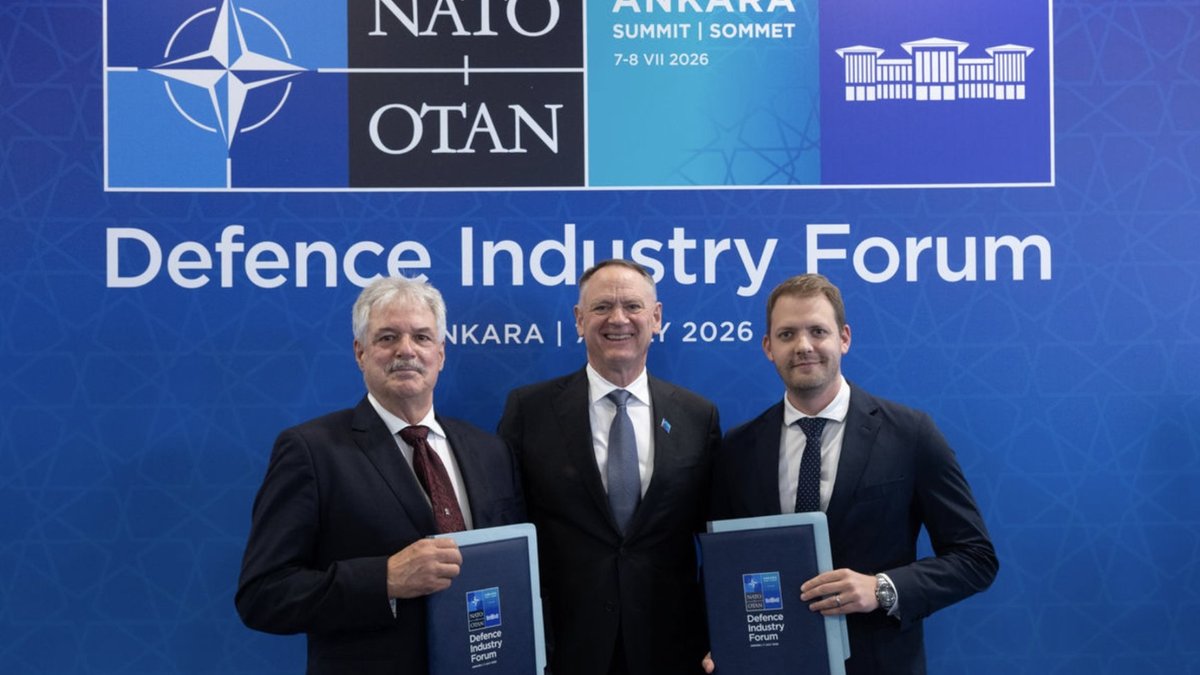
Capitalizing on the momentum of Canada’s selection of Germany’s Thyssenkrupp Marine Systems (TKMS) for its multi-billion dollar submarine project yesterday, Maritime Launch Services (MLS) has signed a 10-year facilities usage contract with German launch provider Isar Aerospace to develop a dedicated launch complex for its Spectrum launch vehicle at Spaceport Nova Scotia.
The agreement, signed during the NATO Summit Defence Industry Forum (NSDIF) in Ankara, Türkiye, marks a transition from a previously signed letter of intent in May to an executed commercial contract. The deal represents another milestone in establishing Canada’s dual-use orbital spaceport near Canso, Nova Scotia, building on a prior Department of National Defence contract for a dedicated pad lease designed to support civil, commercial, and national security missions.
Under the terms of the agreement, Isar Aerospace will manage the end-to-end space access chain, spanning launch pad infrastructure design to vehicle operations. MLS will provide the licensed launch site, including the launch pad, assembly, integration, and testing (AIT) facilities, a launch operations centre, and payload integration facilities.
The contract carries a 10-year base term, with options for Isar Aerospace to renew for two additional five-year terms. Financially, MLS will receive quarterly payments of US$3.75 million during the operational phase. The agreement structures a 30-month fee waiver period beginning at the end of the first year of the term, bringing the base facilities usage value of the contract to US$112.5 million over the initial decade, alongside additional fees per launch structured on a cost-plus basis for specific services.
“While every nation needs data from space, almost no nation has the end-to-end capability to access it independently,” said Alexandre Dalloneau, Vice President Mission and Launch Operations at Isar Aerospace. “This makes launch capacity one of the most consequential bottlenecks in defence and intelligence today, and we are here to close it. Canada is the next step in our roadmap to bring full end-to-end launch capability to sovereign nations.”
To anchor its North American presence, Isar Aerospace has established a domestic subsidiary, Isar Aerospace Canada Inc. The company expects to begin construction on the dedicated launch complex later this year, contingent on meeting several initial programmatic milestones. These conditions require the parties to finalize a mutual statement of work by Sept. 1, 2026, followed by the formal handover of the designated launch pad to Isar Aerospace by Nov. 1, 2026, and the completion of additional spaceport infrastructure by Dec. 31, 2027.
Stephen Matier, President and CEO of MLS, emphasized the broader market strategy behind the multi-user ecosystem model.
“By combining Isar Aerospace’s launch vehicle, Spectrum, with Spaceport Nova Scotia’s licensed infrastructure, we are creating the conditions for reliable orbital launch services from Canada,” Matier said. “Our role is to provide the infrastructure, regulatory framework, and operational support that enable launch providers to serve commercial, civil, and defence customers from Canadian soil.”
Once the preliminary infrastructure frameworks are met, the operational blueprint projects initial orbital launches in 2028. The site plans a rapid operational ramp-up to support up to 40 launches annually by 2029, leveraging Canso’s strategic coastal geography to safely execute high-inclination and polar launch trajectories over the Atlantic Ocean without downrange landmass restrictions.