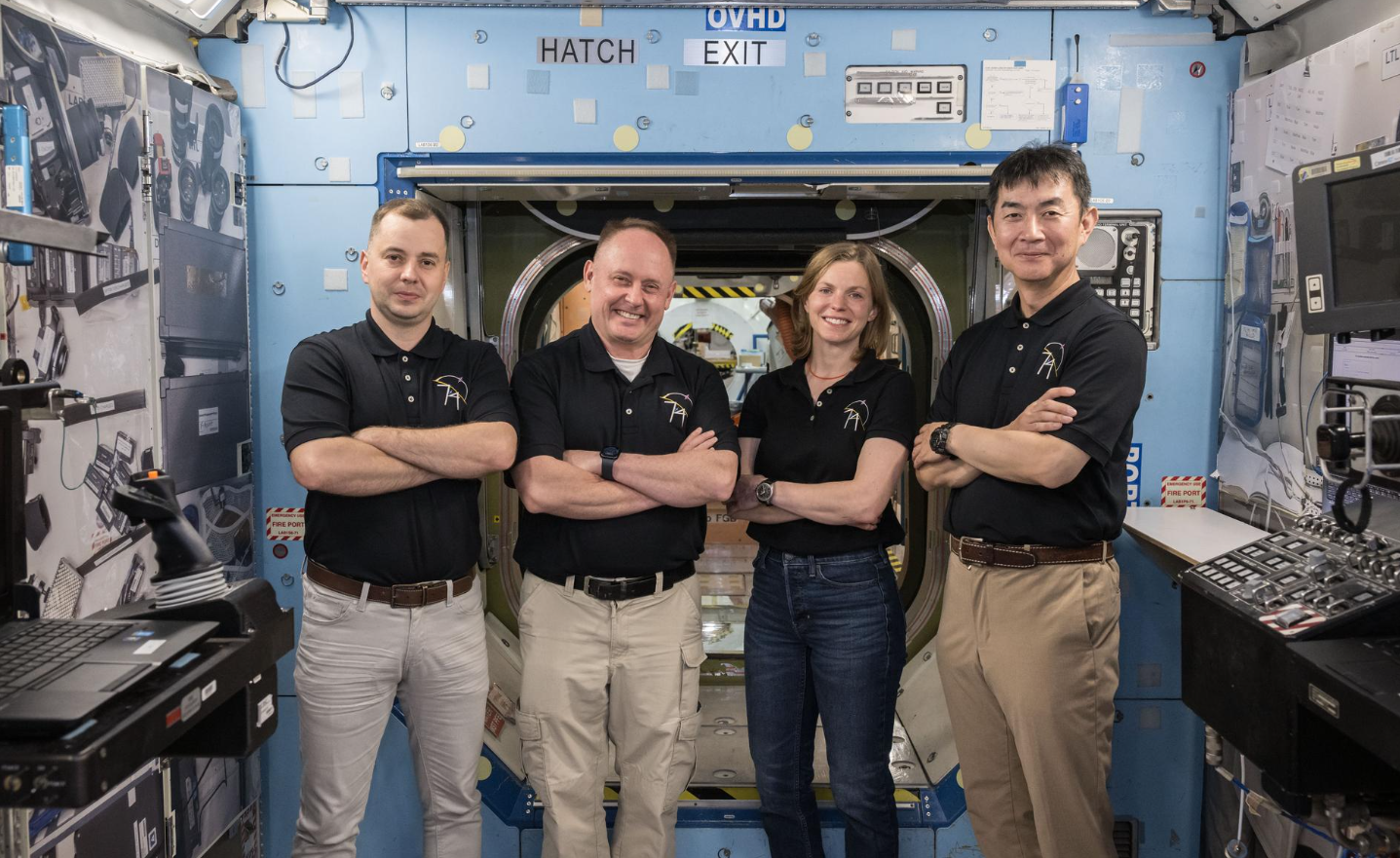
NASA astronaut Mike Fincke is sharing more about the medical event that caused an early end to the Crew-11 mission aboard the International Space Station. In an interview with the Associated Press, he said it happened with no warning and passed quickly, but doctors still do not understand the cause.
Last month, Fincke revealed that he was the ill crew member who prompted the medical evacuation and Crew-11’s return to Earth more than a month ahead of schedule.
On January 7, 2026, the night before he and Crew-11 Commander Zena Cardman were to perform a spacewalk — his 10th, her first — he experienced a “medical event” that NASA declined to disclose for privacy reasons. NASA Administrator Jared Isaacman was careful not to label it an emergency and categorized it as a “controlled medical evacuation” not an “emergency deorbit.”
Fincke, Cardman, JAXA’s Kimiya Yui, and Roscosmos’s Oleg Platanov splashed down on January 15 off the coast of California. All looked fine as they exited the Crew Dragon capsule onto the recovery ship although instead of directly returning to Houston, all spent the night at nearby Scripps Memorial Hospital near San Diego so as not to reveal who was ill. They also looked fine a week later at a post-mission press conference.
In his statement last month, Fincke expressed deep gratitude to his six ISS crewmates — Cardman, Yui, and Platonov, plus the Soyuz MS-28 crew, Sergey Kud-Sverchkov (Roscosmos), Sergei Mikaev (Roscosmos) and Chris Williams (NASA) — and the team on the ground. “I’m doing very well and continuing standard post-flight reconditioning” at Johnson Space Center.
In an interview with the AP at JSC yesterday, he added a bit more: “out of the blue” he was unable to speak for about 20 minutes. He felt fine before and fine afterwards and doesn’t know why. After numerous post-flight medical tests, neither do the doctors. He won’t provide more information about his medical situation lest other astronauts worry theirs might be compromised in the future.
Crew-11 was five-and-a-half months into their mission with a nominal return in mid-late February. Crew-12 was well into their preparations for launch in early February to arrive in time for a standard several-day handover between crews. NASA was able to accelerate the Crew-12 launch by a couple of days to February 13, but in the interim the Soyuz MS-28 crew had the entire International Space Station to themselves.
Last week, NASA astronauts Jessica Meir (Crew-12 commander) and Chris Williams (Soyuz MS-28 flight engineer) performed the spacewalk Fincke and Cardman had planned to do.
User Comments
SpacePolicyOnline.com has the right (but not the obligation) to monitor the comments and to remove any materials it deems inappropriate. We do not post comments that include links to other websites since we have no control over that content nor can we verify the security of such links.
Facts Only
NASA astronaut Mike Fincke experienced a medical event on January 7, 2026, aboard the International Space Station.
The event occurred the night before a scheduled spacewalk with Crew-11 Commander Zena Cardman.
Fincke was unable to speak for approximately 20 minutes, with no prior symptoms or lasting effects.
NASA did not classify the situation as an emergency, describing it as a "controlled medical evacuation."
Crew-11, including Fincke, Zena Cardman, JAXA’s Kimiya Yui, and Roscosmos’s Oleg Platanov, returned to Earth on January 15, 2026.
The crew splashed down off the coast of California and spent the night at Scripps Memorial Hospital near San Diego.
Post-mission medical tests have not identified the cause of Fincke’s medical event.
Fincke has declined to provide additional details to avoid worrying other astronauts.
Crew-11’s mission was cut short by over a month, with an original return planned for mid-to-late February 2026.
Crew-12’s launch was accelerated to February 13, 2026, to minimize the gap in ISS crew rotations.
The Soyuz MS-28 crew temporarily had exclusive occupancy of the ISS following Crew-11’s early departure.
The spacewalk originally planned for Fincke and Cardman was later performed by Crew-12 astronauts Jessica Meir and Chris Williams.
Fincke is currently undergoing standard post-flight reconditioning at Johnson Space Center.
Executive Summary
NASA astronaut Mike Fincke experienced an unexplained medical event aboard the International Space Station (ISS) on January 7, 2026, prompting an early return of the Crew-11 mission. The incident occurred the night before a planned spacewalk with Commander Zena Cardman and involved a sudden inability to speak for about 20 minutes, with no prior warning or lingering effects. NASA categorized the evacuation as "controlled" rather than an emergency, and the crew splashed down off California on January 15, spending a night at Scripps Memorial Hospital for observation. Post-mission medical tests have not determined the cause, and Fincke has declined to share further details to avoid causing concern among other astronauts. The early return disrupted mission schedules, accelerating Crew-12’s launch to February 13, while the Soyuz MS-28 crew temporarily had sole occupancy of the ISS. The planned spacewalk was later conducted by Crew-12 astronauts Jessica Meir and Chris Williams. Fincke has since resumed standard post-flight reconditioning at Johnson Space Center, expressing gratitude to his crewmates and ground teams.
The situation highlights the unpredictability of medical events in space and NASA’s protocols for handling such incidents while balancing transparency and privacy. The lack of a clear diagnosis underscores the challenges of space medicine, where even routine conditions can behave differently in microgravity. The agency’s cautious communication—avoiding labels like "emergency"—reflects both operational discipline and sensitivity to astronaut well-being. Meanwhile, the rapid adjustment of mission timelines demonstrates the flexibility built into NASA’s crew rotation systems, though it also raises questions about the long-term implications of such disruptions on research and operational continuity aboard the ISS.
Full Take
The strongest version of this narrative emphasizes NASA’s preparedness and adaptability in responding to an unpredictable medical event in space. The agency’s decision to frame the evacuation as "controlled" rather than an emergency reflects a deliberate effort to maintain operational calm while prioritizing astronaut safety. Fincke’s transparency about his experience—without oversharing—balances public accountability with personal privacy, a tension inherent in high-stakes space missions. The rapid adjustment of Crew-12’s launch timeline demonstrates the robustness of NASA’s contingency planning, though it also reveals the fragility of tightly scheduled space operations.
Patterns detected: none. The reporting avoids emotional exploitation or distortion, presenting the facts without sensationalism. However, the lack of a clear medical explanation invites speculation, which NASA has preemptively mitigated by limiting details. The root cause paradigm here is the inherent risk of human spaceflight, where even minor medical anomalies can trigger cascading operational changes. The narrative assumes that privacy and operational security outweigh full public disclosure—a reasonable stance, but one that could fuel conspiracy theories if mishandled.
Implications for human agency include the psychological toll on astronauts who must grapple with unexplained health events in isolation, as well as the broader question of how space agencies balance transparency with the need to protect crew morale. The costs are borne by mission planners, who must absorb schedule disruptions, and by researchers whose experiments may be delayed or deprioritized. Second-order consequences could include increased scrutiny of astronaut health monitoring systems or calls for more redundant medical capabilities on the ISS.
Bridge questions: How might NASA’s communication strategy evolve if similar incidents become more frequent? What trade-offs exist between astronaut privacy and the public’s right to know about risks in taxpayer-funded missions? Would a clearer diagnosis change the narrative, or is the mystery itself a valuable lesson in the uncertainties of space exploration?
Counterstrike scan: A bad actor seeking to undermine trust in NASA might exploit the ambiguity of Fincke’s condition, framing it as a cover-up or evidence of systemic negligence. They could amplify unanswered questions—"Why won’t they tell us what really happened?"—to sow doubt. However, the actual content does not align with this pattern. NASA’s measured response and Fincke’s own statements provide a credible counter-narrative, focusing on safety and adaptability rather than secrecy.
Sentinel — Human
This article shows signs consistent with human authorship. The text is coherent and provides a unique perspective, including personal elements from Mike Fincke himself. However, it's important to note that stylometric analysis alone does not definitively determine if a piece of writing is human or synthetic.