'Proclaim the Gospel of Life,' Pope Leo Says in First Papal Visit to Monaco in Modern Era
By: OSV News
Pope Leo XIV travels the Formula 1 circuit by popemobile, urging Monaco’s faithful to remember the poor and protect every human life
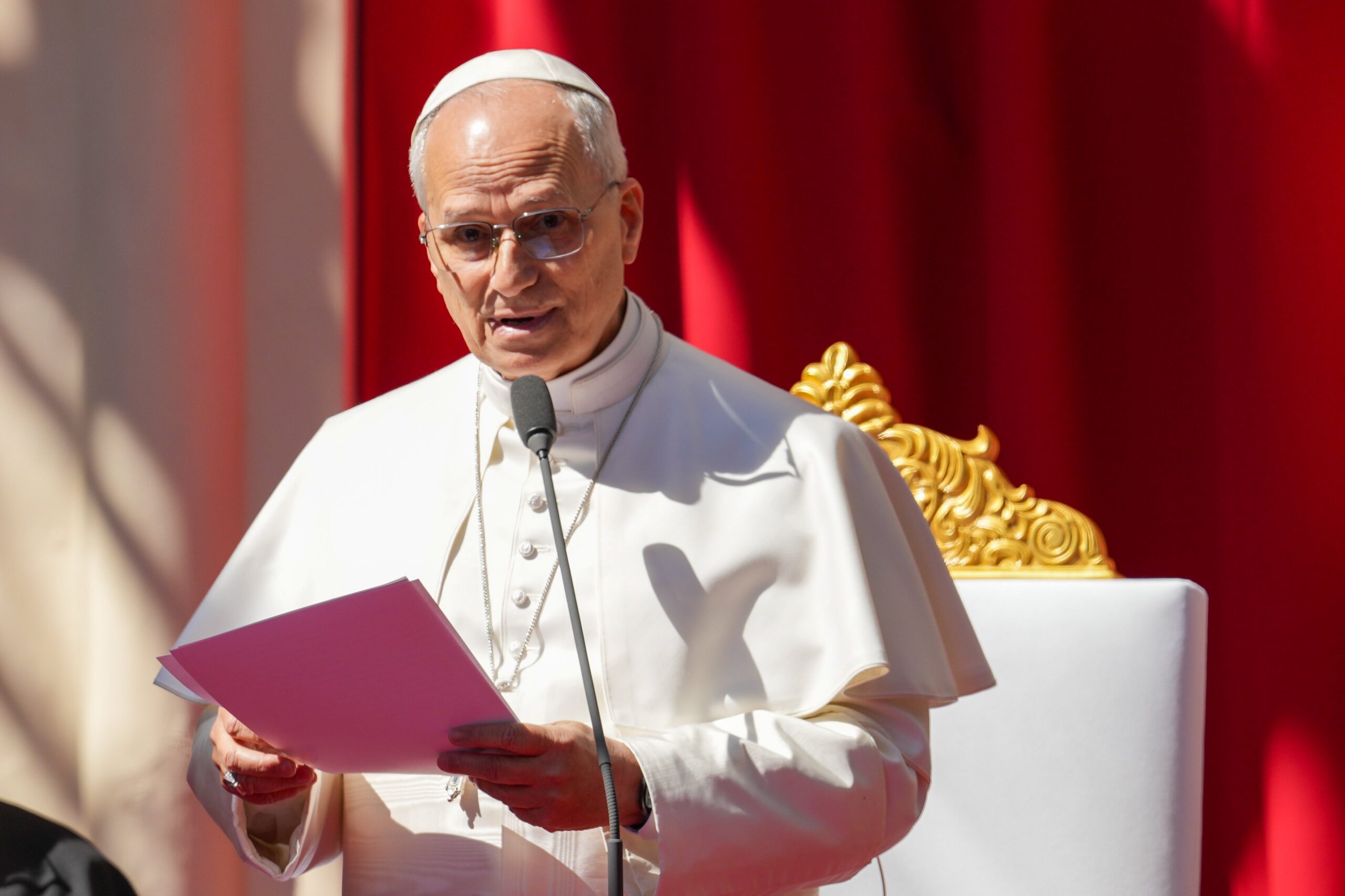
MONACO (OSV News) — In the principality known for super yachts and sports cars, Pope Leo XIV urged Monaco’s wealthy citizens to remember the poor and protect every human life, calling on them to remember that the Last Judgment “places the poor at its center.”
“Within your community, many people hold positions of considerable influence in the economic and financial spheres,” Pope Leo said in his speech from the balcony of the Prince’s Palace of Monaco March 28.
“The kingdom of God, to which Jesus dedicated his life … comes among us and shakes up the unjust configurations of power — those structures of sin that create chasms between the poor and the rich, between the privileged and the discarded,” he said.
Pope Leo became the first pope in modern history to visit Monaco March 28, traveling the streets of the famed Formula 1 Monaco Grand Prix Circuit by popemobile, instead of by race car, to meet the faithful of the tiny Catholic Mediterranean principality.
A kingdom of brothers and sisters
Flanked by Prince Albert II of Monaco and Princess Charlene on the palace balcony, Pope Leo addressed an elegantly-dressed Monégasque crowd in his first speech of the quick 13-hour trip to Monaco, the world’s second smallest state after Vatican City. The visit is Pope Leo’s first international journey of 2026 and only the second of his pontificate.
In his speech in the palace, Pope Leo entrusted the Catholic principality with the task of “protecting every human life” and deepening its “commitment to the social doctrine of the Church.”
Roman Catholicism is the official state religion of Monaco, where roughly 82% of the population is Catholic.
“You are among the few countries in the world to have the Catholic faith as a state religion,” Pope Leo said in his speech at the Prince’s Palace.
“This faith places us before the sovereignty of Jesus, who calls Christians to become in the world a kingdom of brothers and sisters — a presence that does not cast down but raises up, that does not separate but connects, always ready to protect every human life with love, at any time and in any condition.”
Proclaiming the Gospel of life
School children in yellow hats eagerly waved the flags of Monaco and Vatican City as Pope Leo traveled by popemobile through Monaco’s famed streets with panoramic views of the Mediterranean below. On the way, he stopped numerous times to bless babies.
At Monaco’s Cathedral of the Immaculate Conception in Monaco-Ville, the pope prayed midday prayer with the local Catholic community and members of the royal family, urging Monaco’s faithful to “proclaim the Gospel of life, hope and love.” The cathedral, consecrated in 1911 on the site of a parish church dating to 1252, contains the tombs of Monaco’s royal family, including Princess Grace Kelly, an Irish American Catholic actress from Philadelphia, who married Prince Rainier III there in 1956 and died in 1982.
“Bring the light of the Gospel to everyone so that the life of every man and woman may be defended and promoted from conception until natural death. Offer new pathways capable of stemming the tide of secularism, which risks reducing humanity to individualism and basing social life on the production of wealth,” Pope Leo said.
‘An amazing day’
Catherine Sassi was among the local Monégasque Catholics who prayed midday prayer with Pope Leo.
“It’s a great pleasure, a great honor and we are so happy to welcome His Holiness Leo XIV,” Sassi told OSV News.
“It’s an amazing day,” she said. “I was so pleased to be able to live it with my family, my husband, my two children. And so it will be a day we will always remember.”
Pope Leo then made his way to the church of St. Devota, one of Monaco’s most cherished religious sites. Dedicated to the patron saint of Monaco, an early Christian martyr from Corsica executed during the reign of the Roman Emperor Diocletian, the chapel lends its name to the first corner of the Formula 1 Monaco Grand Prix Circuit. At St. Devota, the pope met with young people and catechumens, including 70 adults preparing to receive the sacraments of baptism, first Communion, and confirmation.
The witness of ancient and modern saints
Inside the chapel, he spent a few moments in prayer before the Blessed Sacrament and paused to venerate the relics of St. Devota.
Under the bright Mediterranean sun, Pope Leo answered questions from young people and soon-to-be baptized catechumens about how to maintain hope in difficult times, witness to God’s love, and comfort those who feel abandoned by God.
In his speech Pope Leo pointed to the witness of both the ancient Roman martyr, St. Devota, and the modern millennial saint, St. Carlo Acutis.
Highlighting St. Carlo’s Eucharistic devotion, the pope told young people to make time for “prayer, moments of silence and reflection to quiet the frenzy of doing and saying, of messages, reels and chats, and to delve deeper into and savor the beauty of truly and genuinely being together.”
“Monaco is a beautiful country, but its true beauty comes from you, when you are able to look into the eyes of those who suffer or who feel invisible amid the city lights,” he told the young people and those preparing to come into the full life of the Catholic Church.
‘Do not be afraid to give everything’
As Pope Leo was speaking about peace during his meeting with Monégasque youth, yachts in the nearby harbor were blowing their horns in the port. The pope laughed, saying, off-the-cuff, “We also desire peace.”
Pope Leo then attended a private lunch at the residence of Archbishop Dominique-Marie David of Monaco. It was a moment of rest before the day’s culminating event, a 3:30 p.m. Mass at Louis II Stadium.
“Dear young people, do not be afraid to give everything — your time, your energy — to God and to your brothers and sisters, to pour yourselves out completely for the Lord and for others,” the pope told the young crowd at the church of St. Devota.
“Only in this way will you find an everlasting joy and an ever-deeper meaning in life,” he said. “The world needs your witness to overcome the errors of our time, face its challenges and, above all, to rediscover the sweet taste of loving God and neighbor.”
—
Courtney Mares is Vatican editor for OSV News and reported from Monaco. Follow her on X.
Facts Only
Pope Leo XIV visited Monaco on March 28, 2026, the first modern papal visit to the principality.
He traveled the Formula 1 Monaco Grand Prix Circuit by popemobile.
From the Prince’s Palace balcony, he addressed Monaco’s citizens, emphasizing protection of human life and aid to the poor.
Monaco’s official state religion is Roman Catholicism, with 82% of the population identifying as Catholic.
The pope prayed midday prayer at the Cathedral of the Immaculate Conception, which houses the tombs of Monaco’s royal family, including Princess Grace Kelly.
He met with young people and catechumens at St. Devota’s Church, venerated the saint’s relics, and answered questions on faith and hope.
Pope Leo referenced St. Carlo Acutis, urging youth to prioritize prayer and genuine connection over digital distractions.
The visit concluded with a Mass at Louis II Stadium, where he called for defending life from conception to natural death.
The trip lasted 13 hours and was Pope Leo’s first international journey of 2026.
Prince Albert II and Princess Charlene accompanied the pope during the palace address.
The cathedral was consecrated in 1911 on the site of a 13th-century parish church.
St. Devota, Monaco’s patron saint, was a Corsican martyr executed under Roman Emperor Diocletian.
Executive Summary
Full Take
The strongest version of this narrative presents Pope Leo XIV as a moral voice challenging wealth disparity and secularism in a symbolically opulent setting. By framing Monaco’s Catholic identity as a call to social justice, the pope leverages the principality’s influence to advocate for the marginalized—a classic example of religious authority intersecting with economic power. The visit’s choreography—popemobile on a Formula 1 circuit, prayers at royal tombs, and youth engagement—creates a compelling visual and emotional appeal, reinforcing the Church’s relevance in modern society.
Patterns detected: ARC-0024 Ambiguity (vague calls to "protect life" without policy specifics), ARC-0043 Motte-and-Bailey (broad moral appeals that could retreat to doctrinal purity if challenged).
Root cause: The narrative assumes that religious identity inherently fosters social responsibility, a paradigm that risks conflating faith with political activism. Historically, this echoes the Church’s tension between spiritual leadership and temporal power, from medieval Christendom to modern Vatican diplomacy.
Implications: For human agency, the pope’s message empowers individuals to act but risks oversimplifying systemic inequality. The wealthy are urged to "remember the poor," yet structural solutions remain abstract. Second-order consequences may include heightened scrutiny of Monaco’s tax policies or charitable efforts, as the pope’s words create a moral benchmark.
Bridge questions: How might Monaco’s elite reconcile their wealth with the pope’s call to "raise up" the discarded? What concrete actions could follow this rhetorical appeal? Would the pope’s message resonate differently in a non-Catholic majority nation?
Counterstrike scan: A coordinated influence campaign would amplify the pope’s moral authority to pressure Monaco’s financial sector, using emotional appeals to guilt and religious duty. The actual content aligns with this playbook but lacks overt manipulation, focusing instead on doctrinal consistency. The absence of specific policy demands suggests a genuine pastoral visit rather than a strategic power play.