By Ross
As the midsummer sun begins to bake the Front Range, many garden favorites begin to flag. The hydrangeas wilt, the lush delphiniums drop their heads, and the gardener is often left questioning if the investment of water and labor was worth it.
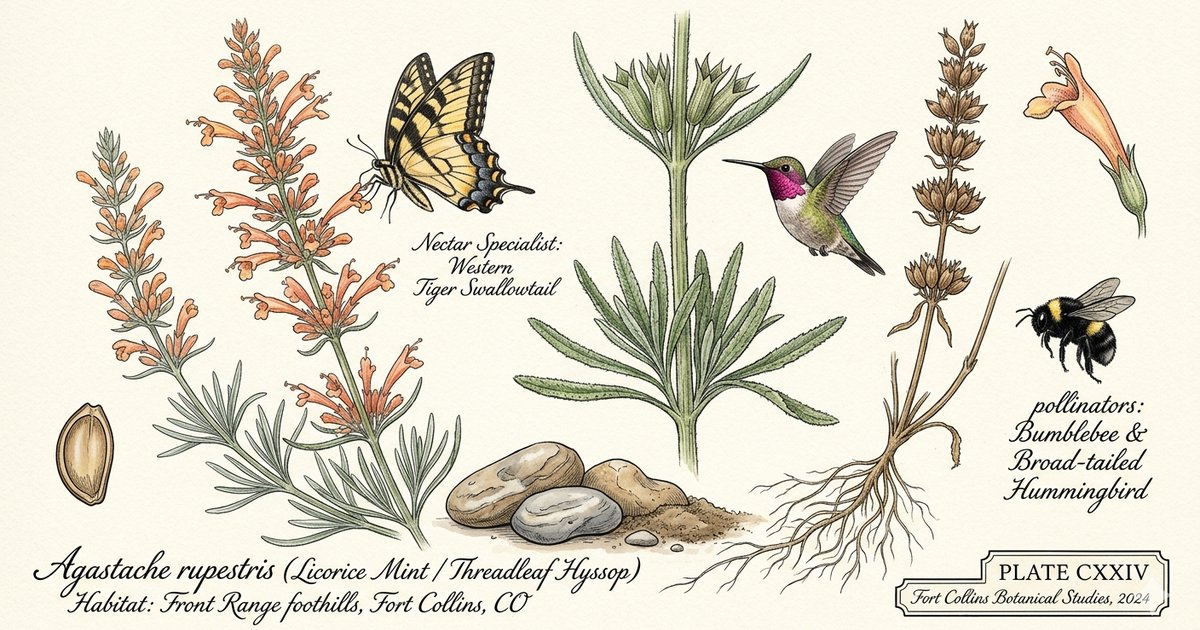
Yet, in some fortunate corners of Fort Collins, one plant is just beginning its spectacular performance. Hovering over fine, aromatic foliage, dozens of spires—shaded in sunset hues of peach, rosy orange, lavender, and royal purple—stand defiant against the heat. This is Agastache (ag-uh-STAH-kee), and if you reside in Larimer County and do not yet grow it, you are missing the soul of the high-desert garden.
The High-Altitude Hero
Agastache, frequently known as Hyssop or Hummingbird Mint, is almost uniquely suited to the unique gardening conditions of Fort Collins. While our winters can be brutal and our springs unpredictable, this genus thrives when conditions are lean. Many of the most stunning varieties originate in the mountains and high plateaus of the American Southwest and Mexico, making them inherently pre-adapted to our intense sunlight, low humidity, and large temperature swings.
The key to its success here lies not in loving the soil, but in appreciating its limitations.
A Masterclass in Drainage
If you take only one piece of advice for growing Agastache on the Front Range, let it be this: Drainage is paramount. This plant does not die from cold; it dies from wet feet.
"A thriving Agastache requires soil that allows water to pass through almost instantly," says local gardening logic. In much of Fort Collins, where heavy, amending clay dominates, this requires intent. You cannot simply dig a hole in unamended clay. You must cultivate "lean" soil.
The best approach is to plant Agastache in a sunny, raised berm or a designated rock garden, where you can control the composition. Ideal backfill is often a lean mixture of local soil, coarse sand, fine pea gravel, or expanded shale. They reject rich, heavy compost; indeed, too many nutrients lead to floppy plants and short lifespans. They are xeric plants, thriving on neglect once established.
The Cultivars to Know
While the native Agastache foeniculum (with strong anise-scented leaves and purple flowers) is a tough, lovely addition that readily reseeds, the standard for visual impact has long been set by the southwestern hybrids. In Fort Collins, several cultivars are standouts:
‘Ava’: One of the grandest hybrids, forming a significant presence (4-5 feet tall). It boasts spikes of deep rose-pink flowers, encased in persistent raspberry-red calyxes, which extend the show long after the florets fall.
‘Sonoran Sunset’: A smaller, more compact plant (18 inches) that is ideal for the front of the border or a container. It produces dense, vibrant, violet-rose flowers.
‘Coronado’ (The Plant Select® Star): We must always look to Plant Select—the collaboration between Colorado State University and Denver Botanic Gardens—for guaranteed regional success. 'Coronado' features brilliant orange-and-yellow spikes and has been proven tough from I-25 to the foothills.
Invitation to the Dance
Beyond its resilience and architecture, the primary argument for Agastache is the wildlife it supports. The name "Hummingbird Mint" is non-coincidental. The long, tubular florets are perfectly evolved to fit the beak of a Broad-tailed or Rufous hummingbird.
When your Agastache blooms, your garden becomes a destination. The buzzing of native bumblebees and the flashing speed of hummingbirds jockeying for territory are guaranteed features.
As water grows scarcer and we look for sustainable beauty that honors our distinct Colorado landscape, Agastache stands ready. It asks for little more than a sunny spot with impeccable drainage, and in return, it paints the high-summer garden with the very colors of the sunset.
Facts Only
Agastache is a plant genus suited to the high-altitude, low-humidity conditions of Fort Collins, Colorado.
It is commonly referred to as Hyssop or Hummingbird Mint.
The plant thrives in well-draining soil and struggles in heavy, wet conditions.
Native to the American Southwest and Mexico, Agastache is adapted to intense sunlight and temperature swings.
Popular cultivars in Fort Collins include ‘Ava’, ‘Sonoran Sunset’, and ‘Coronado’.
‘Ava’ grows 4-5 feet tall with deep rose-pink flowers.
‘Sonoran Sunset’ is compact (18 inches) with violet-rose flowers.
‘Coronado’ is a Plant Select® variety with orange-and-yellow spikes, proven resilient in Colorado.
Agastache attracts hummingbirds and native bumblebees due to its tubular florets.
The plant requires minimal water once established, making it suitable for xeric gardening.
Local soil in Fort Collins is often heavy clay, necessitating amendments like coarse sand or gravel for Agastache.
Plant Select® is a collaboration between Colorado State University and Denver Botanic Gardens.
Executive Summary
Full Take
This article presents Agastache as a near-perfect solution for Fort Collins gardeners, emphasizing its resilience, aesthetic appeal, and ecological benefits. The narrative leans heavily on the plant’s adaptability to local conditions, framing it as a low-maintenance, high-reward choice. However, the piece assumes that all readers have the means to amend soil or construct raised beds, which may not be feasible for everyone. The focus on specific cultivars like ‘Coronado’ also suggests a preference for hybridized varieties over native species, potentially overlooking the ecological value of indigenous plants.
The article’s tone is persuasive, bordering on advocacy, which could be seen as a subtle form of authority appeal—leveraging local gardening expertise to endorse a particular plant. While the claims about Agastache’s benefits are well-supported, the piece doesn’t explore potential drawbacks, such as invasiveness or competition with native species. The emphasis on wildlife attraction is commendable, but it’s worth asking whether promoting non-native hybrids could disrupt local ecosystems over time.
**Patterns detected: none**
**Bridge questions:**
How does the cultivation of hybrid Agastache varieties impact native plant populations in Colorado?
What are the long-term ecological consequences of favoring drought-resistant non-natives over indigenous species?
Could the promotion of specific cultivars be influenced by commercial interests, such as nurseries or plant breeding programs?