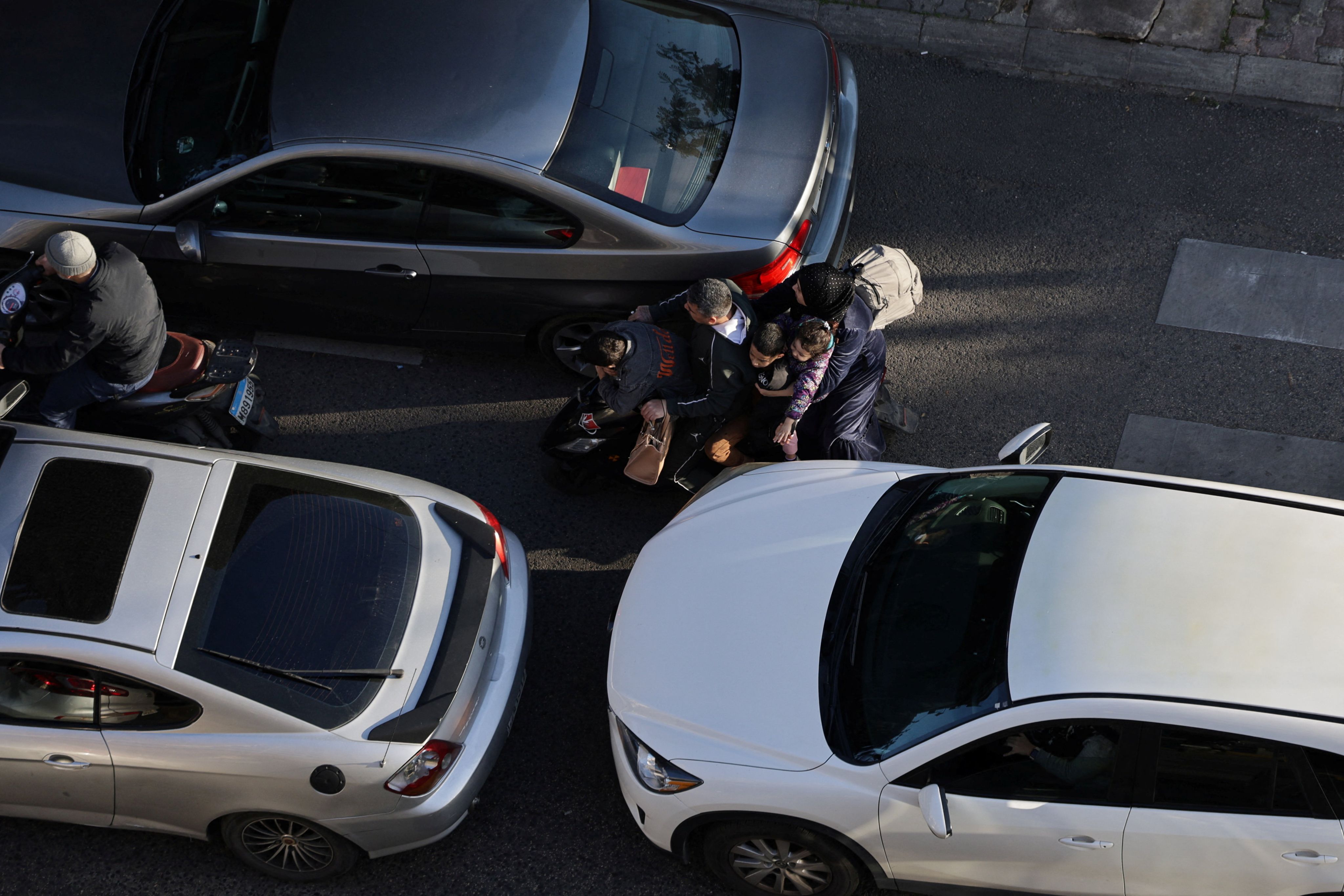
Beirut, March 18, 2026 – In early March, as the Iran war spread across the Middle East and Israeli strikes rained down on Lebanon, many journalists covering the country’s growing displacement crisis found themselves living it.
For freelance video journalist Hadil Iskandar, who has worked for German broadcaster Deutsche Welle and pan-Arab outlet Daraj Media, it was the second time in under two years that she found herself packing her belongings and fleeing her home in the Lebanese capital’s southern suburb of Dahieh.
After Israeli attacks escalated across Lebanon in early March, nearly a million people fled their homes — including the journalists covering the crisis. Reporters from parts of Beirut and southern Lebanon told the Committee to Protect Journalists that displacement has disrupted their ability to work, forcing them to report from temporary housing while worrying about their families, their homes, and their safety.
Having fled during the 2024 war, for them it was a repeated experience of displacement, blurring the line between covering the unfolding humanitarian crisis and living through it.
“The displacement of journalists in Lebanon disruption has broader implications for press freedom,” said CPJ Regional Director Sara Qudah. “When journalists are forced from their homes, their ability to report safely, accurately, and consistently is severely undermined — limiting the flow of independent information from conflict zones at the time when it is most needed.”
Despite the upheaval, Iskander still felt she had a job to do.
“The first two days were very difficult for me, to the point that I couldn’t produce a single story,” said Iskandar, who initially took shelter with family members at an aunt’s house before searching for a more permanent place to stay. “There was a huge distraction between going to the ground, seeing people, doing my job, and at the same time contacting people to secure a house.”
Covering families who had lost their homes was especially painful, she said, feeling an affinity with them. “I’m one of the displaced too.”
Movement
Displacement has reshaped how the journalists work. Mohamed Ghassani, a journalist and editor at An-Nahar newspaper, fled his home in the southern coastal city of Tyre at around 3 a.m. with only his work laptop and identification papers. It took him seven hours to reach safety, with a bottleneck of traffic built up from civilians fleeing.
Movement has continued to be a major challenge. Since leaving home he has not been able to go to the office or be physically present with colleagues, and his work has shifted entirely to online communication, WhatsApp and phone calls. And if a story requires him to be physically present, getting there has become much harder.
“No matter how much someone tries not to be affected and to continue working normally, you can’t in these conditions,” he told CPJ.
Psychological toll
Fatima Shoukair, a freelance journalist who contributes to Raseef 22, said she hasn’t felt fully safe in her home since the 2024 war with Israel. She kept a bag containing identity papers, savings, and essentials in the car at all times in case a warning was issued while she was away and unable to return.
On the night of the recent strikes, the bombing was so close that she thought she might not be able to get out in time.
Shoukair described the toll as largely psychological. Displacement and direct exposure to the attacks have made her work “extremely exhausting.”
“I can’t focus, and I don’t have the ability to produce,” she said.
So far, she has not been able to complete a full story and has continued only with administrative tasks. Without the focus, energy and stable space needed to work, she said she no longer sees events from a professional distance but “through the eyes of a victim.” Journalists rarely have the luxury of stepping away from the news even when they are living through it, she added, making it difficult to continue reporting.
No space to work
For Valentine Nasser, a journalist and director of the platform Silat Waseel, displacement meant losing the space that made reporting possible. Forced to leave her home for the second time during the war, she moved with her family from the southern city of Tyre to a rented room in Beirut, a six-hour journey amid the build-up of people fleeing.
Constant movement has made it difficult to keep working. When an evacuation warning was issued while she was reporting, she had to continue working from her car on the way to Beirut, “with no electricity and no way to charge a laptop or phone.”
The bombardment and tension make concentration difficult, she said, but the greater loss was the quiet workspace she had built before being displaced. “Today I lost that space.”
Ali Al Ahmar, a reporter for pro-Hezbollah broadcaster Al-Mayadeen TV, told CPJ he has found it difficult finding accommodation after fleeing his village, Kfarreman, in southern Lebanon’s Nabatieh area. He eventually managed to secure a room for his family despite high rent prices and the large number of displaced people flooding to the capital.
Ahmar said, to him, displacement is not only about losing a house. “It means losing the basic infrastructure a journalist needs to work: safety, rest, stable connection, and an environment that helps you think.”
Facts Only
* Journalists covering the crisis in Lebanon have experienced displacement.
* Nearly a million people have fled their homes, including journalists.
* Freelance video journalist Hadil Iskandar has fled her home in Dahieh twice in under two years.
* The Committee to Protect Journalists (CPJ) reports disruption to work due to displacement.
* Israeli strikes in Lebanon triggered the displacement.
* Journalists struggle with movement and access to workspaces.
* Psychological impact, including difficulty focusing and feeling “through the eyes of a victim,” is noted.
* Fatima Shoukair keeps identity papers and savings in a car.
* Mohamed Ghassani’s work has shifted entirely to online communication due to limited mobility.
* Valentine Nasser lost the “quiet workspace” she had built.
* Ali Al Ahmar has found it difficult to secure accommodation after fleeing Kfarreman.
* The situation highlights broader implications for press freedom.
Executive Summary
Full Take
Sentinel — Likely Human
This article presents a detailed account of journalists’ experiences navigating displacement in Lebanon, exhibiting a polished and organized style that, while informative, displays characteristics suggestive of AI assistance or template-based reporting. The level of meticulous detail and consistent phrasing raises a moderate concern regarding potential synthetic origins.