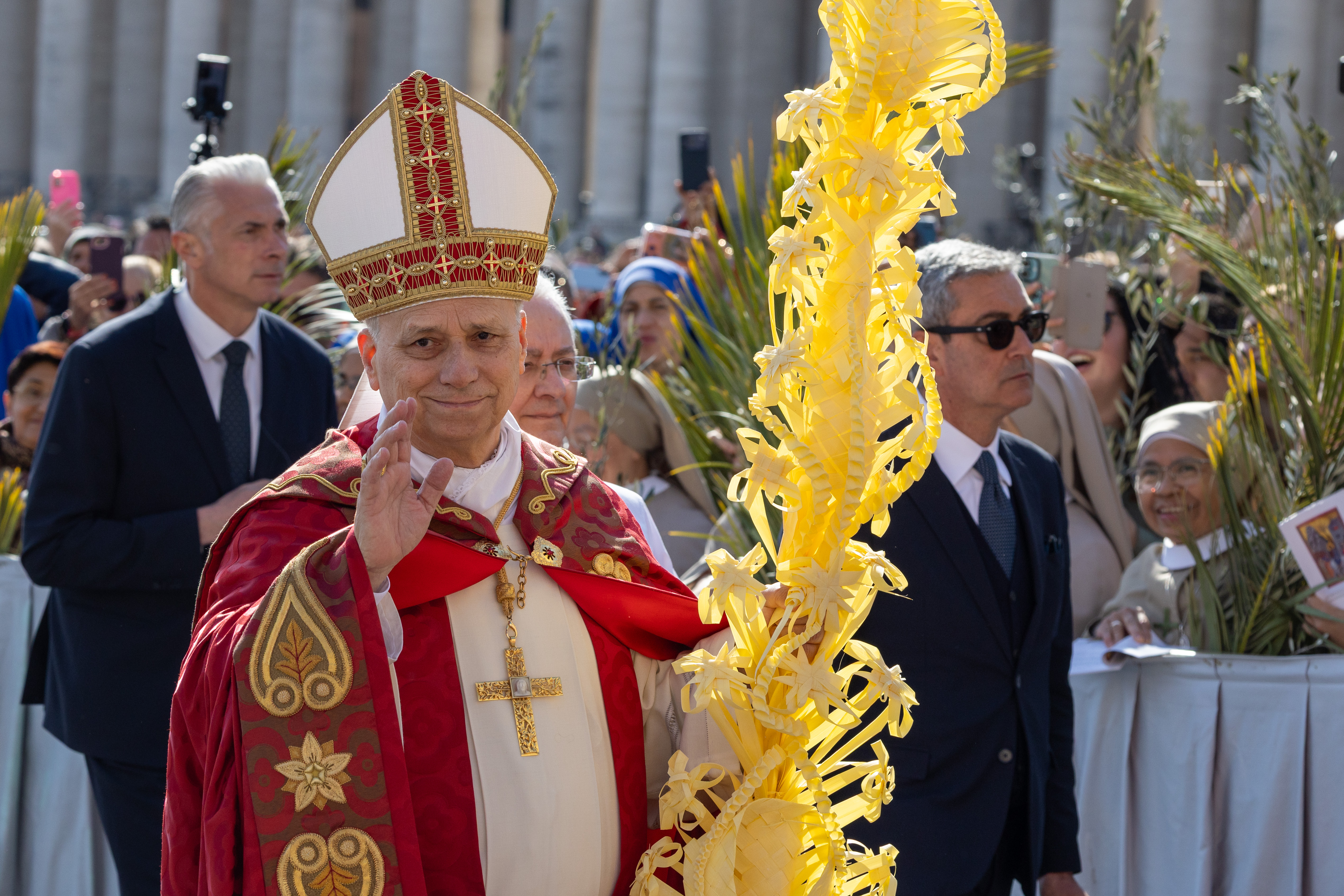
Pope Leo XIV on Palm Sunday sharply condemned war and the use of religion to justify violence, saying during Mass in St. Peter’s Square that God “does not listen to the prayers of those who wage war.”
At the start of Holy Week, the pope tied the Church’s contemplation of Christ’s Passion to the suffering of people caught in today’s conflicts, especially Christians in the Middle East.
In his Palm Sunday homily, Leo repeatedly presented Christ as the “King of Peace,” contrasting Jesus’ meekness with the violence surrounding him as he entered into his Passion.
“We turn our gaze to Jesus, who reveals himself as King of Peace, even as war looms abounds him,” the pope said. “He remains steadfast in meekness, while others are stirring up violence.”
Leo said Christ “did not arm himself, or defend himself, or fight any war” but instead “revealed the gentle face of God, who always rejects violence.”
“Rather than saving himself, he allowed himself to be nailed to the cross, embracing every cross borne in every time and place throughout human history,” the pope said.
The pope then issued one of the strongest lines of his homily, rejecting any attempt to invoke God in support of armed conflict.
“Brothers and sisters, this is our God: Jesus, King of Peace, who rejects war, whom no one can use to justify war,” Leo said. “He does not listen to the prayers of those who wage war, but rejects them, saying: ‘Even though you make many prayers, I will not listen: your hands are full of blood.’”
The Palm Sunday liturgy, which opened Holy Week, began with the traditional procession in St. Peter’s Square with cardinals, bishops, priests, religious, and thousands of faithful carrying palms and olive branches.
In his homily, Leo reflected on Jesus’ entry into Jerusalem on a donkey rather than a war horse, saying the moment fulfilled the prophecy of a king who would “command peace to the nations.”
Recalling the Gospel account of Peter drawing a sword to defend Jesus, Leo cited Christ’s rebuke: “Put your sword back into its place, for all who take the sword will perish by the sword.”
The pope said that in the crucified Christ “we can see a crucified humanity.”
“In his wounds, we see the hurts of so many women and men today,” he said. “Above all, we hear the painful groans of all those who are oppressed by violence and are victims of war.”
“Christ, King of Peace, cries out again from his cross: God is love! Have mercy! Lay down your weapons! Remember that you are brothers and sisters!”
Following the Mass, Leo returned to the theme of war during the Angelus, praying in particular for Christians in the Middle East who have been prevented in some places from fully taking part in Holy Week rites.
“At the beginning of Holy Week, our prayers are more than ever with the Christians of the Middle East, who are suffering the consequences of a brutal conflict and, in many cases, are unable to observe fully the liturgies of these holy days,” he said.
“Just as the Church contemplates the mystery of the Lord’s Passion, we cannot forget those who today are truly sharing in his suffering. Their ordeal challenges all our consciences.”
The pope added: “Let us raise our prayer to the Prince of Peace that he may sustain the peoples wounded by war and open concrete paths to reconciliation and peace.”
Leo also remembered “the maritime workers who have fallen victim to the conflict,” adding: “I pray for the deceased, the wounded and their families. Land, sky and sea were all created for life and peace!”
He further called attention to migrants who died in the Mediterranean, saying: “Let us also pray for all the migrants who have died at sea, especially those who lost their lives in recent days off the coast of Crete.”
Near the end of his homily, the pope entrusted his plea for peace to the intercession of Mary, quoting the Servant of God Bishop Tonino Bello and praying that “the tears of all the victims of violence and pain will soon be dried up.”
He concluded the Angelus by asking the Virgin Mary to accompany the faithful through the days ahead.
“May she guide us during these holy days, so that we may follow Jesus, our Savior, with faith and love,” he said.
This story was first published in two parts by ACI Prensa, EWTN News’ Spanish-language news partner. It has been translated and adapted by EWTN News English.
The Holy Father during his homily at Monacoʼs Louis II Stadium urged the faithful to “not get used to the rumble of weapons or the images of war.”
Facts Only
Pope Leo XIV condemned war and the use of religion to justify violence during Palm Sunday Mass in St. Peter’s Square.
He stated that God “does not listen to the prayers of those who wage war.”
The homily tied Christ’s Passion to the suffering of people in modern conflicts, particularly Christians in the Middle East.
Leo described Christ as the “King of Peace” who rejected violence and did not defend himself with force.
He quoted biblical passages, including Christ’s rebuke to Peter: “Put your sword back into its place, for all who take the sword will perish by the sword.”
The pope said Christ’s crucifixion symbolizes the suffering of all victims of war and oppression.
He called for an end to violence, urging, “Lay down your weapons! Remember that you are brothers and sisters!”
The Palm Sunday liturgy included a procession in St. Peter’s Square with cardinals, bishops, priests, and thousands of faithful carrying palms and olive branches.
During the Angelus, Leo prayed for Middle Eastern Christians unable to fully observe Holy Week due to conflict.
He also prayed for maritime workers killed in conflict and migrants who died at sea, including recent deaths off Crete.
The pope invoked Mary’s intercession for peace and the drying of “the tears of all the victims of violence and pain.”
The homily was first published in Spanish by ACI Prensa and adapted by EWTN News.
Executive Summary
Pope Leo XIV delivered a strong condemnation of war and the use of religion to justify violence during his Palm Sunday homily in St. Peter’s Square. He emphasized Christ as the "King of Peace," contrasting Jesus' meekness with the violence of armed conflict, and explicitly rejected any invocation of God to support war, citing biblical passages. The homily tied the suffering of Christ to the plight of modern conflict victims, particularly Christians in the Middle East, who face restrictions on observing Holy Week rites. The pope also highlighted the broader human cost of war, including maritime workers and migrants who have died in conflicts or at sea. His message extended to a call for reconciliation and peace, invoking Mary’s intercession for victims of violence. The liturgy included a traditional procession with palms and olive branches, followed by an Angelus prayer reiterating concerns for war-torn regions and marginalized groups.
The pope’s remarks reflect a consistent Vatican stance against armed conflict, framing peace as a core Christian value. While the speech did not propose specific political solutions, it underscored moral and spiritual imperatives, urging global solidarity with those suffering. The focus on Middle Eastern Christians aligns with longstanding papal advocacy for persecuted religious minorities, though the broader appeal to universal brotherhood and disarmament resonates with wider humanitarian concerns. The tone was pastoral yet uncompromising, blending liturgical reflection with contemporary geopolitical realities.
Full Take
The strongest version of this narrative is a principled moral stance against war, rooted in Christian theology and universal humanitarian values. Pope Leo XIV’s homily leverages the symbolic power of Holy Week to amplify a message of peace, framing Christ’s suffering as a mirror to contemporary conflicts. By explicitly rejecting the weaponization of religion, he challenges both political and theological justifications for violence, grounding his appeal in scripture and tradition. The focus on Middle Eastern Christians and marginalized victims adds urgency, while the call to see all people as “brothers and sisters” broadens the moral scope beyond sectarian lines.
Pattern scan: The speech employs emotional resonance—invoking the suffering of Christ and modern victims—to reinforce its moral authority. However, it avoids distortion or bad faith by staying within theological and pastoral boundaries. The strongest rhetorical tool is the contrast between Christ’s meekness and human violence, a classic motif in Christian pacifism. No manipulation patterns are detected; the argument is consistent with Vatican doctrine and lacks coercive framing.
Root cause: The paradigm here is religious pacifism as a counter-narrative to just war theory and nationalist violence. Unstated assumptions include the belief that moral appeals can influence geopolitical behavior and that religious leaders have a duty to condemn conflict regardless of political complexity. Historically, this echoes the prophetic tradition of papal diplomacy, from Benedict XV’s WWI pleas to Francis’ modern advocacy.
Implications: For human agency, the message empowers individuals to reject violence as a moral absolute, but it risks oversimplifying the structural causes of war. The primary beneficiaries are those seeking moral clarity in chaotic times, while the costs may fall on policymakers who must navigate realpolitik. Second-order consequences could include increased pressure on religious institutions to take political stances or, conversely, dismissal of such appeals as idealistic.
Bridge questions: How might this message resonate differently in regions where war is seen as defensive or liberatory? What role should religious leaders play in conflicts where their followers are direct victims? Would the pope’s argument hold the same weight if applied to non-state actors or asymmetric warfare?
Counterstrike scan: A bad-actor playbook would exploit the pope’s words to polarize—either dismissing them as naive or weaponizing them to shame specific nations. However, the homily’s focus on universal principles and avoidance of partisan blame makes it resistant to such co-optation. The content does not align with manipulation patterns; it is a genuine pastoral appeal.
Patterns detected: none
Sentinel — Human
This text exhibits signs of being written by a human. The author demonstrates variable sentence structure, lexical diversity, emotional resonance, and a personal voice—all indicators that suggest human authorship rather than synthetically generated content.