The starkest, most disquieting scene from the film was printed on postcards and handed out at the door. We picked up our postcards as we hurried into the theater to secure our seats. My eyes widened: a group of women in burqas sat on a beach facing the ocean. Before them stood a woman with dark hair—uncovered—wearing a long, flowing white dress as she faced the women in the burqas. I began mentally preparing for the ideological and cultural translations—and mistranslations—I might be in for by the end of the movie, when we would inevitably run into acquaintances and friends in the foyer.
The director was privy to the provocations of her film, Leila and the Wolves. “This film offended everyone,” she proudly told the packed room at the Brooklyn Academy of Music, at a screening last spring. When the movie came out in the Eighties, everybody, including those on the left, could find something to be offended by in it. Her films were deemed insufficiently feminist for being full of guns, while at the same time criticized for “overemphasizing” women’s liberation in comparison to imperialism. Now her films could finally resume their provocations: since last spring, the “eighty-springs-young” director, Heiny Srour, has toured Europe, the U.K. and the U.S., screening new restorations of her masterpieces The Hour of Liberation Has Arrived (1974) and Leila and the Wolves (1984), thanks to programmers determined to bring her provocative socialist feminist oeuvre to wider audiences (a destiny all too rare in the history of Global South cinema). But this time around, especially in the West, she has found the political engagement with her work to be lacking. “In France, they shower me in praises,” Srour complained. Praise is boring. Trained as a sociologist, she wants her films to spark arguments. When they are treated only as objects of historical record, however admiringly, they become dead artifacts.
Such an attitude is rare in today’s artistic and intellectual circles. Srour has celebrated defiance not just in her public statements but in her life: as a young director she embedded herself with guerrilla fighters resisting the Omani Sultanate and filmed under British Royal Air Force bombardment. That project became the first film by a female Arab director to screen at Cannes and was subsequently banned across the Arab world. The film we saw that night, Leila and the Wolves, was also shot under dangerous conditions, under the surveillance of armed Ba’athist soldiers in Syria. But it was defiant in a different way: it traces vignettes from the life, surroundings, memories and unconscious of its protagonist Leila, a Lebanese woman who lives in modern-day London and also embodies the collective memory of Arab women in the Levant.
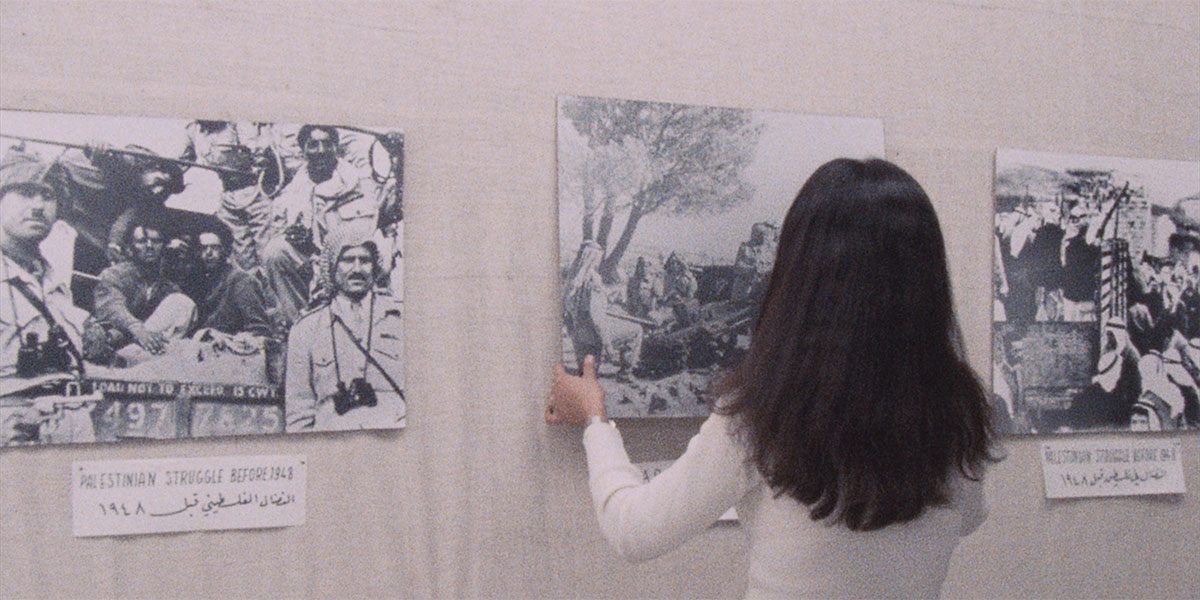
In the film the title character, Leila, saunters amidst uprisings in British-occupied Palestinian towns in the 1920s. She witnesses the horror of the Deir Yassin massacre of 1948. In another scene, set during the Israeli invasion of Lebanon in 1982, she converses with other women, encouraging them to take up arms. In London we find her working on an photography exhibition about historical Palestine, wrestling with its patriarchal depiction of the liberation movement and the erasure of women’s involvement in Palestinian resistance.
What’s remarkable about the film, to my eyes, is the continuity between the personal and the political. This theme, shared across Srour’s cinema, embodies the commitment of the old left to the denial of any space outside of politics; her insistence on being challenged is rooted in this commitment. As Srour very well knows, there is much to debate in the film: one could easily raise questions about the film’s evenhanded treatment of Zionism and patriarchy, or what from our present standpoint can feel like a facile celebration of feminism and secularism. And this packed Brooklyn screening was a promising place to do so: this city was perhaps the only place on earth where a recently restored film by an anti-Zionist Lebanese Jewish director could sell out its first week and extend into a second just a few miles away from auctions of new settlements in the West Bank—a place where one might expect everyday people to be expert practitioners of politics.
Yet to her dismay, Srour’s wish to be challenged about her choices went unanswered that night in Brooklyn. If the audience had critiques, they kept them private. I did not raise my hand for most of the Q&A either—only to half-raise it too timidly and too late—stopped in my tracks by an all-too-common worry. What would my question reveal about my worldview? And would I get a chance to defend it?
●
We often feel anxious about the possibility that someone might attribute a worldview to us. To have a worldview is one of those things that registers both as a compelling responsibility and an insurmountable burden. A worldview, as Raymond Geuss observes in his 2020 book, Who Needs a World View?, need not be a grand theory; it can be something that “characteristically actively addresses particular people by name, telling them who they are and at the same time imposing on them an identity.” A proletarian is addressed by the communist as the immigrant is addressed by the fascist. These identities prescribe duties and expectations. The communist uses the identity of the proletarian to motivate those who are proletarians to rise up against their exploitation. The fascist speaks of immigrants to provoke resentment among those it deems to be rightful citizens. The French Marxist theorist Louis Althusser held that in every society there is an ongoing process by which identities are created, matched with a set of norms and internalized by individuals: he named this process “interpellation.”
Having a worldview is to avail oneself of an interpellation, to accept a destiny, to assume a responsibility—and sometimes to fall short of it. As such, it is something that those holding grand theories have consistently failed to uphold, by not owning the duties that are ascribed to them by their theories. An underrated feature of today’s crisis of rampant individualism is a divestment from worldviews, understood as normative frameworks that shape our understanding of the good life. This crisis, I believe, was bequeathed to us by the Western liberal project (coupled, of course, with unbridled capitalism). From liberalism’s fetishism of choice we inherit the view that we can choose how we view the world, without having something so burdensome as a worldview. Liberal societies celebrate the freedom of self-making: you are free to espouse a worldview or refuse a political identity altogether.
But this bargain comes with consequences. “Liberalism’s much vaunted ‘freedom’ did not amount, as one could see by simply looking around,” Geuss writes, “to much more than the unlimited consumer choice of the members of a population who were allowed to remain uninformed, undisciplined, and mentally and emotionally stunted, or even worse, were intentionally kept in this state, manipulated, deceived, and actively mystified.” The celebration of the choice to denounce political consciousness, it turned out, was the celebration of ignorance, lack of discipline and stultified social education. We are now living in that post-political social reality, where some members of society are proud to think of themselves as outside of politics.
I was never attracted to the promise of post-political life. To the contrary, developing a worldview was emancipatory for me. While working on my dissertation in a philosophy Ph.D. program, I came to realize that this reaction was the foundation for my research. What is the relationship between having a worldview and engaging politically with the world? Where does politics begin and end? My answers, I hoped, would usher in a readiness to have a worldview and to engage in politics.
Back then, I lived in a first-floor apartment in Flatbush with slightly raised windows, affording a good vantage point for people-watching from the desk where I worked deep into the night. My best writing hours were between midnight and 2 a.m. Something about the formal close of the day let my writing feel as if it existed out of time, beyond the reach of contemporary expectations. But at night, my illumination (and headache) came courtesy of the New York Police Department, which regularly parked a floodlight in front of my desk. Introduced in 2014 following a court ruling that found stop-and-frisk unconstitutional, these lights represented a multimillion-dollar investment by the Bill de Blasio administration. Even though the lights’ ability to curb crime did not hold up to scrutiny, and had well-documented adverse health and environmental effects, they became something of a Brooklyn landmark, extending as far as the outer edges of Manhattan.
Blinding and deafening, these monstrosities were powered by diesel and shone at six hundred thousand lumens—about two hundred times the brightness of a car headlight. (After all, they were designed for and used in open-air prisons.) I couldn’t drown out their noise with music at that hour. Instead, their menacing sound pulsed beneath the instrumentation of every album I listened to in that period. Yet by day, they became useful. I noticed that residents and visitors commented on them as they would the weather. Gritty Brooklyn youth praised their ghetto-chic look, historians reflected on their connection to eighteenth-century “lantern laws,” artists deconstructed and reconstructed them in New York’s galleries, and anybody with windows within range simply glared at them.
Each individual I observed found these objects salient. Not everyone had a worldview that sustained a judgment about their existence, yet people reacted to others’ reactions readily. The way in which they were salient to a person revealed something about what was top of mind for them. In doing so, they revealed the worldview of a NIMBY, a gentrifier, a progressive, or so their interlocutors claimed. After all, the significance they invested in these objects showed something about them: Did they walk around Flatbush concerned for their safety, evaluating the aesthetics of gentrification, or caring for the quality of life of local residents?
Geuss ends Who Needs a World View? on a Nietzschean note: perhaps the ideal of articulating a complete and coherent worldview is completely wrongheaded. But surely there is value, Geuss proffers, in expressing our incomplete worldviews, in transitioning between worldviews, and in negotiating our differences as we do that. When people addressed each other and challenged each other’s views on the floodlights, they were motivated to engage politically and justify their positions to each other. They readily practiced what we can call everyday politics.
Everyday politics—of the kind that took place by the floodlights on Bedford Avenue—features a contest between incomplete worldviews: a negotiation that happens at two levels, both in the ascription of a worldview to each party and in sorting out the agreement and disagreement between them. It doesn’t show up as a battle between communism and fascism. On Bedford Avenue we find a contest between improvised normative frameworks for the good life, the good society, the good government; visions of freedom, equality or justice, and the role each of us should play in bringing them about.
●
If politics begins with contestation, it ends when an impasse is reached. The contestation is no longer productive when two sides retreat behind their trenches and negate the legitimacy of each other’s worldviews. Grand theoretical battles lend themselves to this sort of exchange, as those who have grand theories find it easy to discount others’ views as being rooted in a legitimate worldview at all. We all recognize this move from being dismissed for having a certain ideology, from being accused of dogma (“Well, of course you would think that”).
To negate a worldview in this way isn’t properly political, according to the French philosopher Jacques Rancière. His distinction between “politics” and “police’ corresponds to the change in character in a political confrontation when one’s interlocutor switches from interpretation to negation. “Political activity is whatever shifts a body from the place assigned to it or changes a place’s destination,” Rancière writes, “It makes visible what had no business being seen, and makes heard a discourse where once there was only place for noise.” Politics trades on the currency of worldviews because it concerns how we judge people, objects, social relations, institutions—the very fabric of social life. It is worldmaking. Policing, by contrast, trades on the currency of dogmatic ideologies, and it is no accident that it often requires grand theories.
Geuss and Rancière give us a vocabulary to describe what’s to be gained from successful political engagement, but this view of politics doesn’t entail that as individuals we must engage politically in any particular instance, especially if our political activity is unlikely to result in the kinds of change we are hoping for—like stopping the genocide in Gaza, now in its third year with more than 75,000 dead. So how do we know which situations require us to participate politically?
One way to address this question is through the typically liberal distinction between the public and the private spheres. Around me, the question of political responsibility most often comes up with regard to academics. Today, the confinement of intellectuals to the ivory tower is démodé precisely because it is accepted that the ivory tower does not exist outside of the public sphere. A new catchphrase can be heard across the halls of the university: in this house, we respect the pedagogy of the deed. In the public sphere—now inclusive of places like the university—liberals and socialists alike have embraced a politics of action.
But does politics take place solely in the public? Must it culminate in action? The tradition known as “public reason liberalism” would say yes, carving a space for discourse outside contestation; namely, the private sphere. According to this liberal tradition, politics takes place only in public, where we need to socially coordinate our actions. We have a responsibility to engage politically in the public sphere to contribute to this social coordination, and we have to do so rationally.
The liberal discipline of rationality takes different forms. Public reason theorists have proposed “methods of avoidance” that spell out procedures for how public discussions can live up to certain standards of reason and thereby be deemed rational. To politically engage, individuals must justify their claims in terms that others can accept (for Rawls and Rawlsians) or at least understand (for Habermas and Habermasians). Liberal theory casts democracy’s greatest challenge as procedural: How can a plurality of worldviews yield legitimate decisions? In practice, this means that those fluent in the idiom of reason are those who get their claims to count.
Public reason’s regime of rationality generates the ideal of a complete worldview. To translate my claim into public reason, I must present it as part of an intelligible whole: I must be able to say not only what I want but contextualize it against worldviews on offer around me. Therefore, I need to master the art of reasonable translation. This is liberalism’s irony: liberalism preaches the inclusion of worldviews, while making a disciplined style of speech the price of admission. Worse, it favors complete worldviews and relegates partial and emergent claims to the private sphere. It institutes a police order, to use Rancière’s terms.
One notable exception to this tradition is the political thought of Hannah Arendt. In Linda Zerilli’s refreshing recent reading, Arendt “discovers judgment as a political capacity of ordinary democratic citizens.” For Arendt, viewing the world becomes a worldview not when the individual translates claims into the language of public reason but when the individual makes judgments that they think should compel others.
Arendt seeks not only to bring politics back to the dinner table; she thinks politics ought to be modeled by conversations at the dinner table. “To belong to a democratic political community is to have a ‘common world,’” Zerilli writes, quoting Arendt. This common world is made up of ordinary objects of judgment, like the floodlights on my old street in Flatbush. In Zerilli (and Arendt’s) words, “The common world … is ‘the space in which things become public.’”
Politics doesn’t begin, move or end with reason. Therefore, it is not constrained to public life or improper in private life. Politics takes place in the everyday as much as it takes place in institutions. The goal of political engagement is not tied to action in the public: we have a duty to engage politically not in order to change society but to make it. Political engagement transforms worldviews—however inchoate or inert, public or private. The social is the political. Political engagement, then, need not flow from a complete worldview; it can and should be based on a conviction that we must move around the world politically. As social beings, we have the opportunity, and responsibility, to continuously engage in the transformation of people through the practice of everyday politics itself.
●
Toward the end of Leila and the Wolves, two barebacked women sunbathe on the same beach. “Equality is exhausting,” says one to the other, complaining about splitting the bill with a man. This scene reveals Srour’s fear that women are not up to sharing the equal responsibility of emancipation with men. My worry echoes hers: Politics is exhausting. Can we on the left shoulder the responsibility of politics?
Watching world history unfold, as many have in the past year, reduces people’s willingness to engage in mutual transformation. When the stakes are so high, it’s easy to feel like we might as well give up. While we are all within our rights to refuse conversation with those who won’t negotiate their worldview with us, we cannot give up on the project of negotiation altogether.
The audience at the screening of Leila and the Wolves performed all the gestures of political engagement: we bought tickets to support an anti-Zionist filmmaker, we listened to her respectfully, we asked her questions to contextualize her film, and we applauded her for her courage. But when the moment came to actually engage, we couldn’t deliver.
That night I left the theater and headed downstairs, only to pause midway and tell my companions that I had to go ask her a question. I asked Srour about the depiction of the Zionists in the film. She had treated the Zionists with such generality, whereas the misogynistic freedom fighters were presented as particular people. This discrepancy, I thought, came across as a prioritization of enemies: treat endemic misogyny first before you launch a struggle for liberation. Srour and I could only exchange a few words, as people had queued up to get their books signed, but I was inspired by her openness, and we kept in touch.
Later, I connected Srour with a group of activists in Berlin so that Leila and the Wolves could have its Berlin premiere, four decades too late. Hundreds filled the Berlin theater to see it on the big screen. Srour took the stage for the Q&A after, hoping once again to be challenged. What ensued was another failure of political engagement: Srour shared a piece of her worldview that hit a nerve with the audience—that she doesn’t like the slogan from the river to the sea. Some people registered their disappointment in her by taking the mic and calling her out, while others simply walked out.
This episode, to me, epitomized the loss of the skill of political engagement on the left under the multi-decade chokehold of liberal rule and the stagnation of socialism as a mass movement. Srour and I met again months later. We sat at a Senegalese restaurant on the Upper West Side following yet another agreeable screening of the film, this time at Columbia University. We finally got a chance to share our worldviews with one another and our resulting judgments—regarding the relation between feminism and socialism and the role of slogans in political messaging. As I had once feared, our conversation did reveal some of the basic differences in our worldviews: that I didn’t feel as viscerally about the issue of violence against women as women as she did, for example. But that night we challenged each other, as she would later describe, as “sisters in struggle.”
In a world where new West Bank settlements are auctioned just a few miles from anti-Zionist film screenings, a lot hangs on getting the scope of politics right. The promise of leftist politics has always been more than opposition to what destroys life—it has been the construction of what makes life worth living. This promise relies as much on our commitment to political judgment as our commitment to political action.
Political judgment can take as its subject matter any object of social life. It necessarily involves contestation between worldviews and the promise of transformation. I can’t say whether old icons of the left, like Srour, can actually be persuaded by young activists, but their willingness to engage politically, continuously, is inspiring. They recognize something we have forgotten: that politics takes place when we politicize a social interaction by contesting each other’s worldviews, and not when we perform political speech in safety or engage in a combat of absolute ideologies. The scope of politics, in this view, is as wide as our ability to create a space where political engagement can happen.
This is a web supplement to the issue 36 forum on “the left and the good life.” To read the rest of the forum, click here.
The starkest, most disquieting scene from the film was printed on postcards and handed out at the door. We picked up our postcards as we hurried into the theater to secure our seats. My eyes widened: a group of women in burqas sat on a beach facing the ocean. Before them stood a woman with dark hair—uncovered—wearing a long, flowing white dress as she faced the women in the burqas. I began mentally preparing for the ideological and cultural translations—and mistranslations—I might be in for by the end of the movie, when we would inevitably run into acquaintances and friends in the foyer.
The director was privy to the provocations of her film, Leila and the Wolves. “This film offended everyone,” she proudly told the packed room at the Brooklyn Academy of Music, at a screening last spring. When the movie came out in the Eighties, everybody, including those on the left, could find something to be offended by in it. Her films were deemed insufficiently feminist for being full of guns, while at the same time criticized for “overemphasizing” women’s liberation in comparison to imperialism. Now her films could finally resume their provocations: since last spring, the “eighty-springs-young” director, Heiny Srour, has toured Europe, the U.K. and the U.S., screening new restorations of her masterpieces The Hour of Liberation Has Arrived (1974) and Leila and the Wolves (1984), thanks to programmers determined to bring her provocative socialist feminist oeuvre to wider audiences (a destiny all too rare in the history of Global South cinema). But this time around, especially in the West, she has found the political engagement with her work to be lacking. “In France, they shower me in praises,” Srour complained. Praise is boring. Trained as a sociologist, she wants her films to spark arguments. When they are treated only as objects of historical record, however admiringly, they become dead artifacts.
Such an attitude is rare in today’s artistic and intellectual circles. Srour has celebrated defiance not just in her public statements but in her life: as a young director she embedded herself with guerrilla fighters resisting the Omani Sultanate and filmed under British Royal Air Force bombardment. That project became the first film by a female Arab director to screen at Cannes and was subsequently banned across the Arab world. The film we saw that night, Leila and the Wolves, was also shot under dangerous conditions, under the surveillance of armed Ba’athist soldiers in Syria. But it was defiant in a different way: it traces vignettes from the life, surroundings, memories and unconscious of its protagonist Leila, a Lebanese woman who lives in modern-day London and also embodies the collective memory of Arab women in the Levant.
In the film the title character, Leila, saunters amidst uprisings in British-occupied Palestinian towns in the 1920s. She witnesses the horror of the Deir Yassin massacre of 1948. In another scene, set during the Israeli invasion of Lebanon in 1982, she converses with other women, encouraging them to take up arms. In London we find her working on an photography exhibition about historical Palestine, wrestling with its patriarchal depiction of the liberation movement and the erasure of women’s involvement in Palestinian resistance.
What’s remarkable about the film, to my eyes, is the continuity between the personal and the political. This theme, shared across Srour’s cinema, embodies the commitment of the old left to the denial of any space outside of politics; her insistence on being challenged is rooted in this commitment. As Srour very well knows, there is much to debate in the film: one could easily raise questions about the film’s evenhanded treatment of Zionism and patriarchy, or what from our present standpoint can feel like a facile celebration of feminism and secularism. And this packed Brooklyn screening was a promising place to do so: this city was perhaps the only place on earth where a recently restored film by an anti-Zionist Lebanese Jewish director could sell out its first week and extend into a second just a few miles away from auctions of new settlements in the West Bank—a place where one might expect everyday people to be expert practitioners of politics.
Yet to her dismay, Srour’s wish to be challenged about her choices went unanswered that night in Brooklyn. If the audience had critiques, they kept them private. I did not raise my hand for most of the Q&A either—only to half-raise it too timidly and too late—stopped in my tracks by an all-too-common worry. What would my question reveal about my worldview? And would I get a chance to defend it?
●
We often feel anxious about the possibility that someone might attribute a worldview to us. To have a worldview is one of those things that registers both as a compelling responsibility and an insurmountable burden. A worldview, as Raymond Geuss observes in his 2020 book, Who Needs a World View?, need not be a grand theory; it can be something that “characteristically actively addresses particular people by name, telling them who they are and at the same time imposing on them an identity.” A proletarian is addressed by the communist as the immigrant is addressed by the fascist. These identities prescribe duties and expectations. The communist uses the identity of the proletarian to motivate those who are proletarians to rise up against their exploitation. The fascist speaks of immigrants to provoke resentment among those it deems to be rightful citizens. The French Marxist theorist Louis Althusser held that in every society there is an ongoing process by which identities are created, matched with a set of norms and internalized by individuals: he named this process “interpellation.”
Having a worldview is to avail oneself of an interpellation, to accept a destiny, to assume a responsibility—and sometimes to fall short of it. As such, it is something that those holding grand theories have consistently failed to uphold, by not owning the duties that are ascribed to them by their theories. An underrated feature of today’s crisis of rampant individualism is a divestment from worldviews, understood as normative frameworks that shape our understanding of the good life. This crisis, I believe, was bequeathed to us by the Western liberal project (coupled, of course, with unbridled capitalism). From liberalism’s fetishism of choice we inherit the view that we can choose how we view the world, without having something so burdensome as a worldview. Liberal societies celebrate the freedom of self-making: you are free to espouse a worldview or refuse a political identity altogether.
But this bargain comes with consequences. “Liberalism’s much vaunted ‘freedom’ did not amount, as one could see by simply looking around,” Geuss writes, “to much more than the unlimited consumer choice of the members of a population who were allowed to remain uninformed, undisciplined, and mentally and emotionally stunted, or even worse, were intentionally kept in this state, manipulated, deceived, and actively mystified.” The celebration of the choice to denounce political consciousness, it turned out, was the celebration of ignorance, lack of discipline and stultified social education. We are now living in that post-political social reality, where some members of society are proud to think of themselves as outside of politics.
I was never attracted to the promise of post-political life. To the contrary, developing a worldview was emancipatory for me. While working on my dissertation in a philosophy Ph.D. program, I came to realize that this reaction was the foundation for my research. What is the relationship between having a worldview and engaging politically with the world? Where does politics begin and end? My answers, I hoped, would usher in a readiness to have a worldview and to engage in politics.
Back then, I lived in a first-floor apartment in Flatbush with slightly raised windows, affording a good vantage point for people-watching from the desk where I worked deep into the night. My best writing hours were between midnight and 2 a.m. Something about the formal close of the day let my writing feel as if it existed out of time, beyond the reach of contemporary expectations. But at night, my illumination (and headache) came courtesy of the New York Police Department, which regularly parked a floodlight in front of my desk. Introduced in 2014 following a court ruling that found stop-and-frisk unconstitutional, these lights represented a multimillion-dollar investment by the Bill de Blasio administration. Even though the lights’ ability to curb crime did not hold up to scrutiny, and had well-documented adverse health and environmental effects, they became something of a Brooklyn landmark, extending as far as the outer edges of Manhattan.
Blinding and deafening, these monstrosities were powered by diesel and shone at six hundred thousand lumens—about two hundred times the brightness of a car headlight. (After all, they were designed for and used in open-air prisons.) I couldn’t drown out their noise with music at that hour. Instead, their menacing sound pulsed beneath the instrumentation of every album I listened to in that period. Yet by day, they became useful. I noticed that residents and visitors commented on them as they would the weather. Gritty Brooklyn youth praised their ghetto-chic look, historians reflected on their connection to eighteenth-century “lantern laws,” artists deconstructed and reconstructed them in New York’s galleries, and anybody with windows within range simply glared at them.
Each individual I observed found these objects salient. Not everyone had a worldview that sustained a judgment about their existence, yet people reacted to others’ reactions readily. The way in which they were salient to a person revealed something about what was top of mind for them. In doing so, they revealed the worldview of a NIMBY, a gentrifier, a progressive, or so their interlocutors claimed. After all, the significance they invested in these objects showed something about them: Did they walk around Flatbush concerned for their safety, evaluating the aesthetics of gentrification, or caring for the quality of life of local residents?
Geuss ends Who Needs a World View? on a Nietzschean note: perhaps the ideal of articulating a complete and coherent worldview is completely wrongheaded. But surely there is value, Geuss proffers, in expressing our incomplete worldviews, in transitioning between worldviews, and in negotiating our differences as we do that. When people addressed each other and challenged each other’s views on the floodlights, they were motivated to engage politically and justify their positions to each other. They readily practiced what we can call everyday politics.
Everyday politics—of the kind that took place by the floodlights on Bedford Avenue—features a contest between incomplete worldviews: a negotiation that happens at two levels, both in the ascription of a worldview to each party and in sorting out the agreement and disagreement between them. It doesn’t show up as a battle between communism and fascism. On Bedford Avenue we find a contest between improvised normative frameworks for the good life, the good society, the good government; visions of freedom, equality or justice, and the role each of us should play in bringing them about.
●
If politics begins with contestation, it ends when an impasse is reached. The contestation is no longer productive when two sides retreat behind their trenches and negate the legitimacy of each other’s worldviews. Grand theoretical battles lend themselves to this sort of exchange, as those who have grand theories find it easy to discount others’ views as being rooted in a legitimate worldview at all. We all recognize this move from being dismissed for having a certain ideology, from being accused of dogma (“Well, of course you would think that”).
To negate a worldview in this way isn’t properly political, according to the French philosopher Jacques Rancière. His distinction between “politics” and “police’ corresponds to the change in character in a political confrontation when one’s interlocutor switches from interpretation to negation. “Political activity is whatever shifts a body from the place assigned to it or changes a place’s destination,” Rancière writes, “It makes visible what had no business being seen, and makes heard a discourse where once there was only place for noise.” Politics trades on the currency of worldviews because it concerns how we judge people, objects, social relations, institutions—the very fabric of social life. It is worldmaking. Policing, by contrast, trades on the currency of dogmatic ideologies, and it is no accident that it often requires grand theories.
Geuss and Rancière give us a vocabulary to describe what’s to be gained from successful political engagement, but this view of politics doesn’t entail that as individuals we must engage politically in any particular instance, especially if our political activity is unlikely to result in the kinds of change we are hoping for—like stopping the genocide in Gaza, now in its third year with more than 75,000 dead. So how do we know which situations require us to participate politically?
One way to address this question is through the typically liberal distinction between the public and the private spheres. Around me, the question of political responsibility most often comes up with regard to academics. Today, the confinement of intellectuals to the ivory tower is démodé precisely because it is accepted that the ivory tower does not exist outside of the public sphere. A new catchphrase can be heard across the halls of the university: in this house, we respect the pedagogy of the deed. In the public sphere—now inclusive of places like the university—liberals and socialists alike have embraced a politics of action.
But does politics take place solely in the public? Must it culminate in action? The tradition known as “public reason liberalism” would say yes, carving a space for discourse outside contestation; namely, the private sphere. According to this liberal tradition, politics takes place only in public, where we need to socially coordinate our actions. We have a responsibility to engage politically in the public sphere to contribute to this social coordination, and we have to do so rationally.
The liberal discipline of rationality takes different forms. Public reason theorists have proposed “methods of avoidance” that spell out procedures for how public discussions can live up to certain standards of reason and thereby be deemed rational. To politically engage, individuals must justify their claims in terms that others can accept (for Rawls and Rawlsians) or at least understand (for Habermas and Habermasians). Liberal theory casts democracy’s greatest challenge as procedural: How can a plurality of worldviews yield legitimate decisions? In practice, this means that those fluent in the idiom of reason are those who get their claims to count.
Public reason’s regime of rationality generates the ideal of a complete worldview. To translate my claim into public reason, I must present it as part of an intelligible whole: I must be able to say not only what I want but contextualize it against worldviews on offer around me. Therefore, I need to master the art of reasonable translation. This is liberalism’s irony: liberalism preaches the inclusion of worldviews, while making a disciplined style of speech the price of admission. Worse, it favors complete worldviews and relegates partial and emergent claims to the private sphere. It institutes a police order, to use Rancière’s terms.
One notable exception to this tradition is the political thought of Hannah Arendt. In Linda Zerilli’s refreshing recent reading, Arendt “discovers judgment as a political capacity of ordinary democratic citizens.” For Arendt, viewing the world becomes a worldview not when the individual translates claims into the language of public reason but when the individual makes judgments that they think should compel others.
Arendt seeks not only to bring politics back to the dinner table; she thinks politics ought to be modeled by conversations at the dinner table. “To belong to a democratic political community is to have a ‘common world,’” Zerilli writes, quoting Arendt. This common world is made up of ordinary objects of judgment, like the floodlights on my old street in Flatbush. In Zerilli (and Arendt’s) words, “The common world … is ‘the space in which things become public.’”
Politics doesn’t begin, move or end with reason. Therefore, it is not constrained to public life or improper in private life. Politics takes place in the everyday as much as it takes place in institutions. The goal of political engagement is not tied to action in the public: we have a duty to engage politically not in order to change society but to make it. Political engagement transforms worldviews—however inchoate or inert, public or private. The social is the political. Political engagement, then, need not flow from a complete worldview; it can and should be based on a conviction that we must move around the world politically. As social beings, we have the opportunity, and responsibility, to continuously engage in the transformation of people through the practice of everyday politics itself.
●
Toward the end of Leila and the Wolves, two barebacked women sunbathe on the same beach. “Equality is exhausting,” says one to the other, complaining about splitting the bill with a man. This scene reveals Srour’s fear that women are not up to sharing the equal responsibility of emancipation with men. My worry echoes hers: Politics is exhausting. Can we on the left shoulder the responsibility of politics?
Watching world history unfold, as many have in the past year, reduces people’s willingness to engage in mutual transformation. When the stakes are so high, it’s easy to feel like we might as well give up. While we are all within our rights to refuse conversation with those who won’t negotiate their worldview with us, we cannot give up on the project of negotiation altogether.
The audience at the screening of Leila and the Wolves performed all the gestures of political engagement: we bought tickets to support an anti-Zionist filmmaker, we listened to her respectfully, we asked her questions to contextualize her film, and we applauded her for her courage. But when the moment came to actually engage, we couldn’t deliver.
That night I left the theater and headed downstairs, only to pause midway and tell my companions that I had to go ask her a question. I asked Srour about the depiction of the Zionists in the film. She had treated the Zionists with such generality, whereas the misogynistic freedom fighters were presented as particular people. This discrepancy, I thought, came across as a prioritization of enemies: treat endemic misogyny first before you launch a struggle for liberation. Srour and I could only exchange a few words, as people had queued up to get their books signed, but I was inspired by her openness, and we kept in touch.
Later, I connected Srour with a group of activists in Berlin so that Leila and the Wolves could have its Berlin premiere, four decades too late. Hundreds filled the Berlin theater to see it on the big screen. Srour took the stage for the Q&A after, hoping once again to be challenged. What ensued was another failure of political engagement: Srour shared a piece of her worldview that hit a nerve with the audience—that she doesn’t like the slogan from the river to the sea. Some people registered their disappointment in her by taking the mic and calling her out, while others simply walked out.
This episode, to me, epitomized the loss of the skill of political engagement on the left under the multi-decade chokehold of liberal rule and the stagnation of socialism as a mass movement. Srour and I met again months later. We sat at a Senegalese restaurant on the Upper West Side following yet another agreeable screening of the film, this time at Columbia University. We finally got a chance to share our worldviews with one another and our resulting judgments—regarding the relation between feminism and socialism and the role of slogans in political messaging. As I had once feared, our conversation did reveal some of the basic differences in our worldviews: that I didn’t feel as viscerally about the issue of violence against women as women as she did, for example. But that night we challenged each other, as she would later describe, as “sisters in struggle.”
In a world where new West Bank settlements are auctioned just a few miles from anti-Zionist film screenings, a lot hangs on getting the scope of politics right. The promise of leftist politics has always been more than opposition to what destroys life—it has been the construction of what makes life worth living. This promise relies as much on our commitment to political judgment as our commitment to political action.
Political judgment can take as its subject matter any object of social life. It necessarily involves contestation between worldviews and the promise of transformation. I can’t say whether old icons of the left, like Srour, can actually be persuaded by young activists, but their willingness to engage politically, continuously, is inspiring. They recognize something we have forgotten: that politics takes place when we politicize a social interaction by contesting each other’s worldviews, and not when we perform political speech in safety or engage in a combat of absolute ideologies. The scope of politics, in this view, is as wide as our ability to create a space where political engagement can happen.
This is a web supplement to the issue 36 forum on “the left and the good life.” To read the rest of the forum, click here.
If you liked this essay, you’ll love reading The Point in print.
Facts Only
Heiny Srour is a Lebanese Jewish filmmaker whose works include *The Hour of Liberation Has Arrived* (1974) and *Leila and the Wolves* (1984).
*The Hour of Liberation Has Arrived* was the first film by a female Arab director to screen at Cannes and was subsequently banned across the Arab world.
*Leila and the Wolves* was filmed under surveillance by armed Ba’athist soldiers in Syria.
Srour has toured Europe, the U.K., and the U.S. since spring 2023, screening restored versions of her films.
The film *Leila and the Wolves* depicts a Lebanese woman in London who embodies the collective memory of Arab women, spanning historical events like the Deir Yassin massacre and the 1982 Israeli invasion of Lebanon.
Srour expressed frustration that Western audiences, including in Brooklyn and Berlin, avoided critical engagement with her films, preferring praise over debate.
During a Berlin screening, Srour’s criticism of the slogan "from the river to the sea" led to audience walkouts and confrontations.
The article references political theorists Raymond Geuss, Jacques Rancière, and Hannah Arendt to discuss worldviews, political engagement, and the decline of everyday politics.
The author describes living in Flatbush, Brooklyn, where NYPD floodlights, introduced in 2014, became a contentious symbol of policing and gentrification.
The author and Srour later met in New York to discuss their differing worldviews, including feminism, socialism, and political messaging.
The genocide in Gaza, now in its third year, is mentioned as a context for the urgency of political engagement.
The article is part of a forum on "the left and the good life" in *The Point* magazine.
Executive Summary
Full Take
**Steelman:** The article presents a compelling critique of contemporary leftist political culture, using Heiny Srour’s films as a lens to examine the erosion of meaningful engagement. Srour’s defiance—filming under bombardment, challenging audiences to debate rather than merely applaud—embodies a commitment to politics as a transformative, even exhausting, practice. The piece effectively contrasts this with the performative politics of modern audiences, who attend screenings but shy away from contestation. The author’s personal reflections on worldviews, liberalism’s "freedom" as stultification, and the floodlights of Flatbush as sites of everyday politics add depth, grounding abstract theory in lived experience. The call to embrace incomplete, evolving worldviews—rather than retreating into ideological trenches—is a refreshing antidote to the polarization plaguing leftist discourse.
**Pattern Scan:** The article avoids overt manipulation, but it does employ a subtle *ARC-0024 Ambiguity* in its framing of "political engagement." While celebrating Srour’s confrontational style, it risks implying that *any* reluctance to engage is a failure of political courage, without fully acknowledging the power dynamics at play (e.g., a marginalized audience member challenging a revered filmmaker). The Berlin screening anecdote also flirts with *ARC-0043 Motte-and-Bailey*: the "from the river to the sea" slogan is treated as a litmus test for political seriousness, yet the article doesn’t interrogate whether Srour’s rejection of the slogan stems from principled critique or a generational divide in Palestinian solidarity tactics. The piece’s strength—its emphasis on contestation—could also be read as a *ARC-0011 False Binary* (engage or surrender), eliding the exhaustion many feel when "politics" demands constant performative labor.
**Root Cause:** The narrative rests on a paradox: the left’s historical commitment to collective struggle now clashes with liberalism’s atomizing effects, where "freedom" is reduced to consumer choice and worldviews become burdens to avoid. This echoes the decline of mass movements and the professionalization of activism, where politics becomes a spectacle (e.g., sold-out screenings) rather than a practice. The unstated assumption is that *discomfort* is the metric of genuine politics—a valid point, but one that risks romanticizing confrontation without addressing how power shapes who gets to set the terms of debate.
**Implications:** The article’s vision of politics as "worldmaking" through everyday contestation is liberating, but it places a heavy burden on individuals to perpetually negotiate worldviews. Who has the energy for this when material conditions (e.g., Gaza’s genocide) make debate feel futile? The piece also reveals a generational tension: Srour’s socialism is rooted in armed struggle and clear enemies, while younger leftists grapple with intersectional critiques that complicate such binaries. The cost of failing to engage politically, per the article, is a "post-political" world where floodlights and settlements go unchallenged—but the path forward remains unclear.
**Bridge Questions:**
If politics requires contestation, how do we distinguish between productive debate and performative conflict? When does challenging a worldview become an exercise of power rather than a search for truth?
The article critiques liberalism’s "freedom" as stultifying, but could Srour’s demand for confrontation also be a form of coercion—imposing a duty to engage on those who lack the safety or resources to do so?
The floodlights of Flatbush are framed as objects that reveal worldviews, but what about the people who ignore them entirely? Does their silence reflect apathy, survival, or a rejection of the terms of the debate?
**Counterstrike Scan:** A bad actor pushing this narrative might weaponize the call for "political engagement" to police ideological purity, framing hesitation as moral failure (e.g., "If you won’t debate Srour, you’re part of the problem"). They could also exploit the article’s nostalgia for "old left" defiance to dismiss contemporary movements as weak or performative. However, the actual content resists this: it acknowledges the exhaustion of politics, centers Srour’s openness to dialogue (e.g., her later conversation with the author), and avoids prescribing a single "correct" mode of engagement. The piece’s vulnerability—admitting the author’s own timidity in asking questions—undercuts any potential for bad-faith weaponization.
Sentinel — Human
The text exhibits strong markers of human authorship, including personal voice, stylistic idiosyncrasies, and complex narrative structure. No significant synthetic signals detected.