Art & Exhibitions
British Museum Recasts America’s Founding Through Indigenous Eyes
The London museum and other European cultural institutions are marking America250 with shows of historical artifacts.
Amid a triumphant drumbeat of exhibitions and auctions celebrating the revolutionaries, texts, and ideals of America’s founding, the British Museum is complicating the picture with a small exhibition focused on the role of Indigenous Peoples.
For the stewards of the continent since time immemorial, the signing of the Declaration of Independence on August 2, 1776, was no sweeping emancipatory moment. Some Indigenous Nations formed allegiances with the revolutionaries, but most sided with the British. Indeed, colonial grievances over Indigenous land were a key driver of the conflict: saddled with debts from the French and Indian War, in 1763 the Crown barred colonial settlement west of the Appalachians, a restriction colonists including George Washington and Benjamin Franklin strongly opposed.
“Declaring independence: USA 250” offers a window onto the complex and shifting alliances between revolutionaries, Great Britain, and Indigenous Peoples in North America through three diplomatic gifts from the London institution’s collections
“The Indigenous narrative is often overlooked and ignored when it comes to recounting the history of the American Revolution and the Declaration of Independence,” Rose Taylor, Americas curator at the British Museum, said over email. “We wanted to emphasize that the war was fought on Indigenous lands.”
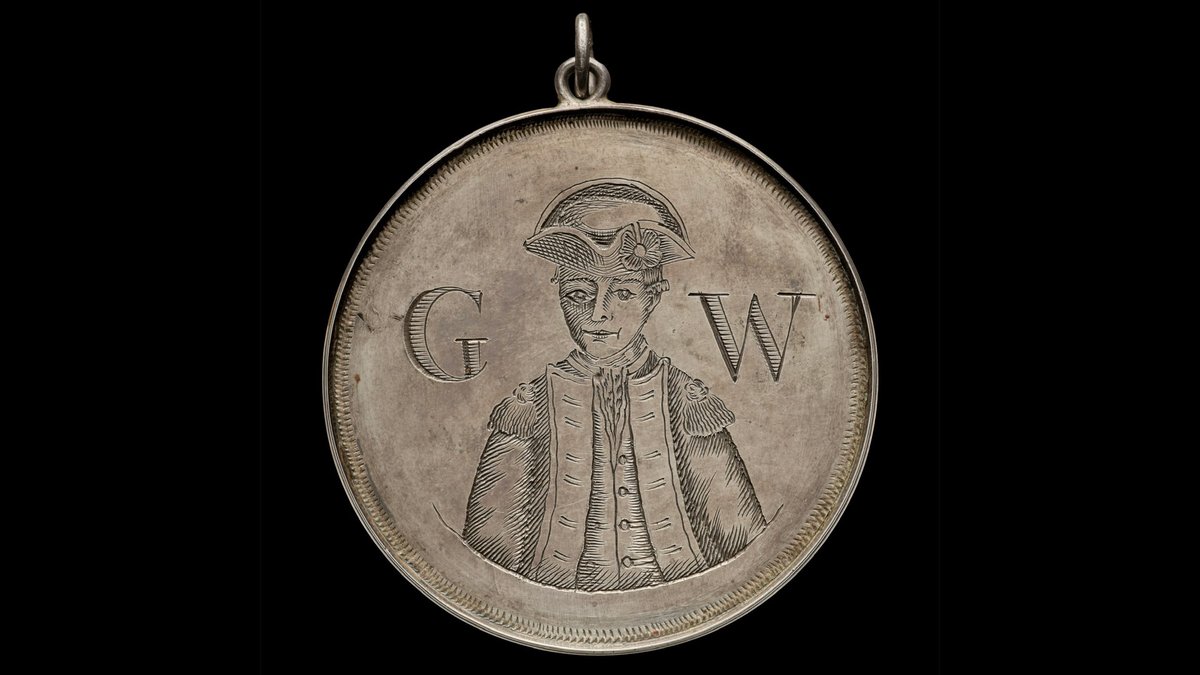
At the center of the display is a silver Washington Peace Medal, the likes of which the U.S. government presented to Indigenous leaders in the late 18th century and early 19th century as a sign of friendship, but also of American sovereignty. This one was engraved in 1777 by Paul Revere and gifted to the Wabanaki Conferderacy as part of a wartime treaty of friendship and alliance against the British.
One side depicts a boyish-looking Washington, then commander of the Continental Army, in a tricorn hat and waistcoat. The other shows a classical column surrounded by 13 hands, one for each of the colonies, with a caricature depiction of an Indigenous Person sat at its base. The medal was later confiscated by the British and given to King George III, thereby passing through the hands of all three actors in the conflict.
Alongside the Washington Peace Medal is a token of an allegiance that went in the opposite direction.
The Mohawk were among the most pro-British of the Haudenosaunee Confederacy (also known as the Iroquois Confederacy), a long-standing allegiance of six Indigenous Nations. Having fought with the British, their land was ceded to the United States following the war. A pipe tomahawk gifted to the Mohawk leader Joseph Brant by the Duke of Northumberland reflects his attempts to advocate for Mohawk land rights in Parliament in the early 1800s. Ultimately, many Mohawk fled to British-controlled Canada and were granted land along the Grand River in Ontario.
A further artifact evidences diplomatic relations between Indigenous Peoples. A wampum belt, used to record treaties and important agreements, marks the Lenape engaging in peaceful diplomacy with the Haudenosaunee Confederacy in 1712. The Lenape would later become the first Indigenous Nation to agree a formal treaty with the revolutionaries in 1778.
Beyond the artifacts, some academics argue the structure and ideals of the Haudenosaunee Confederacy served as a model for the emerging nation, with the U.S. Senate officially recognizing the influence of the Confederacy and the Great Law of Peace in 1988. “It’s an often unknown history,” Taylor said, “and a reason why we wanted to emphasize an Indigenous element to the show.”
Halfway through the display’s showing, a fourth artifact will join the trio: the Sussex Declaration, a handwritten copy of the Declaration of Independence on sheepskin parchment. Discovered a decade ago in the archives of the West Sussex Record Office in the U.K., it’s the only handwritten copy other than the original manuscript, which is housed at the National Archives in Washington, D.C. It was produced in either New York or Philadelphia sometime in the 1780s and possibly arrived in the U.K. via the Third Duke of Richmond, an active supporter of the American colonists.
Other European cultural institutions are also marking the 250th year of America’s independence. A German language version of the Declaration of Independence aimed at the 100,000 Germans living in America in the 1770s has gone on display at the German Historical Museum in Berlin as part of the exhibition “Objects. History. Stories.” In Paris, the National Archives Museum‘s “Lafayette between France and America” is exploring the role of military officer Gilbert Du Motier de Lafayette in the American Revolutionary War.
“Declaring independence: USA 250” is on view at the British Museum, Great Russell St, London, through November 29. “Lafayette between France and America” is on view at the National Archives Museum, 60 Rue des Francs Bourgeois, Paris, France, through July 14. “Objects. History. Stories.” is on view at the German Historical Museum, Unter den Linden 2, Berlin, Germany, through October 31, 2027.
Sentinel — Human
This text exhibits the nuanced structure and specific historical detail of human-authored content, focusing on complex diplomatic history rather than broad, synthetic generalizations.