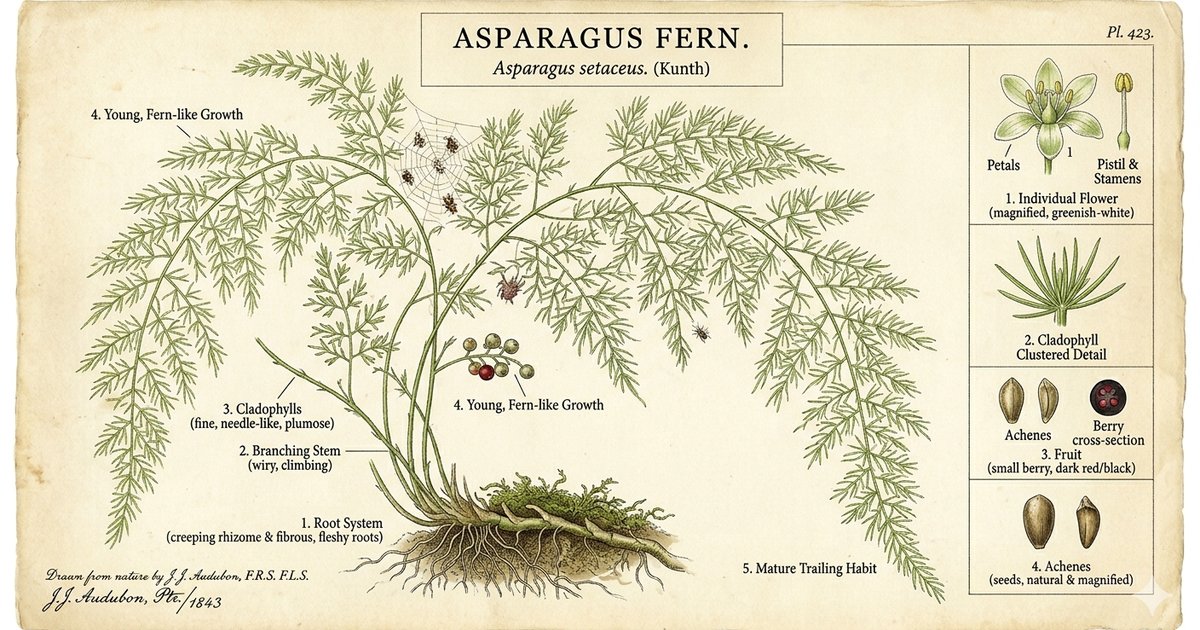
As the Fort Collins summer sun transitions from a welcoming warmth to a drying force, the texture of a high-desert garden must evolve. While broad-leafed plants compete for moisture, a subtle, highly refined architecture finds its moment. This is where Asparagus setaceus, the Asparagus Fern (also known as the Plumosa Fern), commands attention. Though not a true fern, its delicate, plumose fronds and trailing habit offer a unique aesthetic resilience, providing an essential cool contrast to the intense UV environment of Northern Colorado.
A Marvel of Mimicry and Structure
The Asparagus Fern’s visual appeal lies in its contradiction. It presents a soft, feathery appearance, composed of thousands of fine cladophylls—modified stems that perform photosynthesis, perfectly mimicking delicate fern pinnae. However, this softness is a facade for remarkable structural toughness. Its primary stems are wiry, tenacious, and semi-climbing, anchored by a vigorous, fleshy rhizome system. This robust root architecture is the secret to its endurance in Larimer County; it serves as a water reservoir, allowing the plant to maintain its intricate, emerald cascades through drying afternoon winds off the foothills and the occasional midsummer drought that leaves other ornamentals struggling.
Cultivation Strategy for the High Plains
Successfully growing the Asparagus Fern in a Fort Collins landscape involves a few critical regional adjustments to manage humidity and light:
Siting for Light, Not Scorch: Unlike many high-desert plants, A. setaceus is a master of filtered light. Placed in intense, direct high-altitude sun, its fine cladophylls can quickly scorch and turn yellow. However, in our region, it excels as an understory plant, thriving in bright, indirect light, dappled shade under established trees, or, perhaps most effectively, as a robust container specimen positioned to catch only early morning sun. This controlled exposure prevents stress while maximizing its vibrant green coloration.
Soil and Humidity Management: Drainage is paramount, given its rhizomatous nature. Our common local clay must be significantly amended with organic compost to provide the open, well-draining environment it requires. While highly drought-tolerant once established, it benefits from a protected location that reduces exposure to drying winds. We recommend deep, careful watering, prioritizing soil moisture consistency without achieving waterlogged conditions, which can lead to root issues. Container growing, especially on shaded patios or balconies, simplifies humidity management, as the plant can easily be misted during prolonged dry spells typical of our region.
Integrating Textural Depth
Designing with A. setaceus is an exercise in contrast. Its fine, complex architecture makes it a superior companion for bolder, broader-leafed sun and shade favorites alike. On a shaded porch, it pairs beautifully with the structured foliage of Hostas or the dark reds of trailing Coleus. On a sun-filtered balcony, its light, airy structure adds depth when interspersed among more rigid plants like Sansevieria. Ultimately, the Asparagus Fern proves that true garden robustness is not just about withstanding heat—it is about maintaining visual sophistication through structural intelligence, offering a cascade of cool emerald elegance that persists through the most challenging days of the Colorado summer.
Facts Only
Asparagus Fern (Asparagus setaceus)
High-desert garden in Fort Collins, Colorado
Feathery fronds mimicking fern pinnae
Wiry, tenacious stems with semi-climbing habit
Vigorous rhizome system for water storage
Drainage and humidity management required
Executive Summary
In the face of Fort Collins' summer climate transition, the resilience of Asparagus setaceus, or the Asparagus Fern, emerges as a remarkable gardening choice. This plant thrives in high-desert conditions due to its unique combination of feathery fronds and robust root system that allows it to withstand water scarcity.
To cultivate Asparagus Fern successfully, adjustments are required to manage light and humidity levels. Positioning the plant in bright, indirect light avoids scorching and optimizes its vibrant green coloration. Soil amendment with organic compost is essential for providing an open, well-draining environment, while deep watering maintains soil moisture without causing waterlogging.
Integrating Asparagus Fern into a garden provides textural depth, making it an ideal companion for a variety of other plants. On shaded porches or in filtered sunlight, it pairs well with Hostas and Coleus, while on sunny balconies, its delicate structure adds depth among Sansevieria.
Full Take
The Asparagus Fern's unexpected endurance in the high plains can be attributed to its structural design, mimicking delicate ferns while exhibiting remarkable toughness. Its light, airy structure contrasts beautifully with broader-leafed plants, offering a cooling effect in the intense UV environment of Northern Colorado.
However, understanding its resilience goes beyond just its physical attributes. By analyzing this plant through an A.R.C. lens, we can identify patterns that highlight potential manipulation in gardening media or educational content related to high-desert landscaping. For instance, the article may employ distortion techniques by exaggerating the plant's adaptability to stressful conditions for promotional purposes (ARC-0024 Ambiguity).
To cultivate an informed, independent perspective, it is crucial to consider the broader context of Asparagus Fern in high-desert gardening. This includes understanding its origins, potential challenges, and complementary plant pairings to create a balanced, visually appealing garden that can withstand the harsh summer conditions of Fort Collins.