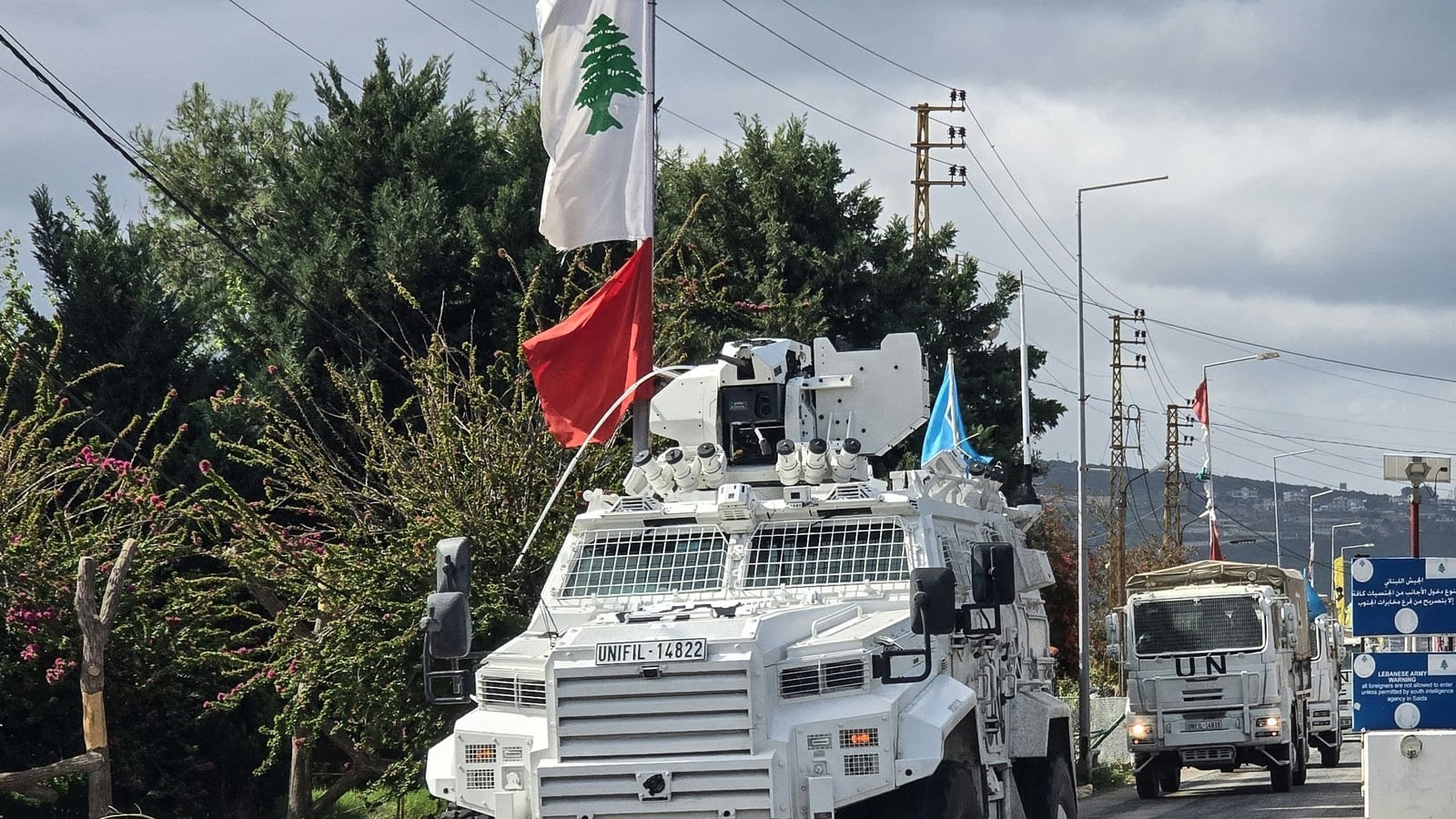
Israel's military has launched an investigation into separate incidents that killed three UN peacekeepers in southern Lebanon.
Three United Nations peacekeepers from Indonesia were killed in two separate incidents in southern Lebanon after a bloody weekend in which Lebanese journalists and medics were killed in Israeli strikes.
"The incidents are being thoroughly reviewed in order to clarify the circumstances and determine whether they resulted from Hezbollah activity or from IDF activity," the Israeli military posted on Telegram.
"It should be noted these incidents occurred in an active combat area," where it was operating against Iran-backed group Hezbollah, the post added.
"Therefore, it should not be assumed that incidents in which UNIFIL soldiers were harmed were caused by the IDF," it said, referring to the United Nations Interim Force in Lebanon (UNIFIL).
The UN peacekeeping mission in Lebanon earlier said two of its personnel were killed in an explosion and another had died late Sunday when a projectile hit their position.
Two peacekeepers were killed after an explosion from an unknown origin destroyed their vehicle near Bani Hayyan in south Lebanon, the UN peacekeeping force UNIFIL said in a statement.
Two other soldiers were wounded in the blast.
Another Indonesian soldier was killed overnight yesterday when a projectile exploded near one of the group's positions close to the southern Lebanese village of Adchital-Qusayr.
Another peacekeeper was critically injured at the time.
The death on Sunday was the first among the UN's peacekeeping force in the new war between Israel and Lebanese armed group Hezbollah which erupted on 2 March.
"These are two separate incidents and we are investigating them as two separate incidents," said UNIFIL's spokesperson Kandice Ardiel.
The UN Security Council will meet in an emergency session this morning following the killings.
The request for this meeting came from France - a permanent member of the Security Council.
Making the announcement on social media, French Foreign Minister Jean Noel Barrot said that his country condemned the attacks on UNIFIL peacekeepers in the strongest possible terms.
Yesterday, the head of UN peacekeeping Jean Pierre Lacroix told reporters at the UN in New York that UNIFIL was a Security Council mandated operation and had a "duty to stay" but said operations were constrained.
A UN source told RTÉ News that UNIFIL peacekeepers remained in position but that contingency plans - ranging from risk mitigation measures to relocation of troops - were on the table, should the situation continue to deteriorate.
In response to the first death, Indonesia's foreign ministry said on Monday the deceased peacekeeper was one of its citizens and that three others were injured by "indirect artillery fire".
Indonesia condemned the incident and said any harm to peacekeepers is unacceptable, while reiterating its condemnation" of Israel's attacks in southern Lebanon."
Israel's military said early it is aware of the reports regarding the two incidents and they are being reviewed thoroughly to determine whether they resulted from Hezbollah or the military activity.
UN Secretary-General Antonio Guterres said attacks on peacekeepers are grave violations of international humanitarian law and may amount to war crimes.
"We strongly condemn these unacceptable incidents -peacekeepers must never be a target," the UN peacekeeping chief Jean-Pierre Lacroix told reporters in a briefing.
Paramedics, journalists killed
UNIFIL is stationed in southern Lebanon to monitor hostilities along the demarcation line with Israel - an area that is at the heart of clashes between Israeli troops and Iran-backed Hezbollah fighters.
Lebanon was pulled into the war in the Middle East when Hezbollah fired rockets at Israel in solidarity with Tehran, two days after Iran was attacked by Israel and the United States.
Hezbollah's attack prompted a new Israeli ground and air offensive.
More than 1,240 people have been killed in Israeli strikes on Lebanon, according to Lebanese authorities.
They include more than 120 children, nearly 80 women and dozens of paramedics.
More than 400 Hezbollah fighters have been killed since 2 March, according to two sources familiar with Hezbollah's count.
The Israeli military issued evacuation warnings to residents of six villages in Lebanon's western Bekaa region, in the first such warning for those areas.
The military said the warning was prompted by what it described as militant activity in the area, without providing further details.
Fresh airstrikes hit several towns in southern Lebanon and at least one strike hit Beirut's southern suburbs.
The Israeli military said strikes in Beirut targeted commanders responsible for coordination between Hezbollah and Palestinian militant groups.
At least 10 paramedics were killed over the weekend in Israeli strikes, according to the Lebanese health ministry.
Three journalists were killed in an Israeli strike on their car.
The Israeli military has accused Hezbollah operatives of posing as Lebanese paramedics, and has said that some journalists it killed were part of the group's intelligence or military wing.
It has not publicly provided evidence to support those claims.
Lebanon's health ministry has denied that any ambulances or health facilities are used for military purposes.
Lebanon's presidency has said that targeted journalists are "civilians performing a professional duty. "Israel has said it intends to control a buffer zone up to the Litani River, which runs about 30 km north of the Lebanese border with Israel.
Its ground troops have been pushing into Lebanese border towns and demolishing homes in the area.
Israel's military said that a sixth soldier had been killed in fighting in southern Lebanon.
Lebanon's armed forces said that a Lebanese soldier had been killed in an Israeli airstrike. At least nine Lebanese soldiers have been killed by Israel.
Lebanon's army has not been fighting Israeli forces.
Read more:
Free public transport and four-day weeks - how nations are responding to fuel crisis
Israel passes death penalty law for Palestinians convicted of carrying out lethal attacks
Trump issues new warning to Iran over Strait of Hormuz
Facts Only
Three Indonesian UN peacekeepers killed in southern Lebanon
Two deaths caused by explosions of unknown origin
One death due to a projectile hitting a UN position
Two other peacekeepers injured in these incidents
Israeli military investigating whether incidents resulted from Hezbollah activity or their own operations
UNIFIL confirming two personnel killed and another died on late Sunday
Executive Summary
Full Take
These events highlight the complexities of the ongoing conflict between Israel and Hezbollah, with innocent lives caught in the crossfire. The investigation by Israel's military into these incidents could potentially shed light on the level of collateral damage caused during their operations against Hezbollah. Meanwhile, the UN Security Council meeting underscores international concern over the escalating violence and its impact on peacekeeping forces.
Patterns detected: ARC-0024 Ambiguity (regarding whether incidents were caused by Israeli or Hezbollah activity), ARC-0043 Motte-and-Bailey (with Israel investigating their own actions while suggesting they may not be responsible).
Root Cause: Historical tensions and proxy conflicts in the region continue to fuel violence.
Implications: The escalation of violence has led to increased casualties among civilians and peacekeepers, raising questions about accountability and the protection of innocent lives.
Bridge Questions: What role should international forces play in preventing further violence between Israel and Hezbollah? How can innocent lives be better protected during times of conflict? What long-term solutions are needed to resolve tensions in the region?
Sentinel — Human
This text appears to be written by a human journalist, exhibiting natural variations in sentence structure and lack of perfect paragraph structure. Additionally, the text includes idiosyncratic emphasis, specific attribution of quotes, and varying writing style, which are signs consistent with human authorship.