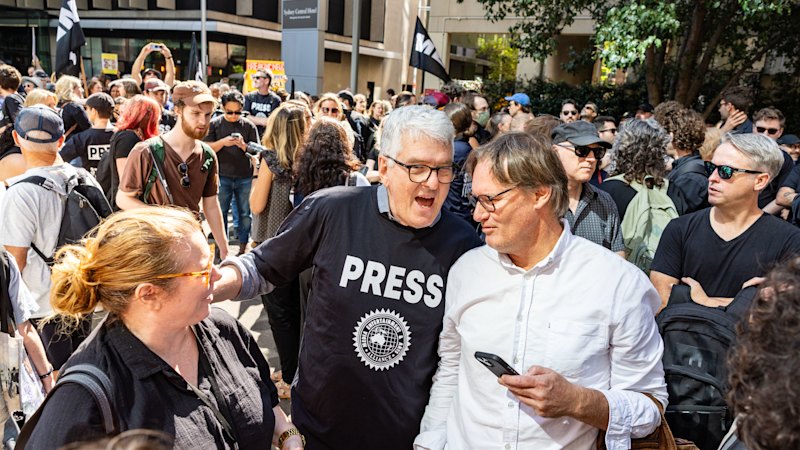
Walking off the job for a week during the May federal budget is one of a number of options the media union is canvassing ABC staff on as it considers a second strike over pay and working conditions.
ABC managing director Hugh Marks will meet with staff and representatives from the Media, Entertainment & Arts Alliance and the Community and Public Sector Union on Monday in a mediated session in hopes of breaking the stalemate that led to a landmark strike last week.
But while the nine-month process has reached a standstill and staff returned to work on Thursday, the union began asking members what future action they would be prepared to take.
Some of the options considered include a one-hour stop work during the next Reserve Bank of Australia rates decision in April, a second 24-hour walk-out to week-long walk-outs during April or during budget week in May. Action could also be limited to social media campaigns or writing to the ABC board.
Monday’s meeting will be mediated by the Fair Work Commission, after Marks last week said he was seeking the help of the industrial umpire over intractable bargaining orders. An intractable bargaining order or declaration can be made by the commission when negotiations have gone on for more than nine months, and it deems them to have hit a dead end.
But on Sunday, an ABC spokesperson backtracked on Marks’ previous comments, saying the broadcaster was not currently seeking an intractable bargaining order, and that it was looking to first seek resolution with the help of the commission on Monday.
ABC management and union representatives are yet to agree on a number of issues ranging from pay, secure contracts, automatic pay band progression and clauses protecting journalist jobs from being replaced by artificial intelligence in future years.
Many of the ABC’s more than 2000 union member staff walked out last week, shutting down many of the ABC’s services after 60 per cent of those who voted rejected Marks’ latest offer.
Following the offer, which included a 10 per cent pay rise over three years, the MEAA, which represents the majority of unionised ABC staff alongside the CPSU, reduced its own proposal to a pay rise of 4.5 per cent each year for three years.
Marks appeared on ABC Local radio on Thursday morning in the final hours of the strike, claiming that the offer on the table for staff of the public broadcaster was more than that being offered to Victorian teachers, who also walked off the job in major strike action last week.
However, the 10 per cent offer for ABC staff over three years is below the annual increase offered to the Australian Education Union of 17 per cent over four years last week, which it turned down.
Marks has since indicated his intentions to hold firm on the current 10 per cent pay offer, though he has signalled a willingness to address some of the experiences raised by junior staff.
“I know many of them do not have ideal experiences. I can’t begin to imagine some of the experiences that some of – particularly our junior and entry-level – come through in the ABC. I think in there is something we have to address,” he said on ABC radio.
Insecure contracts and the ABC’s ongoing use of fixed-term or rolling contracts have been a major focus point for both unions. Speaking to this masthead last week, Marks dismissed claims of widespread job insecurity at the ABC, saying that “more than 90 per cent of our staff are on long-term contracts”. The ABC spokesperson reaffirmed this position this week, though some sources have said this figure does not include casual staff, which could account for at least 500 employees.
The cost of increasing its current offer from 3.5 per cent to 4.5 per cent in the first year would be $7 million. Marks has said the one-time $1000 bonus paid to staff put its offer ahead of recent inflation figures of 3.8 per cent, though the unions said including the cash offer in base pay figures was not an accurate link to draw.
The ABC’s budget is $1.23 billion in the 2026 financial year. It has additional funding of about $125 million from other sources, such as content deals and grants.
The 24-hour shutdown crippled the ABC’s ability to put live broadcast content to air. Its flagship nightly television news bulletin was pulled on Wednesday, alongside national current affairs program 7.30.
Radio services were replaced by the BBC’s World Service, repeats and pre-programmed music on triple j and ABC Classic. Many of the 53 Local Radio stations broadcast a national, extended breakfast show on Thursday, hosted by Sydney station manager Nick Lowther and former AM presenter Sabra Lane.
The Business Briefing newsletter delivers major stories, exclusive coverage and expert opinion. Sign up to get it every weekday morning.
Facts Only
ABC staff and unions are considering a seven-day strike during the May federal budget over pay and working conditions.
ABC managing director Hugh Marks will meet with staff and union representatives on Monday in a Fair Work Commission-mediated session.
The Media, Entertainment & Arts Alliance (MEAA) and the Community and Public Sector Union (CPSU) represent ABC staff in negotiations.
ABC staff rejected a 10% pay rise over three years, with 60% of voting union members opposing the offer.
The MEAA reduced its pay demand to 4.5% annually for three years, down from previous demands.
ABC management claims over 90% of staff are on long-term contracts, though this excludes casual staff, estimated at 500 employees.
A 24-hour strike last week disrupted ABC services, including the cancellation of flagship news programs and replacement of radio content with pre-recorded or external programming.
The cost of increasing the pay offer from 3.5% to 4.5% in the first year would be $7 million.
The ABC’s budget for the 2026 financial year is $1.23 billion, with additional funding of $125 million from other sources.
Hugh Marks has indicated willingness to address concerns raised by junior staff but remains firm on the 10% pay offer.
The ABC spokesperson clarified that the broadcaster is not currently seeking an intractable bargaining order from the Fair Work Commission.
Negotiations have been ongoing for nine months, with disputes over pay, job security, AI protections, and contract stability.
Executive Summary
ABC staff and unions are escalating industrial action over stalled pay negotiations, with a potential seven-day strike during the May federal budget among the options being considered. The dispute centers on a 10% pay rise over three years offered by ABC management, which was rejected by 60% of voting union members. The Media, Entertainment & Arts Alliance (MEAA) has since lowered its demand to 4.5% annually for three years. A Fair Work Commission-mediated meeting is scheduled for Monday to break the deadlock, though ABC managing director Hugh Marks has signaled he will not increase the pay offer beyond 10%.
The strike last week disrupted ABC services, including the cancellation of key news programs and the replacement of radio content with pre-recorded or external broadcasts. Beyond pay, unions are pushing for job security, protections against AI replacement, and stable contracts, with ABC management claiming over 90% of staff are on long-term contracts—a figure that excludes casual workers. The cost of meeting the union’s revised pay demand would be $7 million in the first year. While Marks has acknowledged concerns from junior staff, the broader dispute reflects deeper tensions over working conditions and the ABC’s financial constraints amid a $1.23 billion budget.
Full Take
The strongest version of this narrative frames the ABC dispute as a clash between management’s fiscal constraints and staff demands for fair compensation and job security. The unions’ willingness to reduce their pay demand suggests a pragmatic effort to find middle ground, while management’s insistence on a 10% offer—despite last week’s disruptive strike—highlights the rigidity of institutional bargaining. The article presents both sides’ positions clearly, though the ABC’s claim that 90% of staff are on long-term contracts omits casual workers, a potential oversight or strategic framing.
Patterns detected: **ARC-0024 Ambiguity** (omission of casual staff in contract security claims), **ARC-0043 Motte-and-Bailey** (ABC’s shifting stance on seeking an intractable bargaining order).
Root cause: The dispute echoes broader tensions in public sector funding, where fixed budgets collide with rising living costs and workforce expectations. The ABC’s reliance on government funding limits its flexibility, while unions leverage industrial action to pressure management. The underlying assumption is that public broadcasters must balance fiscal responsibility with workforce stability—a tension exacerbated by inflation and AI-driven job insecurity.
Implications: If unresolved, prolonged strikes could erode public trust in the ABC’s reliability, while management’s firm stance risks demoralizing staff. The second-order consequence may be a precedent for other public sector disputes, where unions test the limits of industrial action in tight fiscal environments.
Bridge questions: How might the ABC’s funding model be reformed to better align with workforce needs? What role should AI protections play in modern media contracts? Would a compromise on non-pay issues (e.g., contract stability) break the deadlock?
Counterstrike scan: A coordinated influence campaign would amplify divisions by framing the ABC as "wasteful" or unions as "unreasonable," using selective data (e.g., omitting casual staff numbers) to skew perceptions. This article does not match that pattern, as it presents both sides’ arguments and context without overt manipulation.
Sentinel — Human
The article appears to be written by a human journalist, showing signs of variable sentence length variance, presence of idiosyncratic emphasis, personal voice, and no strong indicators of argumentative skeleton matching known template patterns.