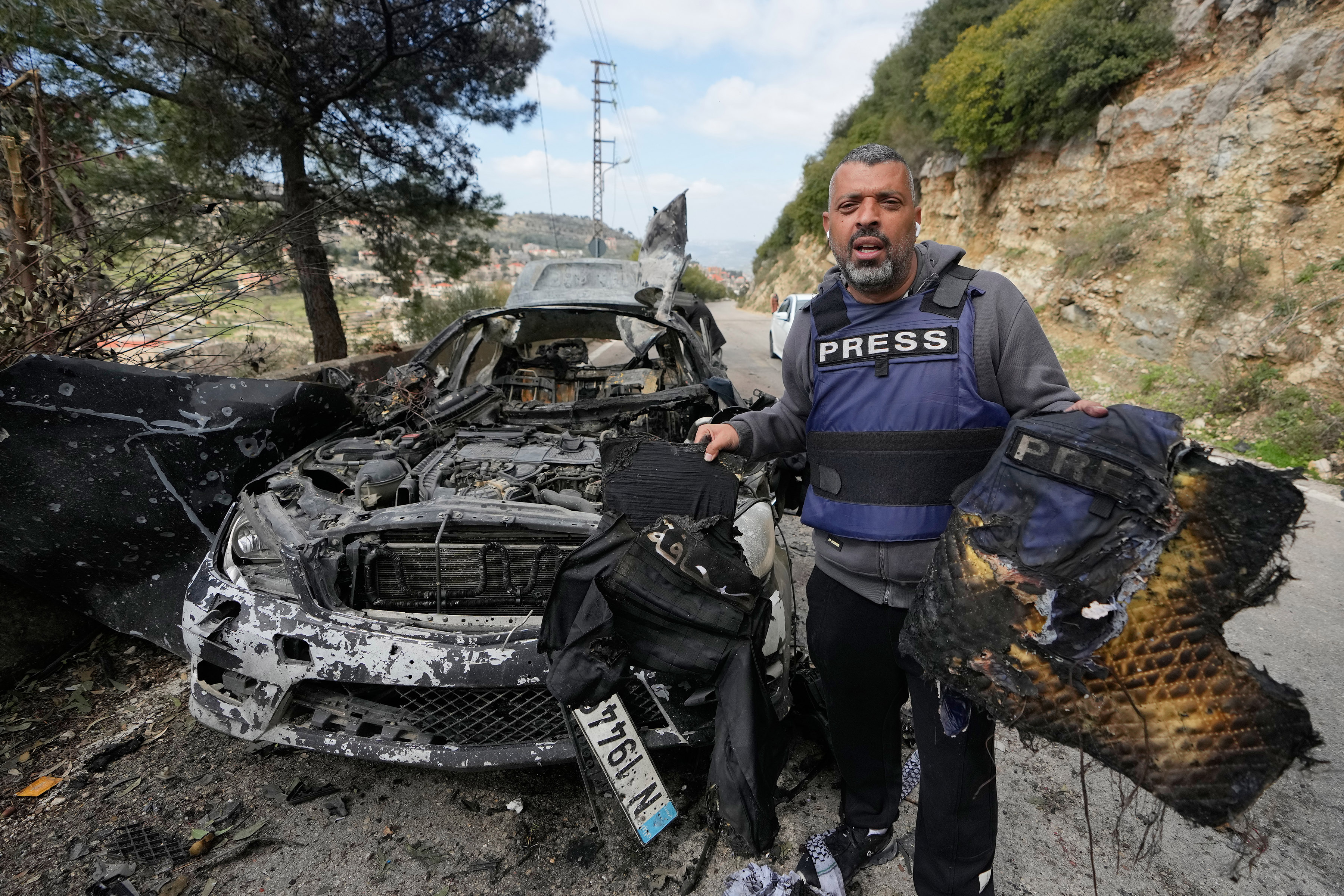
Amman, March 28, 2026––On Saturday, an Israeli strike targeted a media car on Jezzine highway in southern Lebanon on Saturday, killing journalist Ali Shoaib of Hezbollah-affiliated Al-Manar TV, journalist Fatima Ftouni of pro-Hezbollah Al-Mayadeen TV, and her brother, freelance photojournalist Mohamad Ftouni.
According to Al-Mayadeen TV, the Lebanese journalists were reportedly en route to cover an assignment at the time of the attack. Israel Defence Forces (IDF) Situation Room confirmed to CPJ it carried out the strike, saying that Shoaib (whom it referred to as Ali Hassan Shaib) was a member of Hezbollah’s Radwan Force.
The military told CPJ that Shoaib had been using his journalism as a cover while conducting intelligence-gathering activities and maintaining contact with Hezbollah fighters, but it did not provide evidence to support these claims. In a post on X, Israeli military spokesperson Avichay Adraee accused Shoaib of being a Hezbollah intelligence-gatherer.
CPJ emailed the IDF later that day requesting further information regarding the targeting and killing of all three journalists, including asking for evidence supporting the allegation that Shoaib was a combatant, and received a reply that the incident is being further investigated.
“CPJ is investigating this latest attack on journalists in Lebanon which has been an increasingly deadly zone for journalists, despite their status as civilians who must not be targeted,” said CPJ Regional Director Sara Qudah. “We have seen a disturbing pattern in this war and in the decades prior of Israel accusing journalists of being active combatants and terrorists without providing credible evidence. Journalists are not legitimate targets, regardless of the outlet they work for.”
Lebanon’s president Joseph Aoun and the Lebanese Minister of Information Paul Morcos denounced the killing of the journalists, with president Aoun calling the attack “a blatant crime that violates all the norms and treaties under which journalists enjoy international protection in wars.”
CPJ has documented the killing of at least four other journalists across the Middle East since the outbreak of the Iran war in late February. The targeting of the three journalists comes two days after the killing of the photojournalist Hussain Hamood, and 9 days after the killing of journalist Mohammed Sherri, who also worked for Al-Manar TV, in an Israeli strike in central Beirut. This latest attack brings the total number of press members killed in Lebanon since the Israel-Gaza war began to 11.
Facts Only
On March 28, 2026, an Israeli strike hit a media car on Jezzine highway in southern Lebanon.
The strike killed journalist Ali Shoaib of Al-Manar TV, journalist Fatima Ftouni of Al-Mayadeen TV, and her brother, freelance photojournalist Mohamad Ftouni.
The journalists were en route to cover an assignment at the time of the attack.
The Israel Defence Forces (IDF) confirmed carrying out the strike.
The IDF referred to Ali Shoaib as Ali Hassan Shaib and claimed he was a member of Hezbollah’s Radwan Force.
The IDF alleged Shoaib used journalism as cover for intelligence-gathering and contact with Hezbollah fighters but provided no evidence.
Israeli military spokesperson Avichay Adraee accused Shoaib of being a Hezbollah intelligence-gatherer in a post on X.
CPJ requested further information from the IDF, including evidence supporting the combatant allegation, and was told the incident is under investigation.
Lebanese President Joseph Aoun and Information Minister Paul Morcos condemned the killings.
President Aoun called the attack a "blatant crime" violating international protections for journalists.
CPJ has documented the killing of at least four other journalists in the Middle East since late February 2026.
The strike occurred two days after the killing of photojournalist Hussain Hamood and nine days after the killing of Al-Manar TV journalist Mohammed Sherri in Beirut.
The total number of journalists killed in Lebanon since the Israel-Gaza war began is now 11.
Executive Summary
Full Take
The strongest version of this narrative highlights a clear and documented pattern: journalists in conflict zones are being targeted, with accusations of combatant status often made without verifiable evidence. The IDF’s admission of the strike, coupled with its unproven claims about Shoaib’s alleged Hezbollah ties, underscores a recurring dynamic where military forces justify attacks on media personnel by labeling them as legitimate targets. The CPJ’s response rightly frames this as part of a broader, decades-long trend where journalists—regardless of their affiliations—are deprived of civilian protections. The Lebanese government’s condemnation reinforces the principle that press freedom is non-negotiable, even in war.
Patterns detected: **ARC-0024 Ambiguity** (unsubstantiated claims of combatant status), **ARC-0043 Motte-and-Bailey** (shifting between "journalist" and "combatant" labels without evidence), **ARC-0011 False Equivalence** (implied justification of targeting based on affiliation rather than actionable intelligence).
The root cause here is the erosion of the distinction between civilian and combatant in asymmetric warfare, where media outlets affiliated with armed groups are treated as extensions of those groups. This paradigm assumes guilt by association, ignoring the fact that journalism—even when critical or aligned with a faction—remains a civilian profession under international law. The historical echo is clear: from the targeting of Al Jazeera journalists in past conflicts to the systematic silencing of dissenting voices, this reflects a broader strategy of controlling narratives by eliminating the messengers.
The implications for human agency are dire. When journalists are killed with impunity, the cost is borne by societies deprived of independent reporting, while the beneficiaries are those who seek to dominate information spaces. Second-order consequences include the chilling effect on press freedom, where journalists self-censor or avoid conflict zones entirely, leaving gaps in accountability.
Bridge questions: What mechanisms could verify claims of dual roles (journalist/combatant) without relying on unilateral military assertions? How might international law adapt to protect journalists in an era where affiliation is weaponized? What would it take for military forces to treat media personnel as inviolable, regardless of their employer’s political stance?
Counterstrike scan: A coordinated influence campaign would exploit this incident to polarize audiences—either by amplifying the "journalists as combatants" narrative to justify military actions or by framing it as unprovoked aggression to rally anti-Israel sentiment. The actual content does not fully align with this pattern, as it presents multiple perspectives (IDF claims, CPJ critique, Lebanese condemnation) without overt manipulation. However, the lack of evidence for the IDF’s allegations leaves room for bad actors to exploit ambiguity.