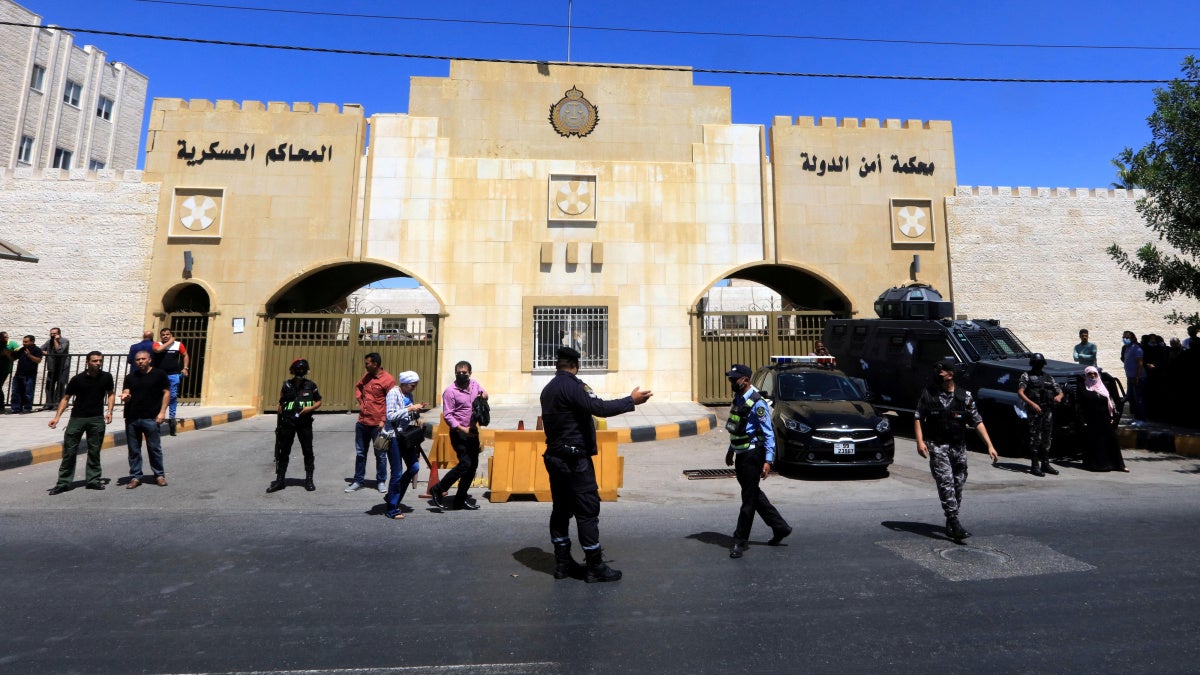
(Amman) – Jordanian authorities executed six men by hanging on June 21, 2026, its first mass execution since 2017, Human Rights Watch said today. All six cases, two involving terrorism-related charges and three involving drug trafficking, included acts of violence in which members of the police or security forces were killed.
All six men were convicted following trials in Jordan’s State Security Court, a military institution that includes military and civilian judges. Mohammad al-Momani, Jordan’s communications minister, said the executions were carried out after the sentences received final judicial confirmation through the Court of Cassation, Cabinet endorsement, and royal decree.
“Carrying out six executions in a single morning marks a sharp return to a practice Jordan has used only sporadically since reinstating capital punishment 12 years ago,” said Adam Coogle, deputy Middle East director at Human Rights Watch. “Jordan should lead the region by example on rights and protection and renew its moratorium on the death penalty.”
Two of those executed, identified by authorities as Mahmoud Nayef Musa and Anwar Adel Saleh, were convicted in connection with the so-called “Salt Cell” case. The government said that they were members of a cell that detonated a bomb near a joint security patrol close to an annual festival in the town of Fuheis, west of Amman, on August 10, 2018, killing two members of the gendarmerie forces and wounding six others. The next day, during follow-up operations to detain the bombing suspects in the nearby town of al-Salt, four additional security personnel were killed.
A third man, Ibrahim Mansour, was executed for his role in a December 2022 ambush on a police patrol in the southern town of Maan that killed Colonel Abdulrazzaq al-Dalabeeh, then-deputy director of the Maan Police Directorate.
The remaining three men executed were also tried before the State Security Court, in cases that al-Momani said involved the killing of law enforcement officers during anti-narcotics operations.
The State Security Court’s jurisdiction includes drug offenses alongside terrorism, treason, and espionage cases.
Jordan reinstated the death penalty in December 2014 after an eight-year unofficial moratorium, hanging 11 people convicted of murder. In March 2017, it executed 15 men, 10 of whom had been convicted by the State Security Court on terrorism-related charges.
Jordan’s National Center for Human Rights (NCHR), the country’s official human rights institution, said in its 2025 annual report that 284 people (264 men and 20 women) were under death sentences in 2023, and 276 (254 men and 22 women) in 2024. The center said in its report that new death sentences issued by the Grand Criminal Court fell from 25 in 2023 to 13 in 2024, and that the State Security Court issued no new death sentences from 2022 through 2024.
However, a 2023 Jordan Times report said that the State Security Court had sentenced three Salt Cell members to death on February 22, 2023.
Human Rights Watch opposes the creation and use of special courts to try national security crimes, because such courts are frequently authorized by law to conduct trials in a manner that restricts the rights of defendants beyond what is permissible under international human rights law. In many countries, regular criminal courts have proven effective in prosecuting terrorism offenses in accordance with international due process standards. Jordan should restrict its security court’s jurisdiction over civilians as a step toward abolishing the court, Human Rights Watch said.
Human Rights Watch opposes capital punishment in all countries and under all circumstances. Capital punishment is unique in its cruelty and finality and is inevitably and universally plagued with arbitrariness, prejudice, and error. Most countries in the world have abolished the practice. In 2012, the United Nations General Assembly called on countries to establish a moratorium on the use of the death penalty, progressively restrict the practice, and reduce the offenses for which it might be imposed, with the view toward its eventual abolition.
“No one disputes that the police and security forces killed in these attacks deserved justice and their families deserved accountability, but the death penalty is an inherently cruel and irreversible punishment,” Coogle said.
Facts Only
Jordan executed six men by hanging on June 21, 2026.
The executions were the first mass execution in Jordan since 2017.
Two cases involved terrorism-related charges, and three involved drug trafficking.
All six men were convicted in Jordan’s State Security Court, which includes military and civilian judges.
The executions followed final judicial confirmation, Cabinet endorsement, and a royal decree.
Mahmoud Nayef Musa and Anwar Adel Saleh were convicted for their roles in the 2018 "Salt Cell" bombing, which killed two gendarmerie officers.
Ibrahim Mansour was executed for a 2022 ambush on a police patrol in Maan, killing Colonel Abdulrazzaq al-Dalabeeh.
The remaining three men were convicted for killing law enforcement officers during anti-narcotics operations.
Jordan reinstated the death penalty in December 2014 after an eight-year moratorium.
In 2017, Jordan executed 15 men, 10 of whom were convicted by the State Security Court on terrorism charges.
The National Center for Human Rights reported 284 people under death sentences in 2023 and 276 in 2024.
The State Security Court issued no new death sentences from 2022 through 2024, except for three in February 2023 related to the Salt Cell case.
Executive Summary
Full Take
The executions in Jordan reflect a broader tension between state security imperatives and human rights principles. The use of the State Security Court, a hybrid military-civilian institution, raises concerns about due process, as such courts often operate with fewer safeguards than regular criminal courts. The focus on terrorism and drug-related offenses—particularly those involving violence against security forces—suggests a prioritization of deterrence and retribution over rehabilitation or systemic justice. The UN’s call for a moratorium on the death penalty underscores global trends toward abolition, framing Jordan’s actions as a regression rather than progress.
The narrative presented by Human Rights Watch is principled but not without its own framing. While it rightly highlights the arbitrariness and finality of capital punishment, it does not engage with the perspective of those who argue that the death penalty serves as a necessary deterrent for violent crimes against the state. The absence of voices from Jordanian officials justifying the executions beyond procedural legitimacy leaves a gap in understanding the government’s rationale. This could be a missed opportunity to steelman the opposing view—that in contexts of persistent security threats, harsh penalties may be seen as a tool of last resort.
Patterns detected: none
Root cause: The paradigm here is the clash between sovereign security needs and universal human rights norms. The unstated assumption is that state violence (via executions) can be justified if it responds to violence against the state, even if it contradicts broader humanitarian principles. Historically, this echoes cycles of retributive justice in post-conflict or high-threat environments, where governments prioritize stability over rights-based reforms.
Implications: For human agency, the reinstatement of executions signals a contraction of legal protections, particularly for those accused of crimes against the state. The beneficiaries are likely state institutions seeking to project strength, while the costs are borne by defendants and their families, as well as civil society groups advocating for abolition. Second-order consequences may include chilling effects on dissent or a normalization of exceptional legal measures.
Bridge questions: What evidence exists that the death penalty effectively deters terrorism or drug-related violence in Jordan? How might the State Security Court’s jurisdiction be reformed to align with international due process standards without compromising security? What alternative justice mechanisms could address the grievances of victims’ families while avoiding irreversible punishments?
Counterstrike scan: If this were part of a coordinated influence campaign, the playbook might involve amplifying the executions to portray Jordan as a "tough on crime" state while downplaying human rights critiques. However, the content does not match this pattern, as it presents a balanced critique without overt manipulation. The focus remains on factual reporting and principled opposition to capital punishment.
Sentinel — Human
This is a grounded journalistic account that effectively synthesizes specific event data with contextual commentary on international human rights concerns regarding the use of capital punishment and security courts.