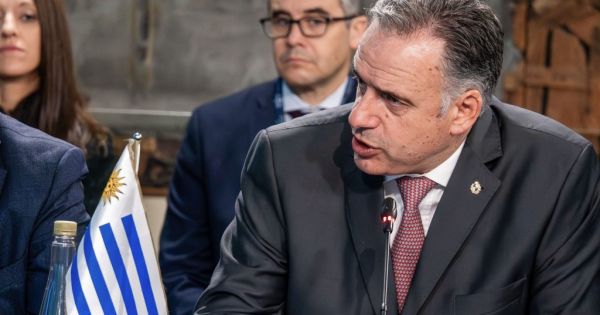
Uruguay's President Yamandú Orsi on Tuesday assumed the pro tempore presidency of Mercosur and set as a priority of his term to “keep modernizing” the bloc and consolidate its trade opening, following the provisional entry into force of the agreement with the European Union. “We want a more modern, more dynamic Mercosur, more open to the world, but above all a Mercosur that produces concrete results for its citizens,” he said as he received the rotating presidency from host Santiago Peña of Paraguay, at the 68th summit of heads of state held in Luque.
Orsi described the closing semester as “historic” for the signing of the pact with the EU, which he called a “turning point” for economic integration and investment, and held that it has sparked “renewed interest” from other countries and blocs in Mercosur. Along those lines, he said that during the Uruguayan tenure “special emphasis” would be placed on implementing the European agreement and on ties with the European Free Trade Association. At the next summit, scheduled for December, the first Council of the Interim Trade Agreement and the first business forum between the two blocs will be held.
The president said Uruguay would work to conclude trade negotiations with Canada and the United Arab Emirates, and to advance talks with India, Vietnam and Japan, with which the bloc announced the start of negotiations this week. “The challenges of this time demand more cooperation, not less; more dialogue, not less; more integration, not less,” he argued, defending that seeking agreements “is not giving up convictions.”
Alongside the external agenda, Orsi focused on border integration, an aspect of direct interest to the bloc's countries. He announced that efforts would be made to modernize integrated control areas to ease the transit of goods and people, and to apply the agreement on linked border localities. “Borders are not a limit; they are places where millions of people live, work, study and start businesses every day,” he said.
On security, the Uruguayan president said his country would seek to strengthen regional coordination against transnational organized crime, through greater integration of the bloc's security information exchange system and new cooperation mechanisms between police forces, especially in border areas. He also mentioned the application of regional agreements on protection for women facing gender-based violence and the fight against human trafficking, as well as educational initiatives focused on artificial intelligence. At the start of his remarks, Orsi expressed Uruguay's solidarity with Venezuela over last week's earthquakes and with Bolivia, and congratulated Peru and Colombia on their recent elections, held, he said, “in a framework of peace, transparency and respect for democratic institutions.”
Top Comments
Disclaimer & comment rulesNo comments for this story
Please log in or register (it’s free!) to comment. Login with Facebook
Sentinel — Human
The article reads like standard geopolitical news reporting, effectively conveying facts and official statements without exhibiting typical markers of machine generation.