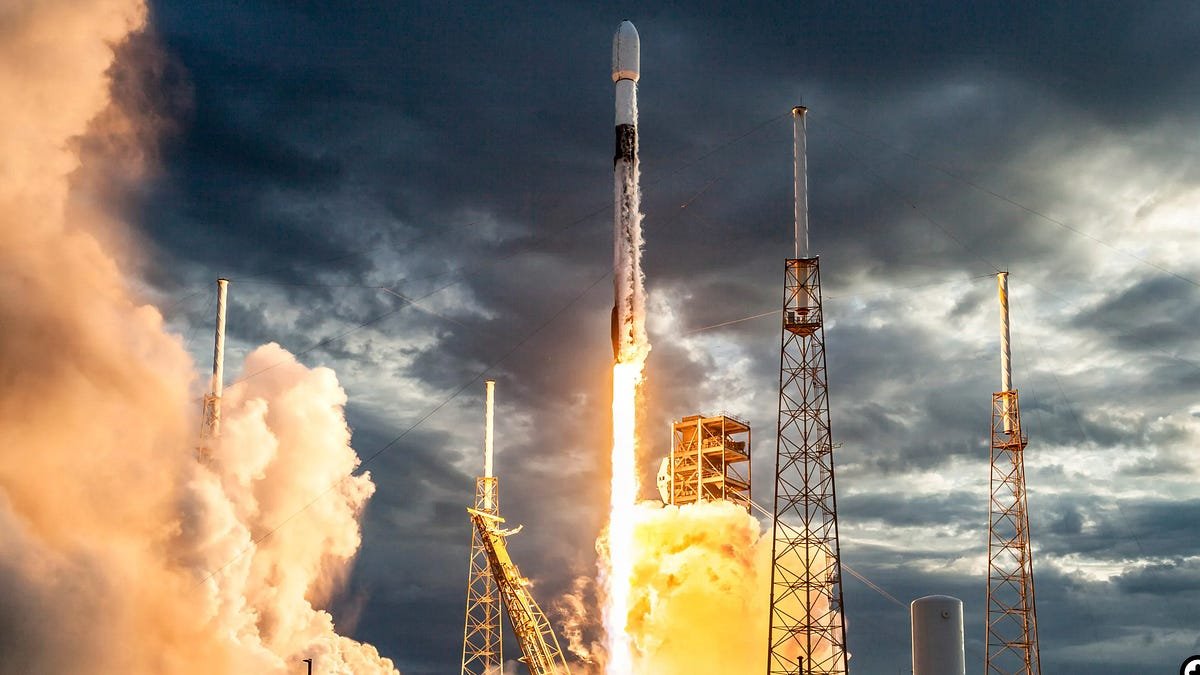
Why not? It's a telecom company with a marketing department that launches (& catches) rockets...
What telecom company has the most unusual and expensive marketing department? SpaceX, of course! Or should I call it StarLinkX? Its marketing department is an order of magnitude better and more impressive than other telecom companies’ marketing departments. On that we can agree. But launching rockets is several orders of magnitude more expensive than just making commercials…
There are, I think, moments when a spur-of-the-momewnt line on a podcast crystallizes a whole industrial strategy better than a dozen white papers and a shelf of McKinsey decks.
This is one of those moment: SpaceX is like, it’s Starlink, and then it’s a really expensive marketing department that launches rockets. It’s like functionally how that business works.
That is a small, sharp work of analytic genius. It is, as far as I can see, completely true and yet oddly original: true, because it captures the underlying economics; original, because almost nobody wants to look past the landing rockets.
The spectacle hypnotizes: The Falcon 9 descends from the heavens, flips, and perches on its barge like a smug, metallic pigeon; the crowds cheer; the slow-motion replay circulates on X; the myth of the heroic techno-entrepreneur is renewed for another news cycle.
But the underlying Mr. Money is the StarLink broadband service. A capital-intensive, regulated, margin-squeezed, utterly prosaic provider of bits from orbit to ground. Pipes with satellites instead of trenches. And as the podcasters David Pierce and Nilay Patel note, telecom in general is not—by the standards of modern capitalism—the road to world-historical rents. Telecom, after all, is the classic case of an industry that is structurally important but not, on the whole, fabulously profitable. You spend huge sums upfront on fixed capital, you are constrained by regulators and by the brute physics of spectrum or orbital slots, you fight price wars and bundle wars and churn.
And then, if you are very good and moderately lucky, you make a solid but unspectacular return on capital. T‑Mobile, not Nvidia. The economics of rockets do not change that. They only give you a more photogenic depreciation schedule.
This is why we have the story of SpaceX showing investors its not-phone AI device. If you are, in truth, a telecom firm, there are only so many knobs you can turn to goose growth. One obvious move is vertical integration down into the end-user device: building a phone to capture not just the monthly broadband fee, but also:
the handset margin,
the app store rake,
the payments float,
the everything-app dream.
You want to be Apple plus Verizon plus WeChat, riding on top of StarLink. But to say that you are building a phone would break the magic: hence you have to claim that you are building a not-phone. Yet everything that would make your device a not-phone is also something that makes your device unambiguously worse than a phone, wouldn’t it?
<https://www.theverge.com/subscribe> <https://www.theverge.com/the-vergecast>
CROSSPOST: David Pierce & Nilay Patel: SpaceX Is Building a Phone!
<https://www.theverge.com/podcast/960810/video-game-disc-dead-vergecast>
David Pierce: I’m just going to read you a Wall Street Journal <https://www.wsj.com/tech/ai/spacex-showed-investors-prototype-of-elon-musks-new-ai-device-b445c57b> story that just dropped a few minutes ago: ‘Elon Musk, SpaceX, has developed a prototype for a handset-like device, designed to reshape how humans interact with artificial intelligence, that SpaceX has shown investors recently. The Rrcket and AI company showed the prototype, which features a sleek design that is slimmer than an iPhone, to some investors and other stakeholders ahead of the company’s mega IPO, according to people familiar with the matter.
Nilay Patel: SpaceX is building a phone.
David Pierce: Sure.
Nilay Patel: We’re doing AI phones.
David Pierce: Sure.
Nilay Patel: Okay.
David Pierce: The funniest part about this to me. I just want you to imagine a phone in which X is presumably a crucial part of the operating system. Grok is how you interact with everything. And presumably Starlink is how you get service.
Nilay Patel: This is the all-time worst idea about cell phones that I’ve ever heard. I love it so much. I think it’s very funny that there are rumors that SpaceX will buy T-Mobile.
David Pierce: I was going to ask you about this. I genuinely want to know what you think about this. And there’s another rumor, you know, Comcast is splitting itself into two that eventually the Comcast broadband business will be acquired by SpaceX as well.
Nilay Patel: They’re a telecom firm. At some point, we’re all just going to have to admit. They’re a telecom firm. At some point, we’re all just going to have to admit that SpaceX is a telecom firm with worse margins than T-Mobile.
David Pierce: Yeah.
Nilay Patel: TRight?
David Pierce: They have way higher costs, and they have to deliver competitive broadband prices. So you inherently have worse margins than T-Mobile.
Nilay Patel: I mean, SpaceX is like, it’s Starlink, and then it’s a really expensive marketing department that launches rockets. It’s like functionally how that business works.
David Pierce: It is, and it’s funny because Starlink is profitable in space, but they have to pay the launch costs to the other part of the company.
Nilay Patel: And like, it’s great that the rocket, every time you talk about SpaceX, you have to concede. It is very cool that the rockets land themselves. Absolutely. No one thought anyone could do it. Gwen Shottwell has been a great job running that company. And obviously, Elon Musk can just overpower the laws of physics through nothing but charisma and racism or whatever combination of traits that he has. Great. The reality of that business is that it’s a telecom provider. At the end of the day, that it is a broadband company. And we know the economics of broadband companies extraordinarily well. And for as uncompetitive as that market is, it’s not like the most lucrative market in the history of the world.
David Pierce: I also think it’s funny that they’re going to make a phone. Like, you’re going to have a Starlink phone that has AI in it.
Nilay Patel: You have to: this is the same bet we were talking about earlier. You’re going to rethink all of computers. You’re going to just going to talk to AI and it’s going to do stuff for you.
David Pierce: Are you going to have an Instagram app? Is it going to run TikTok? People like doing things on their phones. Is it going to have Candy Crush? Like, will it support Outlook? Like, I can just go down the list of things. X is the Everything app?
Nilay Patel: I don’t know if you know this. Sure phones can do. You don’t need anything else. You just run into some pretty obvious problems right away.
David Pierce: There’s xMoney now.
Nilay Patel: That’s true.
David Pierce: It’s not just one bank account. It’s a sweep across many bank accounts in order to...
Nilay Patel: It’s very good.
David Pierce: t’s like, oh, we’re doing financial engineering now as well.
Nilay Patel: I love this.
David Pierce: I’m very happy about it.
Nilay Patel: Yeah, it’s, it’s the whole thing. It’s just deeply, deeply silly.
David Pierce: By the way, it’s the same idea that Sam Altman has. To build a phone.
Nilay Patel: Yeah. Like, there’s no point in making this a Starlink phone. Most people are around places with cell service. The idea is that you will make a device that replaces your phone and you just talk to an AI model and the AI model runs around doing stuff for you.
David Pierce: And it’s like, that’s really hard. Yeah. No one has pulled it off yet.
Nilay Patel: And there’s no true application model for AI yet in that way.
David Pierce: Right. It’s worth saying, by the way, that Elon Musk has denied for a very long time that SpaceX is building a phone.
Nilay Patel: This rumor has been floating around for a long time. It also just makes a lot of sense, right?
David Pierce: Like, even for Starlink in particular, having a sort of Halo device kind of tracks.
Nilay Patel: He also has called it utterly false: a statement to which I put almost no stock.
David Pierce: But that’s what he said.
Nilay Patel: I think there’s going to be a very funny turn that a lot of these folks have to make where they’re going to have to convince you that the phone that they made isn’t a phone. Do you know what I mean?
David Pierce: Like, there is, there are a bunch of reasons that we have cataloged extensively on this show that the thing you should make is a phone, but you can’t because Google and Apple own that.
Nilay Patel: And there’s no winning that game anymore unless you are Google and Apple. So you have to build something else.
David Pierce: But if you like make the stack of things that people want, you end up making a phone. And this is the incredible challenge with all hardware right now. The only way to win is to build a phone that somehow isn’t in Google or Apple’s orbit, and that’s very hard to do.
Nilay Patel: And so what we’re going to see with all of these devices is them try very, very hard to explain to you why this isn’t a phone while shipping you a thing that looks and feels like a worse phone.
David Pierce: And all of it’s going to be input. All of it’s going to be, you just talk to it.
Nilay Patel: Yeah. I think it’s going to be fascinating.
David Pierce: And in a way, like these open AI headphones that keep floating around, like you can sort of understand why they would do that and what the case is there for, right? It’s like easy interaction with your AI assistant.
Nilay Patel: Like, great, well and good. the thing with a six-inch screen that goes in your pocket is a very different kind of game to play next to somebody’s phone.
David Pierce: But if you run a telecom provider and you want that fee on top of your Starlink broadband fee, you almost have to make a phone.
Nilay Patel: Yeah, absolutely. And it is certainly true that a phone made by SpaceX and Starlink and Elon Musk will sell. Like that thing will do numbers, whatever that thing is. It will. You shake your head of me all you want. It will sell. People will buy it. Whether it’s good or not.
David Pierce: How expensive will that thing be? And it will not have Instagram.
Nilay Patel: There’s this Wall Street Journal piece. So, well, I mean, who knows? The prototype was designed to run a proprietary operating system and integrate AI technology from SpaceX’s zAI, some of the people running a a Snapdragon chipset.
David Pierce: It’s a phone that Groks. It’s a Grok phone.
Nilay Patel: Cool. It’s going to run, it’s not going to run Android, right? That’s a proprietary operating system. It feels like a fork of Android.
David Pierce: Yeah. Now, you don’t have Instagram. And I’m keying on Instagram, but just think of any, any edge case app for any human being that’s on their iPhone. I think for most people, it’s Instagram. I think a phone without Instagram almost as a non-starter for like 90% of people.
Nilay Patel: Oh, yeah. And I think you make that list 10 apps long and you’ve captured everybody.
David Pierce: Like right it’s not super hard, but I do think the galaxy brain thesis of all of this puts together the idea of X being an everything app—look at what like WeChat is in China, where essentially that becomes the most important thing.
Nilay Patel: You could essentially build a phone that only ran WeChat and it would work.
David Pierce: Elon Musk could talk himself into: all we need is Grok and X and we can solve everything ,because X is the Everything app and Grok is this agent that accomplishes everything on your behalf. And that’s all we need.
Nilay Patel: It is utterly divorced from reality, but you can see why he might be very excited about the idea.
David Pierce: Right. You don’t need a bank app because you use X, the everything app for your bank.
Nilay Patel: Yes, exactly.
David Pierce: This is nonsense.
Nilay Patel: Is it going to run Outlook?
David Pierce: Do you know what most people need at work? They need Outlook.
Nilay Patel: It’s like I can ask you the dumbest questions. How many times have we covered a new phone platform? Yeah, it’s true.
David Pierce: Is it going to support RCS?
Nilay Patel: I mean, that’s a good one.
David Pierce: Yeah. No, I agree.
Nilay Patel: What version of Bluetooth does it run? I can do this to you all day long.
David Pierce: Yeah. Listen, I wanted the Trump phone to be real, and it kind of is, is.
Nilay Patel: Ish. It’s like real-ish.
David Pierce: No, I’m told that our review units have shipped.
Nilay Patel: Yeah, that’s still real-ish. Sure.
David Pierce: I’m sure there are some Trump phones. But at least the Trump phone runs Android.
Nilay Patel: Like, I know that that phone has gone through Play Store review. It does have Instagram.
David Pierce: Yeah. I first knew that the Trump phone was closer to real when, like, Google people told me it had gone through Play Store review.
Nilay Patel: Very true. Because, you know what that means? It has Instagram. It comes preloaded with TruthSocial, to be clear. But you can download Instagram on it.
David Pierce: Yeah.
Nilay Patel: By the way, that Trump phone supports RCS because Android supports RCS. I can answer the questions.
David Pierce: Is any of this good?
Nilay Patel: No. But it’s more fun.
David Pierce: Does it illegally mine crypto for Eric Trump in the background?
Nilay Patel: Probably. That’s what phones do. That’s Android, baby…
<https://www.theverge.com/subscribe> <https://www.theverge.com/the-vergecast>
Brad DeLong back again: Remember: The Falcon 9 landings are the spectacle; the Starlink balance sheet is the business. In that light, SpaceX’s rumored AI handset looks less like bold innovation and more like the familiar telecom gambit of vertical integration, wrapped in a haze of not‑phone branding and Everything‑App delusion. Telecom is structurally important but rarely fabulously profitable, and Starlink is unlikely to be any exception. The astonishing disjunction in our info-bio tech-attention economy between teh things that are tremendously valuable and important (to humans) and the things that are obscenely profitable (to managers and, they hope, investors) is one of the most striking things about this particularly mode-of-production that we are careening into.
Anyone who does business with Melon Husk will, in the long run, get what they deserve. I feel sorry for people in areas or with needs for which Starlink is a good fit, but even there there will eventually be a reckoning. That's the history, it has both repeated and rhymed several times, and although I won't be around long enough to collect I'll wager one shiny nickel that's what is going to happen with these schemes too.