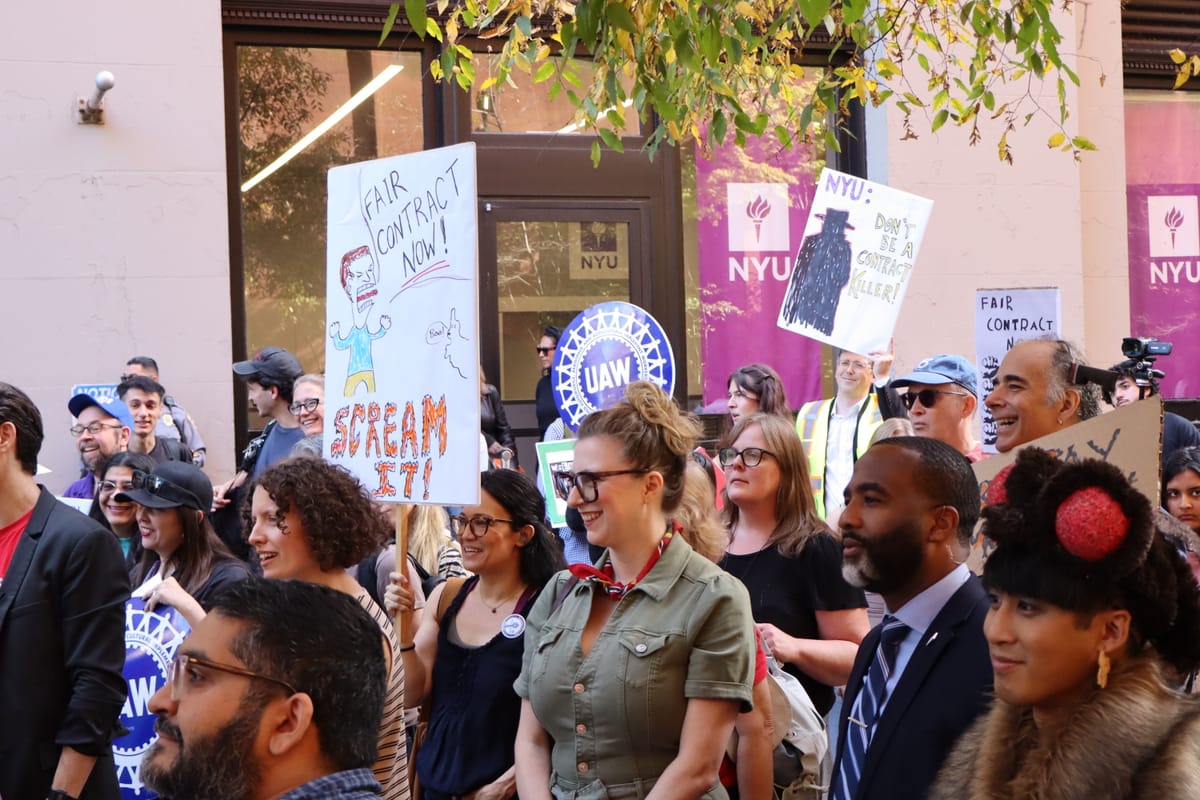
For years, NYU’s administrators have casualized the school’s teaching force, many of them artists, by creating a second tier of full-time contract faculty.
After 15 months of bargaining with a New York University (NYU) administration accused of violating labor law on multiple fronts, the 900-plus professors who make up Contract Faculty United - United Auto Workers (CFU-UAW) have voted by a 90% supermajority to authorize a strike.
How did we get here?
For years, NYU’s handsomely paid administrators have consolidated power over university life while casualizing the school’s teaching force, not only by hiring part-time adjuncts but also by creating a second tier of full-time contract faculty like myself. These contingent workers often have responsibilities equivalent to those of tenured colleagues, but lack commensurate pay, benefits, and protections. Although some have taught at NYU for decades, their renewable appointments mean they must effectively reapply for their jobs every three to five years. Some peer universities have similarly casualized full-time faculties, but not at the same scale. At NYU, contract faculty have grown tenfold over two decades, now comprising half of the school’s full-time faculty.
CFU-UAW emerged from the need for better job security and pay, but also out of a widespread demand for academic freedom, which has been severely compromised under NYU President Linda Mills’s administration. The union also seeks protections regarding AI and intellectual property — issues that administrators have stubbornly refused to negotiate on.
Arts professors are heavily represented within CFU-UAW. NYU’s Steinhardt School, home to programs in music and studio art, and the Tisch School of the Arts make up significant parts of the union, as does the Expository Writing Program, where a third of the faculty hold MFAs.
Artists, of course, have been crucial to building NYU’s reputation. Before the university established itself as a global brand, it was known as a commuter school with strong arts programs. In 2004, when former NYU President John Sexton unveiled his vision of the university in an era of so-called “hyperchange,” he paid special attention to the institution's legacy as having some of the “leading schools of the arts.”
Unfortunately, he also began a process of precaritization, which he rationalized in part by pointing to the supposed “harmony” between “different modalities of faculty” at Tisch. Like many other art schools, Tisch has long hired non-tenure-track professors with careers outside academia.
Since then, “hyperchange” (read: capitulation to market forces) in New York and beyond has engendered a massive affordability crisis, even for those reasonably well-compensated. Solidarity movements have emerged, in turn, alongside a surge in workplace organizing, particularly among cultural and intellectual workers. For the artists represented by CFU-UAW, much is at stake in the fight for a first contract.
Among them is NYU Gallatin School professor and interdisciplinary artist Nina Katchadourian, who is keenly aware that creative practices “always involve financial precarity.” Teaching, she tells me, “feeds my practice.” But the protection that a union contract promises will also benefit her art.
“A fair job with benefits and security (financial, political, intellectual) frees me to make the best work I can make,” Katchadourian said.
These sentiments are echoed by documentary editor and Tisch professor Jason Pollard. A member of the Editors Guild and the Directors Guild of America, in addition to CFU-UAW, Pollard views the struggles of filmmakers and professors as “interconnected.” As he sees it, securing the “basic rights” and dignity that those in both industry and educational contexts have fought for enables everyone to do their jobs better.
Many artist professors cite academic freedom as a central concern. NYU Liberal Studies Professor Sarah Ema Friedland produces film and media work on reproductive justice, undocumented migration, and Palestinian human rights, issues often censored and increasingly difficult to fund in the Trump era.
At NYU, she told me, “students and faculty who criticize the state of Israel have been subject to intense scrutiny and worse.” After her film Lyd (2023), co-directed with Rami Youmis, was censored in Israel, she worried that the attention she received would impact her teaching life. “We need academic freedom protections in our contract,” she said. “We owe it to our students to protect the road ahead, so that they can express themselves freely as artists.”
Guardrails against the misuse of artificial intelligence are another urgent objective for NYU’s artist professors, as novelist and Creative Writing professor Hari Kunzru has emphasized. In Kunzru’s view, “untested and unreliable AI” threatens to “undermine the ethos of the university and the authority of scholars.”
If there is a common sentiment among the artists within CFU-UAW, it is that their fight for a first contract is a fight for the collective well-being of the NYU community.
Solidarity, it seems, is among the most important lessons one can bestow. Following the strike authorization vote, author and Tisch professor Kathy Engel composed a poem for CFU-UAW organizers, in which she recalls labor struggles of the past and affirms her commitment to withholding her labor if necessary. In a nod to Gwendolyn Brooks, the poem concludes: “We are each other’s glory/we are each other’s last chance/we are each other’s other.”
NYU administrators have stalled and stonewalled for months. They now have until March 23 to reach a fair agreement with CFU-UAW and avoid a strike.
Facts Only
* NYU Contract Faculty United (CFU-UAW) represents 900+ professors.
* NYU’s administration has “casualized” the teaching force.
* Contract faculty have responsibilities like tenured colleagues but lack equal pay/benefits.
* The union voted 90% to authorize a strike.
* The strike is over job security, pay, and academic freedom.
* AI and intellectual property protections are key negotiation points.
* Contract faculty comprise half of NYU’s full-time faculty.
* The Steinhardt School, Tisch School, and Expository Writing Program are heavily represented.
* NYU’s administrators have stalled negotiations.
* March 23rd is the deadline to reach an agreement.
Executive Summary
Full Take
Sentinel — Human
The article exhibits strong human authorship signals, including stylistic idiosyncrasies, passionate advocacy, and specific, verifiable attributions. No significant indicators of synthetic generation were detected.