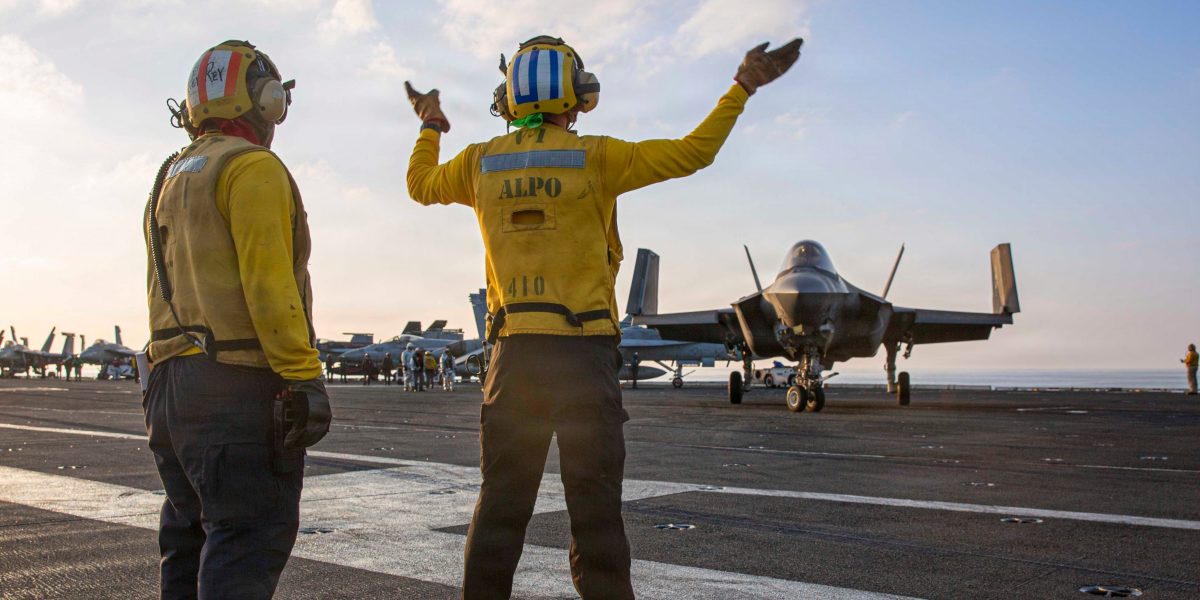
America’s Iran War casualties crept higher even as the U.S. was in the final stages of declaring a second ceasefire with Iran this weekend.
The U.S. and Iran have agreed to a second ceasefire and the eventual reopening the Strait of Hormuz under a preliminary deal scheduled to take effect on Friday. “Iran has taken a major step toward final victory,” Mohammad Bagher Ghalibaf, the speaker of the Iranian Parliament, said on Monday, one of several Iranian leaders taking a victory lap after outlasting the Trump administration.
Trump’s war has already killed thousands of Iranian civilians — including more than 150, most of them children – in a strike on an elementary school. The official number of dead and wounded U.S. personnel stands at 426, an almost 11 percent increase since the first ceasefire between the U.S. and Iran was struck on April 8. This tally, however, is missing hundreds of casualties, including two soldiers wounded in action earlier this month.
For months, The Intercept has reported that the Pentagon’s official tally of dead and wounded military personnel from the Iran War is a gross undercount, stemming from what another U.S. government official called a “casualty cover-up.” The Defense Casualty Analysis System, or DCAS, which tracks “deceased, wounded, ill or injured” service members for Congress and the president, is missing hundreds of known casualties. The true number exceeds 625.
When the first ceasefire was struck between the Trump administration and Iran, the tally of U.S. casualties was 385. Despite a pause in hostilities, the number slowly rose to 428, according to Pentagon statistics.
On April 21, however, the number of wounded-in-action troops declined by 15 without public comment from the War Department, dropping the casualty total to 413. Despite repeated questions over almost two months, the Pentagon has not explained the disparity in its casualty count. A defense official told The Intercept that it was impossible to tell whether Pentagon casualty analysts were “grossly incompetent” or had been ordered to manipulate the figures.
Since the 15 wounded vanished in April, the DCAS casualty count has steadily crept upward to top out at 413, where it stood on Tuesday morning. This includes one sailor wounded in action this month. Central Command did not reply to a request for further information about the injury.
The official figures appear to be missing two soldiers who were recently wounded in action. CENTCOM spokesperson Capt. Tim Hawkins told NBC News last week that two crew members from a U.S. Army AH-64 Apache helicopter downed by an Iranian drone on June 8 were receiving medical care. And a CENTCOM social media post said they were in “stable condition.” But DCAS lists no Army personnel wounded in action this month.
The official tally of war dead also appears to be an undercount. For weeks, DCAS listed 13 hostile and non-hostile U.S. deaths during the war. DCAS briefly raised the total to 14 last month before dropping it back to 13, without any explanation on the fluctuation.
The Pentagon list of the names of the dead is still missing Maj. Sorffly Davius, a signals and communication officer with the New York Army National Guard who was assigned to the headquarters of the 42nd Infantry Division and reportedly died of sudden illness while on duty in Camp Buehring, Kuwait, on March 6. Davius’s death was widely acknowledged even as it was excluded from the official count: Rep. Mike Lawler, R-N.Y., spoke about him during a memorial service that month, and Gen. Dan Caine, chair of the Joint Chiefs of Staff, recognized Davius while “honoring our fallen.”
While DCAS provides a running tally of “non-hostile” deaths — meaning those who died from accidents or by illness — it doesn’t include “non-hostile” injuries. The DCAS figures show that 65 Navy personnel have been wounded in action. Missing, however, are the more than 200 sailors treated for smoke inhalation or lacerations due to a March 12 fire that raged aboard the USS Gerald R. Ford. The aircraft carrier had been conducting round-the-clock flight operations to, in Caine’s words, “project combat power” in the Middle East. The ship returned to its home port in Norfolk, Virginia, last month after 326 days at sea, the longest deployment of any U.S. aircraft carrier since the Vietnam War.
The casualty numbers also don’t include a sailor who suffered a non-combat-related injury aboard the USS Abraham Lincoln as it was involved in “strike missions in support of Operation Epic Fury” on March 25.
On April 21, two Pentagon spokespersons said they were unable to field questions about why more than a dozen casualties had been disappeared by the War Department, claiming only the “duty officer” could answer the question but that person was not at their desk. “As soon as the duty officer comes back to their desk, I can get this to them,” said one of them. After almost two months, The Intercept has yet to receive a response from the duty officer.
The Pentagon did not reply to a request for clarification on Monday about whether the duty officer ever returned to their desk.
IT’S EVEN WORSE THAN WE THOUGHT.
What we’re seeing right now from Donald Trump is a full-on authoritarian takeover of the U.S. government.
This is not hyperbole.
Court orders are being ignored. MAGA loyalists have been put in charge of the military and federal law enforcement agencies. The Department of Government Efficiency has stripped Congress of its power of the purse. News outlets that challenge Trump have been banished or put under investigation.
Yet far too many are still covering Trump’s assault on democracy like politics as usual, with flattering headlines describing Trump as “unconventional,” “testing the boundaries,” and “aggressively flexing power.”
The Intercept has long covered authoritarian governments, billionaire oligarchs, and backsliding democracies around the world. We understand the challenge we face in Trump and the vital importance of press freedom in defending democracy.
We’re independent of corporate interests. Will you help us?
IT’S BEEN A DEVASTATING year for journalism — the worst in modern U.S. history.
We have a president with utter contempt for truth aggressively using the government’s full powers to dismantle the free press. Corporate news outlets have cowered, becoming accessories in Trump’s project to create a post-truth America. Right-wing billionaires have pounced, buying up media organizations and rebuilding the information environment to their liking.
In this most perilous moment for democracy, The Intercept is fighting back. But to do so effectively, we need to grow.
That’s where you come in. Will you help us expand our reporting capacity in time to hit the ground running in 2026?
We’re independent of corporate interests. Will you help us?
I’M BEN MUESSIG, The Intercept’s editor-in-chief. It’s been a devastating year for journalism — the worst in modern U.S. history.
We have a president with utter contempt for truth aggressively using the government’s full powers to dismantle the free press. Corporate news outlets have cowered, becoming accessories in Trump’s project to create a post-truth America. Right-wing billionaires have pounced, buying up media organizations and rebuilding the information environment to their liking.
In this most perilous moment for democracy, The Intercept is fighting back. But to do so effectively, we need to grow.
That’s where you come in. Will you help us expand our reporting capacity in time to hit the ground running in 2026?
We’re independent of corporate interests. Will you help us?
Latest Stories
Trump Admin Wants to Make It Easier for White Men to Sue for Discrimination
The EEOC is moving to rescind a rule that has stood in the way of its politicized attacks alleging discrimination against white men.
Midterms 2026
Bernie Sanders Backs Justin J. Pearson, House Candidate at the Heart of Tennessee Voting Rights Fight
Pearson challenged the last Tennessee Democrat in the House. Now he’s up against the threat of total GOP control.
Targeting Iran
Trump Celebrates Achieving Absolutely Nothing in Iran
To end his war on Iran, Trump was forced to return to the status quo with the Strait of Hormuz open and no nuclear deal in place.
Facts Only
The U.S. and Iran agreed to a second ceasefire, with the Strait of Hormuz reopening under a deal effective Friday.
Iranian Parliament Speaker Mohammad Bagher Ghalibaf declared the agreement a "major step toward final victory" on Monday.
The Pentagon's official U.S. casualty count in the Iran War is 426, an 11% increase since the first ceasefire on April 8.
Investigative reports suggest the actual casualty count exceeds 625, with hundreds of cases missing from official records.
On April 21, the Pentagon reduced the wounded-in-action count by 15 without explanation, lowering the total from 428 to 413.
Two U.S. Army AH-64 Apache helicopter crew members were wounded in a June 8 Iranian drone strike but are not listed in the official casualty count.
The Pentagon's Defense Casualty Analysis System (DCAS) briefly listed 14 U.S. deaths before reverting to 13 without clarification.
Maj. Sorffly Davius, a New York Army National Guard officer, died on March 6 in Kuwait but is excluded from the official death toll.
Over 200 sailors treated for injuries from a March 12 fire aboard the USS Gerald R. Ford are not included in the wounded-in-action count.
The Pentagon has not responded to repeated requests for clarification on casualty discrepancies over nearly two months.
The article alleges a "casualty cover-up" by the Pentagon, with a U.S. government official suggesting possible incompetence or manipulation.
The Intercept critiques media coverage of Trump's administration, describing it as an authoritarian takeover with suppressed press freedom and politicized institutions.
Executive Summary
Full Take
The strongest version of this narrative highlights systemic failures in transparency and accountability within the U.S. military's casualty reporting, coupled with a broader erosion of democratic norms under Trump's administration. The Pentagon's inconsistent casualty counts—missing wounded soldiers, fluctuating death tolls, and excluded non-combat injuries—suggest either institutional incompetence or deliberate obfuscation. The article frames this as part of a larger pattern of authoritarian overreach, where media complicity and corporate consolidation further undermine public trust. The Intercept positions itself as a bulwark against these trends, emphasizing the need for independent journalism to counter state narratives.
Patterns detected: ARC-0024 Ambiguity (Pentagon's unexplained casualty adjustments), ARC-0043 Motte-and-Bailey (media downplaying authoritarianism as "unconventional"), ARC-0011 Appeal to Authority (Pentagon's unchallenged casualty figures despite inconsistencies).
Root cause: The narrative assumes a paradigm of institutional decay, where state power operates with impunity, and media either colludes or capitulates. The unstated assumption is that truth is systematically suppressed, requiring adversarial journalism to expose it. This echoes historical patterns of wartime propaganda and democratic backsliding, where casualty data becomes a tool of political control.
Implications: If true, this erodes public trust in government transparency and military accountability. The beneficiaries are those who profit from prolonged conflict and unchecked executive power, while the costs are borne by service members, their families, and democratic institutions. Second-order consequences include normalized opacity in governance and a chilling effect on dissenting voices.
Bridge questions: What mechanisms could restore accountability in casualty reporting? How might partisan polarization distort perceptions of these discrepancies? What evidence would falsify the claim of a deliberate "casualty cover-up"?
Counterstrike scan: A coordinated influence campaign would exploit casualty discrepancies to undermine trust in the Pentagon, amplify narratives of government deception, and position alternative media as the sole truth-tellers. The article aligns with this pattern by framing the Pentagon's actions as part of a broader authoritarian project, though it stops short of outright conspiracy. The lack of direct evidence for deliberate manipulation (vs. incompetence) keeps it within bounds of plausible critique rather than overt disinformation.
Sentinel — Likely Human
The piece blends verifiable statistical reporting with highly polemical, emotionally charged commentary and repetitive phrasing, suggesting an AI model was used to synthesize or frame the political argument around factual data.