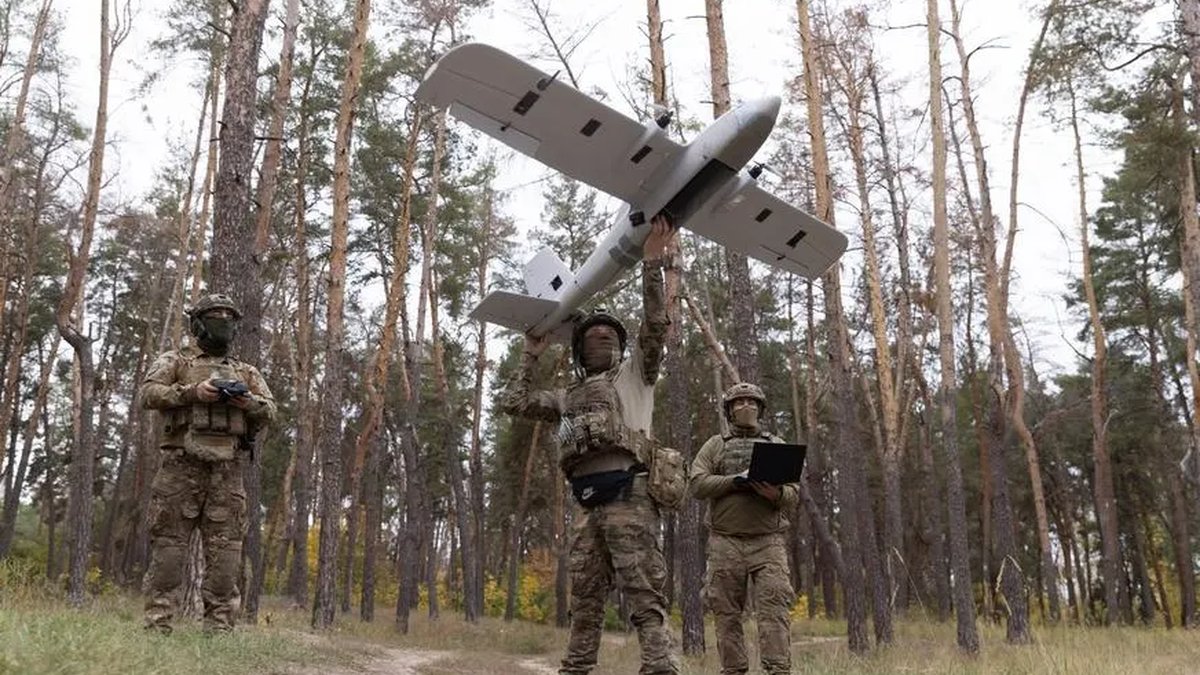
The Russian military that invaded Ukraine in 2022 is not the same force fighting today.
Ukraine repeatedly changed the battlefield. But over four years of war, Russia built a military capable of recognizing change, absorbing lessons and institutionalizing them across the force. Today it adapts far faster than it did in 2022
"The Russians have learned to learn better and faster the longer the war has gone on," retired Australian Major General Mick Ryan told me.
That learning process may prove more important than any single drone. It reveals how one of the world's largest militaries is adapting to a battlefield increasingly dominated by inexpensive unmanned systems.
Rubicon Becomes The Model
One of the clearest examples came in August 2024 with the creation of Rubicon, Russia’s Center for Advanced Unmanned Technologies. Foreign Policy Research Institute Senior Fellow Rob Lee and former Ukrainian Unmanned Systems Forces officer Dmytro Putiata wrote that Rubicon was designed to accelerate the spread of battlefield innovations throughout the force.
Rubicon focuses on targeting Ukrainian drone crews, electronic warfare systems and logistics routes located 10 to 40 kilometers behind the front, rather than directly supporting assaults, according to Lee and Putiata.
Rubicon first demonstrated that approach during Russia’s campaign to retake Kursk before the military expanded it across eastern Ukraine. In late 2025, it also made extensive use of Starlink-enabled mid-range strike drones, allowing operators to strike deeper into Ukraine’s rear areas until access was disabled in February.
Russia also reorganized how it employed drone units across the front.
In their Two Marines Substack newsletter, Lee and Putiata describe Drone Line, a concept that grouped Russian drone units by depth behind the front rather than attaching them to individual brigades. After proving effective within one combined arms army, commanders expanded and refined the concept as frontline needs changed.
Russia is now scaling that model to larger formations. Lee expects the recently formed 50th Unmanned Systems Brigade to become Russia's leading drone formation and eventually the centerpiece of its Unmanned Systems Forces.
The brigade operates first-person-view drones, Geran long-range strike drones and other systems targeting fuel infrastructure, logistics vehicles, rail traffic, warehouses and electrical substations deep behind Ukrainian lines.
Writing for the Ukrainian defense outlet Defense Express in July, weapons expert Ivan Kyrychevskiy wrote that the brigade appears to answer directly to Russia’s General Staff rather than a regional military command, reflecting its strategic role within Russia's drone forces.
Lee and Putiata caution that scaling elite formations carries risks. Pulling experienced operators from conventional units could weaken both elite and conventional formations as Russia expands its most successful drone forces. A Jamestown Foundation analysis from June likewise questioned whether increasing centralization could ultimately limit the experimentation that fueled much of Russia's wartime innovation.
Ukraine Forces Another Adaptation
Ukraine's own innovations quickly forced another adjustment. As Ukraine intensified what Defense Minister Mykhailo Fedorov has called a "logistics shutdown," targeting Russian supply routes across occupied southern Ukraine, including the land bridge to Crimea, Moscow increasingly tasked its elite drone formations with defending logistics routes and infrastructure in the rear.
Lee told me Rubicon and the emerging 50th Unmanned Systems Brigade are helping counter Ukraine's expanding mid-range and deep-strike campaign, though their long-term roles will likely continue evolving as the war changes.
The shift is already affecting the battlefield. Jonathan Lippert, president of Defense Tech for Ukraine, told me that during a recent three-month period, roughly half of the Ukrainian mid-range strike drones Rubicon intercepted were Hornet systems.
Dmytro Zhluktenko, a soldier with Ukraine's 413th Unmanned Systems Regiment "RAID," told me the Rubicon model has proven more effective than Russia's traditional military structure. He expects its methods to be adopted throughout the force, much as Wagner's battlefield tactics eventually spread through Russia's conventional military. Unlike Wagner, however, Rubicon is a formal military organization.
Autonomy Comes To The Battlefield
Russia's organizational adaptation is now being reinforced by technical innovation.
Serhii "Flash" Beskrestnov, an adviser to Ukraine's defense minister, posted on Telegram on July 3 that Russian forces are deploying autonomous versions of the widely used Molniya strike drone in the Zaporizhzhia sector. Unlike earlier variants, the new drones reportedly rely on terrain-following software and onboard computing rather than radio control, making them resistant to many forms of radio-frequency jamming while evading conventional drone detectors.
Anatolii Tkachenko, a Ukrainian mortar battery unit commander with the 92nd Brigade, told me growing Russian drone activity has made frontline logistics more difficult.
"With a 20-kilometer kill zone, it's practically impossible to organize logistics. Infantry are walking 30 kilometers. Mortar crews and drone operators are walking 10 to 15 kilometers."
Tkachenko said his unit has not yet encountered autonomous Molniya drones, suggesting the capability has not spread evenly across the front.
Ryan O'Leary, former commander of Chosen Company, told me Russia's loss of widespread Starlink access significantly reduced forward drone deployments, strike capabilities and communications between units.
Moscow has responded by investing in mobile ad hoc networks, known as MANETs, which allow drones to relay control signals and video through one another instead of relying on a single communications link. Those networks make operations more resilient while restoring some of the reach lost when Starlink access was curtailed.
As Russia adapts to the loss of widespread Starlink access, it is pairing MANET networking with increasingly autonomous drones in an effort to restore the reach and effectiveness of its mid-range strike campaign.
Lee and Putiata caution that throughout the war, Ukraine has typically introduced new drone capabilities first, while Russia has absorbed those developments, refined them and spread successful ideas across the force. Yet adaptation alone has not guaranteed battlefield success. Even expanded elite drone formations failed to produce a breakthrough in the Center Group of Forces sector during the fall of 2025.
Ryan argues in a June report by the Lowy Institute that future wars will reward militaries able to recognize battlefield change, absorb lessons and adapt faster than their opponents. For Western militaries, that may be the war's most important lesson.
The lesson of Ukraine may be that victory in drone warfare depends less on who builds the best drone than on who recognizes change first, scales successful ideas most effectively and adapts before the character of the war changes once again.
Sentinel — Human
The text appears to be a synthesis of high-level, internally consistent military and technological commentary, exhibiting the nuanced flow typical of expert analysis rather than simple AI generation.