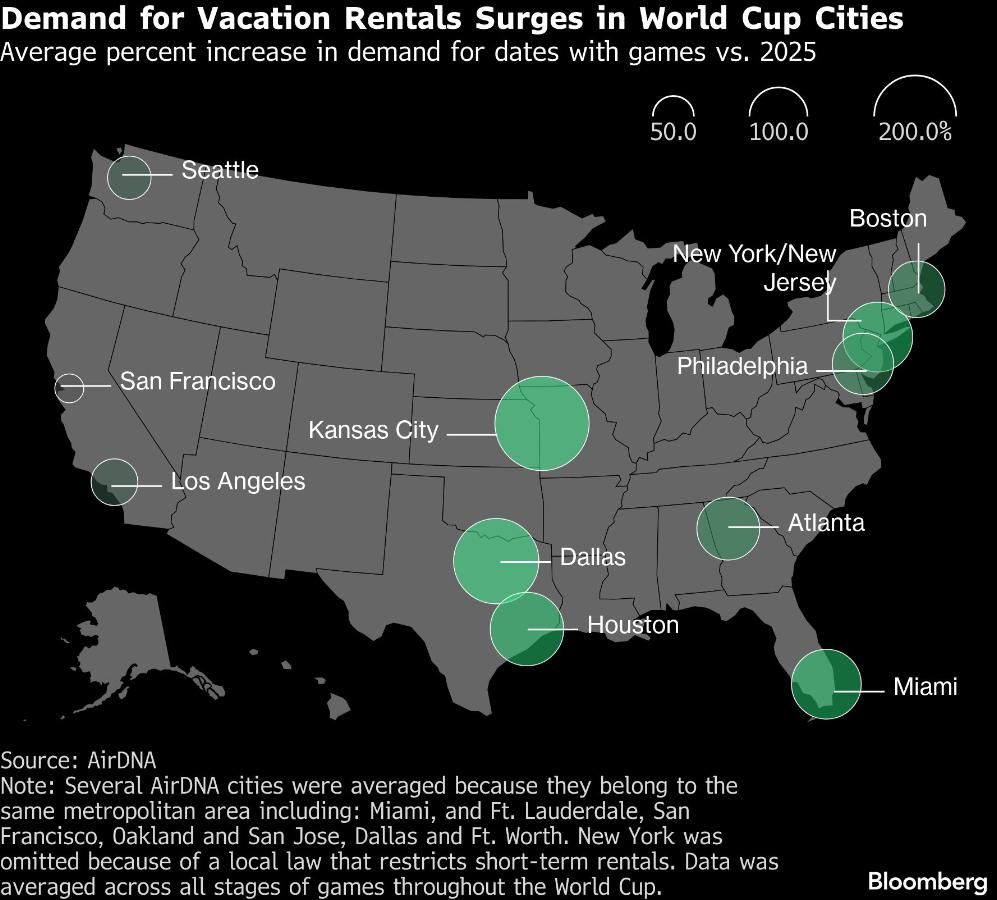
The fervor is reshaping the lodging market in World Cup cities across the U.S., which are expecting millions of visitors throughout the course of the tournament
The biggest winners from this year’s World Cup are poised to be those able to rent out their properties, especially in the tri-state area.
Bobby Roufaeal, who manages more than a dozen short-term rentals in New Jersey, said a luxury rental in the state could bring in $240,000 between June 11 and July 19 when the tournament runs. He said he’s tripling rates for his units in anticipation of fan inflow for the games and fielding calls from homeowners looking to capitalize on demand.
“They’re like, listen, I’ll figure it out. I’ll go stay with my relatives for the month or for a few weeks just to be able to capitalize on this revenue,” said Roufaeal, founder of Settled In Property Management.
Already listings show a surge in prices. One six-bedroom Airbnb Inc. property in Princeton, New Jersey, is offered at roughly $6,000 a night during the World Cup, about 140% higher than its price a year ago. That’s despite being more than an hour’s drive from the games being played at MetLife Stadium.
The fervor is reshaping the lodging market in World Cup cities across the US, which are expecting millions of visitors throughout the course of the tournament. Matches are also being held in Mexico and Canada.
For those renting out their homes, it can be a lucrative prospect — especially as Airbnb has offered as much as $750 in cash for first-timers to incentive new listings. For travelers, the cost of attendance adds up as prices surge for tickets, hotel rooms and flights. The tourism boom is expected to lift hotel rates in the host cities by an average of 300% around opening matches, the New York Times has reported.
Those expenses are causing Mehdi Salem, the founder of French soccer fan association Les Baroudeurs du Sport, to find ways to save money as he organizes accommodations for 80 of his members to see France play at MetLife.
- Toronto mayor seeks to block U.S. ICE agents from city during World Cup
- Iran 'negotiating' with FIFA to relocate World Cup games to Mexico
- Advertisement 1Story continues below
He’s squeezing eight people in a room designed to sleep four and booked hotels in Manhattan more than a year before the games when prices were lower. Now, he is looking at spaces in New York City’s outer boroughs like the Bronx and Queens, as well as Airbnbs in less-traveled New Jersey neighborhoods.
“Some prices are totally ridiculous,” Salem said.
Montclair, New Jersey, a well-off suburb, has seen a 169% increase in short-term rental occupancy during the group stage compared to the same dates last year, according to data as of March 26 from analytics platform AirDNA, which tracks rental demand, rates, and occupancy across host cities. Nearby towns of Clifton, Newark, Paterson and Jersey City, have also seen surges, the data shows.
Jamie Lane, chief economist at AirDNA, said that as the games grow closer — prices are poised to increase.
“When bookings start, people typically aren’t booking the properties that are priced really high,” he said. “Other properties that are more reasonably priced do get booked and then we see the delta between the available rates and the booked rates begin to merge.”
Attending the World Cup will be expensive for any spectator, especially those traveling from abroad. Ticket prices can range wildly, in part due to the implementation of FIFA’s dynamic-pricing strategy which raises rates depending on demand. Initially, tickets started at $60 and could be as much as $6,730 — though those increased in subsequent batches. The numbers are even larger on the secondary market, with those for the coveted July 19 final starting at around $8,000 and topping $50,000, according to listings on resale site StubHub.
Salem, the French organizer, said that many of his members are staying home because of the high costs. “Globally, people are complaining about the prices and we lost many, many good followers and good fans are not coming because of the prices,” he said.
Some fans are looking outside of the major hubs to smaller host cities that can be more affordable. Data from Expedia Group Inc. shows searches rising most sharply in secondary markets, such as Kansas City, Dallas and Houston. Lodging prices outside of the US in Canada and Mexico remain the most affordable.
“If you look to the smaller towns, you can have venues that are more easily accessible,” said Michael Seiler, professor of real estate and finance at the College of William & Mary.
Houston tourism officials say the pace of hotel bookings for June and July is already running more than double last year’s levels across major submarkets. In Dallas — which is hosting more matches than any other US city — searches for housing options are up 230% from last summer, according to the Expedia data from January.
“Dallas is no stranger to major sporting events, but this isn’t simply another big event,” Zane Harrington, a spokesperson for the city’s tourism bureau said. “The FIFA World Cup is unlike anything we’ve experienced before.”
Michael De Micco won World Cup tickets for a game at Gillette Stadium in Foxborough, Massachusetts, through his employer, Frito-Lay Inc. He plans to drive about nine hours from his home near Pittsburgh and has already ruled out hotels as too expensive. Instead, he considered Airbnb and Vrbo Holdings Inc. rentals in Providence, Rhode Island, after seeing a listing near the stadium that was out of his budget.
“There’s no way am I spending a thousand dollars a night,” he said.
Real-estate investor Geoff Colleran is on the other side of the equation, listing his home in Foxborough for more than $2,000 per night. He said he hopes to use the profits to pad out his investments and pay off some debt.
“I would be extremely disappointed if that entire portion of time from mid-June through July isn’t booked,” said Colleran. “On a typical summer we do $50,000 to $60,000. So I’d expect a six-figure summer.”
Our website is the place for the latest breaking news, exclusive scoops, longreads and provocative commentary. Please bookmark nationalpost.com and sign up for our daily newsletter, Posted, here.
Postmedia is committed to maintaining a lively but civil forum for discussion. Please keep comments relevant and respectful. Comments may take up to an hour to appear on the site. You will receive an email if there is a reply to your comment, an update to a thread you follow or if a user you follow comments. Visit our Community Guidelines for more information.
Facts Only
The 2026 World Cup is being held in the U.S., Canada, and Mexico, with matches in cities like New York, Dallas, and Houston.
Short-term rental prices in the New York tri-state area have surged, with some Airbnb listings exceeding $6,000 per night.
Bobby Roufaeal, a property manager in New Jersey, expects a luxury rental to earn $240,000 between June 11 and July 19.
Homeowners are relocating temporarily to rent out their properties during the tournament.
A six-bedroom Airbnb in Princeton, New Jersey, is listed at $6,000 per night, a 140% increase from last year.
Hotel rates in host cities are projected to rise by 300% during opening matches.
Airbnb is offering up to $750 in cash incentives for first-time hosts.
Mehdi Salem, a French soccer fan organizer, is booking hotels in Manhattan’s outer boroughs and New Jersey to reduce costs.
Montclair, New Jersey, has seen a 169% increase in short-term rental occupancy during the group stage compared to last year.
Ticket prices for the World Cup final on StubHub start at $8,000 and exceed $50,000.
Secondary markets like Kansas City, Dallas, and Houston are seeing increased interest due to lower lodging costs.
Geoff Colleran, a real estate investor, is listing his Foxborough home for over $2,000 per night.
Executive Summary
Full Take
The World Cup’s economic impact is a textbook case of supply and demand dynamics, but it also reveals deeper patterns of economic exclusion and opportunism. The strongest version of this narrative highlights how major events create windfall profits for property owners and investors while pricing out average fans—a phenomenon seen in past global tournaments. The article effectively documents the surge in prices and the creative (or desperate) measures fans take to afford attendance, from overcrowding rooms to booking in less desirable locations. However, it also subtly frames the situation as an inevitable market response rather than a systemic issue of accessibility.
Patterns detected: ARC-0024 Ambiguity (framing high prices as a neutral market outcome without interrogating equity), ARC-0043 Motte-and-Bailey (implied justification of price gouging as "capitalizing on demand" while avoiding moral scrutiny).
The root cause is the commodification of global events, where hosting rights and tourism become profit engines for a few while displacing locals and excluding less affluent fans. This echoes historical patterns of gentrification and event-driven displacement, where temporary economic booms benefit investors but leave lasting affordability crises.
Implications: Human agency is constrained by financial barriers, turning a cultural celebration into a luxury experience. The beneficiaries are property owners, platforms like Airbnb, and resellers, while the costs fall on fans, particularly those from lower-income backgrounds or abroad. Second-order effects may include long-term rental market distortions in host cities.
Bridge questions: How might cities balance economic benefits with equitable access for residents and visitors? What policies could mitigate price gouging without stifling market incentives? Would a cap on short-term rental prices during major events be feasible or fair?
Counterstrike scan: A coordinated influence campaign would amplify narratives of "economic opportunity" for hosts while downplaying fan exclusion, using testimonials from investors to normalize price surges. The article aligns partially with this pattern but includes critical perspectives (e.g., Salem’s complaints), suggesting it’s not a full-throated manipulation effort. The framing remains market-centric, but the inclusion of fan struggles adds necessary balance.