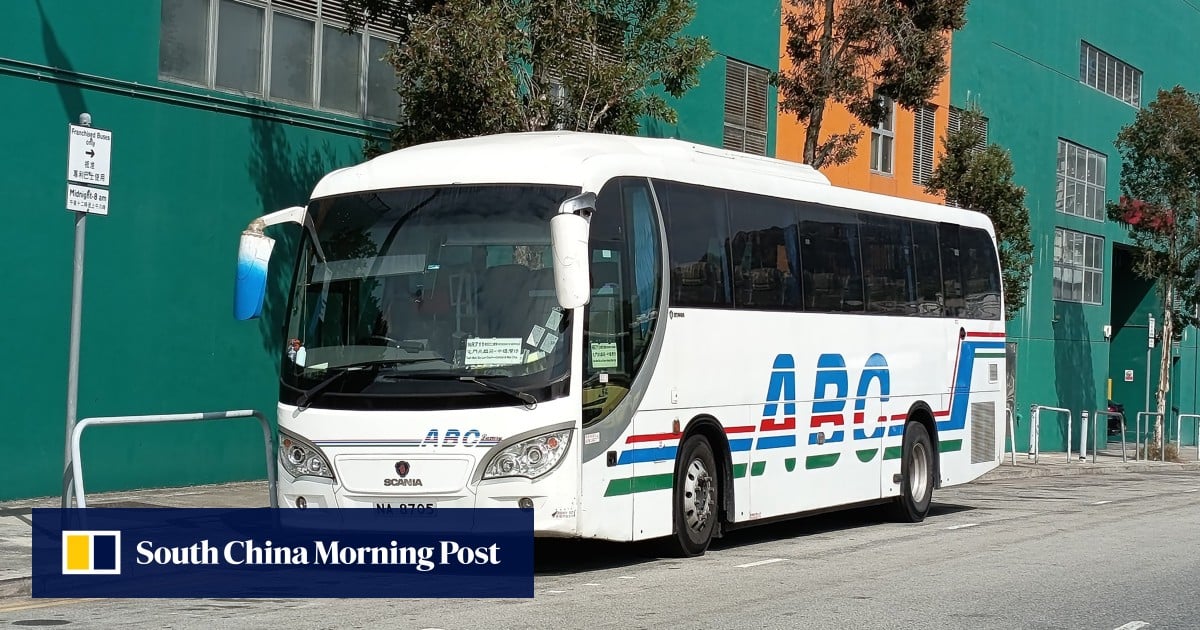
ABC Touring Car Company says rising oil prices mean “every service is like pouring money into the sea”
A Hong Kong bus operator serving commuters in Tuen Mun has scrapped plans to reduce services amid soaring oil prices after transport authorities warned that it needed to apply for any changes at least 14 days in advance.
ABC Touring Car Company, which runs non-franchised bus services linking Tuen Mun and urban areas, announced on Sunday it would reduce its operations with immediate effect as a first step to cut costs.
But the company, which had also warned of ceasing operations, changed course after the Transport Department’s notice requirement.
Fuel bills had more than doubled since late February, pushing the business to the brink, the firm said.
“It is really hard to survive these days,” the company said in a social media post on Sunday. “Our heart sinks when we look at the oil price list. For every passenger we pick up and drop off, the cost has gone up by more than HK$5 [60 US cents] in a month.”
It had applied for a fare increase but said government approval would take time.
Facts Only
ABC Touring Car Company operates non-franchised bus services in Hong Kong, linking Tuen Mun and urban areas.
The company announced plans to reduce services with immediate effect on Sunday.
The decision was attributed to rising oil prices, which have more than doubled since late February.
The Transport Department issued a notice requiring at least 14 days' advance application for any service changes.
ABC Touring Car Company subsequently scrapped its immediate service reduction plans.
The company had also warned of potentially ceasing operations entirely.
Fuel costs have increased by over HK$5 per passenger trip in the past month.
The company has applied for a fare increase, but government approval is pending.
The Transport Department's intervention was based on regulatory requirements for service adjustments.
The company described the financial strain as severe, comparing operations to "pouring money into the sea."
Executive Summary
A Hong Kong bus operator, ABC Touring Car Company, which provides non-franchised bus services between Tuen Mun and urban areas, announced plans to reduce services due to soaring oil prices. The company cited a more than doubling of fuel costs since late February, making operations financially unsustainable. However, after the Transport Department issued a notice requiring at least 14 days' advance application for service changes, the company scrapped its immediate reduction plans. The firm had also warned of potential cessation of operations and had applied for a fare increase, though government approval was pending. The company expressed financial strain, stating that each passenger trip now costs over HK$5 more than a month prior due to rising oil prices.
The situation highlights the tension between regulatory requirements and operational realities for transport providers amid economic pressures. While the company framed the issue as a survival crisis, the Transport Department's intervention underscores the need for structured processes in public service adjustments. The outcome remains uncertain, as the fare increase request is still under review, leaving the company in a precarious position.
Full Take
The strongest version of this narrative is that a small bus operator is facing an existential crisis due to external economic pressures, specifically surging oil prices, and is being constrained by bureaucratic processes that may not account for urgent financial realities. The company’s framing of the situation as a survival struggle is compelling, particularly in its vivid description of costs rising by over HK$5 per passenger trip in a single month. The Transport Department’s intervention, while procedurally justified, could be seen as tone-deaf to the immediate financial pain of the operator.
However, this narrative invites scrutiny of several patterns. The company’s use of emotionally charged language—such as "pouring money into the sea" and "heart sinks"—could be interpreted as an appeal to sympathy, potentially leveraging public sentiment to pressure regulators. This aligns with **ARC-0024 Ambiguity**, where emotional framing is used to obscure the broader context, such as whether the company has explored alternative cost-saving measures or whether the fare increase request is justified. Additionally, the binary framing of "survival or collapse" may oversimplify the situation, hinting at **ARC-0043 Motte-and-Bailey**, where the company retreats to a defensible position (regulatory compliance) while advancing a more extreme claim (imminent shutdown).
The root cause here is the tension between market volatility and regulatory rigidity. The assumption that fare increases are the only solution ignores potential subsidies, operational efficiencies, or temporary relief measures. Historically, this echoes patterns seen in other sectors where small operators struggle under sudden cost shocks, often leading to calls for deregulation or bailouts. The implications for human agency are significant: passengers in Tuen Mun may face reduced mobility if services are cut, while the company’s employees could lose livelihoods. The second-order consequences could include broader public transport disruptions or increased reliance on less regulated, potentially unsafe alternatives.
Bridge questions: What other cost-mitigation strategies could the company pursue before resorting to service cuts? How does the Transport Department balance the need for stability in public services with the flexibility required for operators to adapt to economic shocks? Would a temporary fuel subsidy or emergency funding be a more equitable solution than fare hikes?
Counterstrike scan: If this were part of a coordinated influence campaign, the playbook might involve amplifying the company’s emotional appeals to create public pressure on regulators, while downplaying alternative solutions. The actual content does not fully match this pattern, as it presents both the company’s struggles and the regulatory response without overt manipulation. However, the lack of broader context—such as industry-wide trends or government support mechanisms—could be exploited by bad actors to frame this as a systemic failure rather than an isolated incident.
Sentinel — Human
This text shows signs of a human-written news piece discussing the struggles of a Hong Kong bus operator in response to rising oil prices. However, some stylometric signals hint at possible automated assistance in its creation.