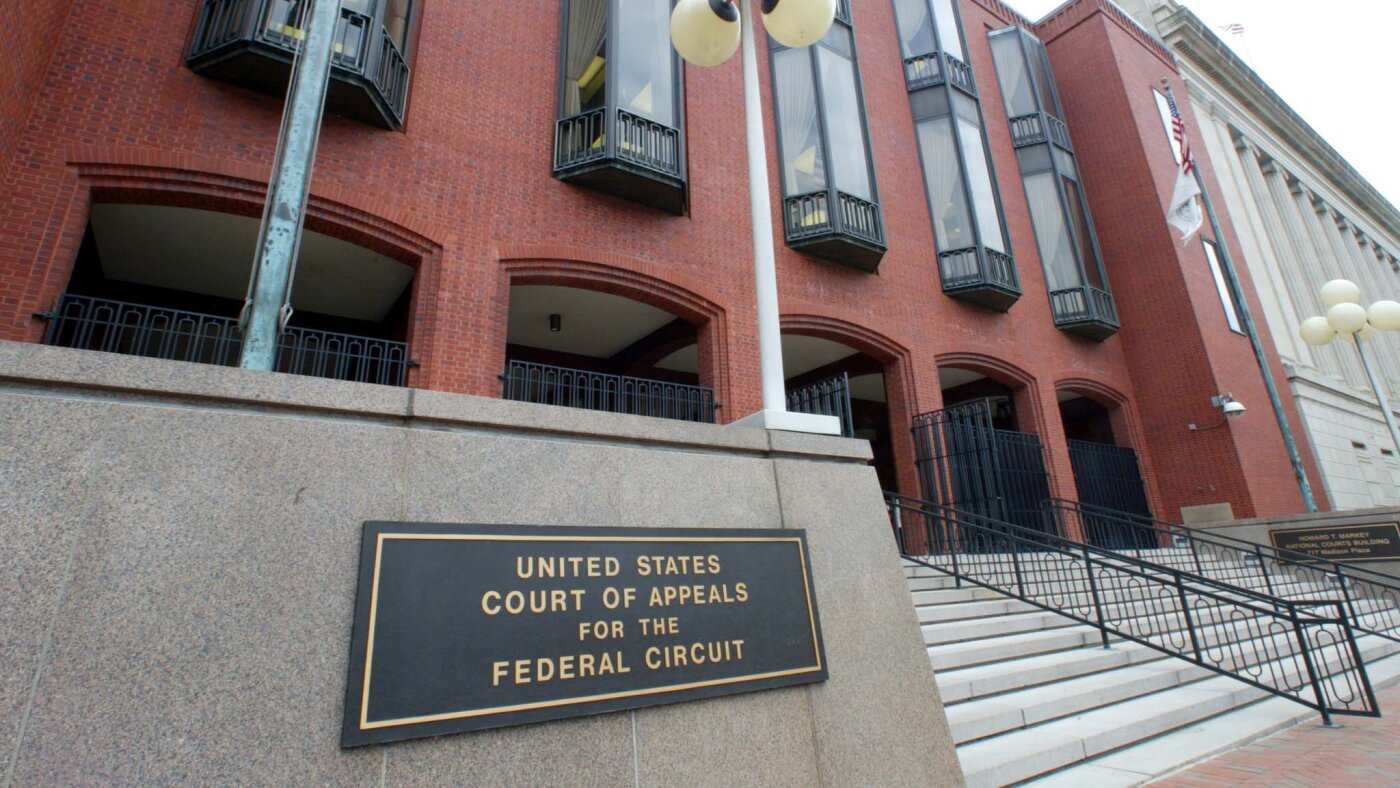
A federal judge who has been sidelined for three years over questions about her competency is asking the Supreme Court to throw her a lifeline. Judge Pauline Newman is 98 years old — and she wants a chance to hear cases again.
Her story shines a light on the aging judiciary, where the average age of federal jurists is 69. Lifetime tenure is now raising thorny questions about retirement.
Newman joined the U.S. Court of Appeals for the Federal Circuit in 1984, during the Reagan era. She quickly became a star in the small community that tracks patent law.
Former colleague Paul Michel said Newman is more or less the same as ever — but the court around her has changed. It's become more skeptical of patents.
"She's extremely bright, very hardworking, quite independent," said Michel, who served alongside Newman for 22 years. "She's slow in writing opinions and that rankles some judges, and she dissents more often than about any other judge, and that also rankles some judges."
Those disagreements came to a head in March 2023, when the chief judge of her court launched an investigation. Newman was 95 at the time.
The appellate court wanted to explore her fitness to serve. But Judge Newman refused to sit for an exam with experts the court selected. Her lawyer said she wanted to choose her own doctors, who gave her a clean bill of health.
"The idea that she's not capable of doing her judicial duties is nonsense," said her attorney John Vecchione, senior litigation counsel at the nonprofit New Civil Liberties Alliance.
To this day, no court has found Newman is incompetent. That question has been paused while attorneys fight over whether the judge has received due process. It's a long time to be off the bench, Vecchione said.
"I mean there have been sexual harassers, there have been people who fudged their ... expenses," he said. "There's been all kinds of skullduggerous activity, alcoholic, all kinds of things and those people have not been kept off the bench as long as Judge Newman, who's done nothing wrong."
Newman says it's about principle
Newman has been speaking at conferences, going to legal events, and writing during her long suspension, according to former colleagues.
In a recent video produced by her legal team, she said she's fighting over principle.
"I thought that it was ridiculous and I should not succumb or set a pattern of judicial colleagues being able to bully and intimidate and force out a colleague they don't like who writes dissents," Newman said.
This month, she asked the Supreme Court to weigh in and evaluate her claims that she's been deprived of due process. It's a long shot because the high court takes only a tiny fraction of cases each term.
The Federal Circuit, where Newman once heard cases, declined to comment for this story. So did the Justice Department, which is defending the court in this bitter dispute.
But an internal committee that hears claims about judicial conduct and disability rejected Newman's due process claims in a March 24 decision. The committee included some of the most highly regarded judges in the federal system. Their ruling said Newman enjoys an office in the courthouse, employs a law clerk and gets a paycheck and benefits.
"Judge Newman cannot have been deprived of a property interest in an office she still holds," they wrote.
Their decision concluded by saying the committee expects Newman to undergo further medical evaluation.
Bigger questions about judicial age
Ryan Black, a political scientist at Michigan State University, said the Newman case signals something bigger about the federal court system.
"Judges are getting appointed at a younger age and serving for a longer period of time," Black said.
More than 30% of federal judges are 75 years or older, according to data from the federal court system.
Black said his research found older judges rely more on their clerks — and might need more support from colleagues.
"The story's pretty clear that, across the board as judges age, there are measurable, reliable empirical decreases in a lot of the performance aspects that they engage in," he said.
Her former colleague, Paul Michel, says Newman is clear and cogent. Michel, who retired more than 15 years ago, personally favors a retirement age for judges, like many other professions.
"Surgeons, airline pilots, many people with sensitive jobs have to stop at a chosen age set by authorities whether they want to continue or not or whether they're able to continue or not," he said.
The question for the Supreme Court is whether judges are different.
Facts Only
Judge Pauline Newman, 98, is a federal appellate judge on the U.S. Court of Appeals for the Federal Circuit.
She was appointed in 1984 during the Reagan administration.
Newman has been sidelined since March 2023 due to an investigation into her competency.
She refused to undergo an evaluation by court-selected medical experts.
Her own doctors declared her fit to serve.
No court has formally ruled her incompetent.
Newman has continued speaking at conferences, attending legal events, and writing during her suspension.
She has filed a petition with the Supreme Court, arguing she was denied due process.
The Federal Circuit and the Justice Department declined to comment on the case.
An internal judicial committee rejected her due process claims in a March 24 decision.
The committee stated Newman still holds her office, employs a law clerk, and receives a salary.
Over 30% of federal judges are 75 years or older.
Former colleague Paul Michel supports Newman’s competency but favors a mandatory retirement age for judges.
Executive Summary
Full Take
The strongest version of this narrative frames Newman’s case as a clash between judicial independence and institutional accountability. Her refusal to submit to court-selected evaluations, coupled with her continued public engagement, suggests a principled stand against what she perceives as overreach. The judicial committee’s response—that she retains her office and pay—underscores the procedural limbo she occupies, where no formal incompetency ruling exists but her ability to hear cases is effectively blocked. This tension mirrors broader systemic questions: Should lifetime tenure for judges persist when medical science extends careers but cognitive decline remains a risk? The article avoids emotional exploitation or distortion, presenting both Newman’s defiance and the committee’s rebuttal without caricature. However, the framing subtly leans into the "maverick judge vs. the system" trope, which could obscure the legitimate concerns about judicial performance and age.
Patterns detected: none
The root cause here is the collision between two foundational principles: judicial independence (lifetime tenure to insulate judges from political pressure) and the need for functional competence in a system where judges wield immense power. The unstated assumption is that self-regulation—judges policing judges—is sufficient, but Newman’s case exposes its fragility. Historically, this echoes debates about term limits for Supreme Court justices, where similar tensions arise between tradition and modern governance demands.
For human agency, the implications are stark. Newman’s dignity is at stake—she insists she is capable, yet the system has sidelined her without a definitive ruling. Conversely, litigants and the public bear the cost if judges remain on the bench despite diminished capacity. Second-order consequences include potential chilling effects: Will judges hesitate to dissent if they fear retaliation under the guise of competency concerns? Or will this case spur reforms, like mandatory cognitive screening or retirement ages?
Bridge questions: If lifetime tenure is sacrosanct, how should the judiciary balance autonomy with accountability? What safeguards could prevent competency disputes from becoming tools for ideological purging? Would Newman’s case be viewed differently if she were a decade younger?
Counterstrike scan: A coordinated influence campaign might amplify this story to undermine trust in the judiciary, framing it as either a "deep state" conspiracy against a conservative icon or proof of systemic ageism. The actual content, however, presents a nuanced procedural dispute without overt manipulation. The focus on due process and institutional mechanics resists reduction to partisan talking points, suggesting a clean narrative.