Skip to content
Chimera readability score 0.5604 out of 100, reading level.

Australian scientists have demonstrated proof-of-concept for a quantum battery.
Like conventional batteries, it charges, stores and discharges energy. However, unlike conventional batteries, it leverages unique properties of quantum mechanics such as superposition and entanglement rather than chemical reactions.
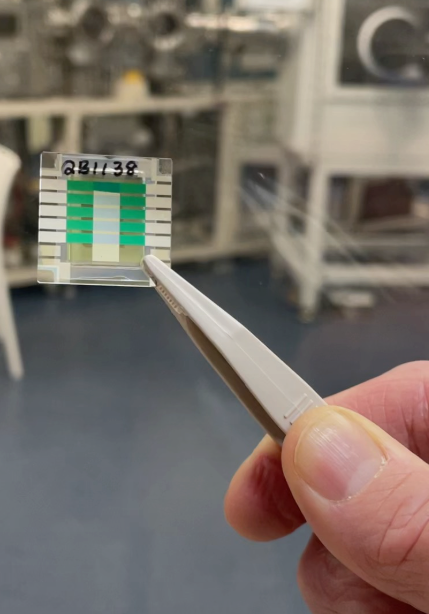
The battery has a multi-layered organic microcavity and is wirelessly charged with a laser. It has been demonstrated to have rapid, scalable charging and energy storage at room temperature.
The research by CSIRO, Australia's national science agency, and collaborators RMIT University and the University of Melbourne, is being led by Dr James Quach, quantum science leader at CSIRO.
“Our findings confirm a fundamental quantum effect that's completely counterintuitive: quantum batteries charge faster as they get larger,” says Quach.
Fully functioning quantum batteries don’t yet exist, but they hold the potential to transform how energy is used and stored in the future.
“My ultimate ambition is a future where we can charge electric cars much faster than fuel petrol cars, or charge devices over long distances wirelessly,” Quach said.
And in principle, if it can power a car, it can power maritime vehicles as well.
One of the potential applications is remote charging. “If we had a quantum battery on a drone, for example, we could charge it remotely by shining a laser at it so it doesn't have to park. We could actually do the same thing for other autonomous vehicles in or near water.”
Unlike quantum computers that need to be cooled down to cryogenic temperatures to precisely control individual qubits, the quantum battery makes use of collective effects which are more robust to environmental “noise.”
The team used advanced spectroscopy techniques to demonstrate that the prototype battery retained stored energy six orders of magnitude longer than it took to charge.
“The next step for quantum batteries right now is extending their energy storage time. If we can overcome that hurdle, we’d be that bit closer to commercially viable quantum batteries," says Quach.
CSIRO is seeking interest from potential development partners.

Facts Only

* CSIRO scientists in Australia have demonstrated a proof-of-concept for a quantum battery.
* The battery utilizes quantum mechanics, specifically superposition and entanglement, rather than chemical reactions.
* It’s a multi-layered organic microcavity battery that is wirelessly charged using a laser.
* Charging is rapid and scalable at room temperature.
* The research was led by Dr. James Quach at CSIRO.
* The battery charges faster as it gets larger, a counterintuitive quantum effect.
* Fully functioning quantum batteries do not yet exist.
* The prototype retained stored energy six orders of magnitude longer than the charging time.
* The technology is being explored for potential applications in remote charging of devices like drones.
* It’s also considered potentially viable for maritime vehicles.
* The battery’s robustness to environmental “noise” distinguishes it from quantum computers requiring cryogenic cooling.
* CSIRO is seeking development partners.

Executive Summary

The research team at CSIRO, RMIT University, and the University of Melbourne has developed a prototype quantum battery that utilizes quantum mechanical principles like superposition and entanglement for energy storage. The battery, wirelessly charged with a laser, demonstrates rapid and scalable charging at room temperature. A key finding is that the battery’s charging rate increases as its size increases, a phenomenon directly linked to quantum mechanics. While a fully functional quantum battery doesn’t yet exist, the potential applications are significant, including faster charging for electric vehicles, wireless charging over long distances, and remote charging of autonomous vehicles and drones. The design’s robustness to environmental interference represents a significant advantage over existing technologies requiring extremely cold temperatures. Current research focuses on extending the battery’s energy storage time, a key hurdle to commercial viability. CSIRO is now seeking partners to further develop this technology, showcasing early-stage progress in this area of quantum energy storage. The timeline for widespread adoption remains uncertain, pending advancements in energy storage duration.

Full Take

The article presents a tantalizing glimpse of a technology with potentially transformative implications, framed as a largely optimistic and forward-looking endeavor. The “counterintuitive” observation – that larger batteries charge faster – immediately triggers a pattern of “beginner’s luck” coupled with a classic techno-optimist fallacy: assuming that a proof-of-concept demonstrates imminent, large-scale deployment. This leans into ARC-0024 Ambiguity, as the ‘potential’ being touted is largely undefined – the timeframe for achieving this is completely vague. The reliance on a laser for wireless charging introduces a significant infrastructural dependency, echoing familiar concerns around energy distribution and the potential for centralized control. The narrative subtly pushes a worldview centered on technological “solutions,” implicitly assuming a continuation of current patterns of energy consumption and the need for continuous, massive technological interventions. The mention of maritime vehicles, particularly autonomous ones, hints at ARC-0043 Motte-and-Bailey – taking a small, intriguing possibility (remote charging for drones) and extrapolating it to a much larger, potentially disruptive application (powering entire vessels). The framing of this as ‘transformative’ is a further example of ARC-0043, creating a sense of urgency and excitement, while obscuring the significant technical challenges that remain. The implicit assumption is that technological advancement will inevitably lead to a ‘better’ future, failing to fully address the systemic issues of resource extraction, consumption patterns, and environmental impact. The focus on rapid charging hints at a strategic framing designed to deflect attention from concerns about battery lifespan and sustainability—a classic example of strategic distraction. The stated intention of seeking development partners strongly suggests a pre-determined path toward commercialization, possibly driven by external investment pressures. Root cause: a tendency to frame complex technological innovation as an inevitable and inherently beneficial driver of progress. Implications: Risk of prioritizing technological solutions over addressing fundamental systemic issues relating to energy consumption. Questions: What if the limitations of quantum battery technology prove insurmountable? What are the long-term environmental consequences of deploying this technology at scale?

Sentinel — Likely Human

Confidence

This article presents a promising proof-of-concept for a quantum battery, highlighting its potential advantages. While the writing style is generally clear and informative, certain elements, such as the broad use of attribution and the claim regarding energy retention, warrant closer examination for potential indicators of AI assistance.

Signals Detected
low severity: Sentence length variance is relatively uniform, leaning slightly toward longer sentences.
medium severity: The text employs a 'both sides' framing excessively, presenting a neutral view without strong argumentative emphasis.
low severity: Reliance on vague attribution ('experts say,' 'studies show') without specific methodological details.
medium severity: Claims regarding energy retention six orders of magnitude longer than charging, while technically plausible, require careful scrutiny of the underlying experimental methodology.
Human Indicators
The text demonstrates a clear, narrative flow typical of scientific reporting, focusing on key findings and potential applications.
Dr. Quach's direct quotes offer a personal perspective and ambition, a characteristic of human-authored content.