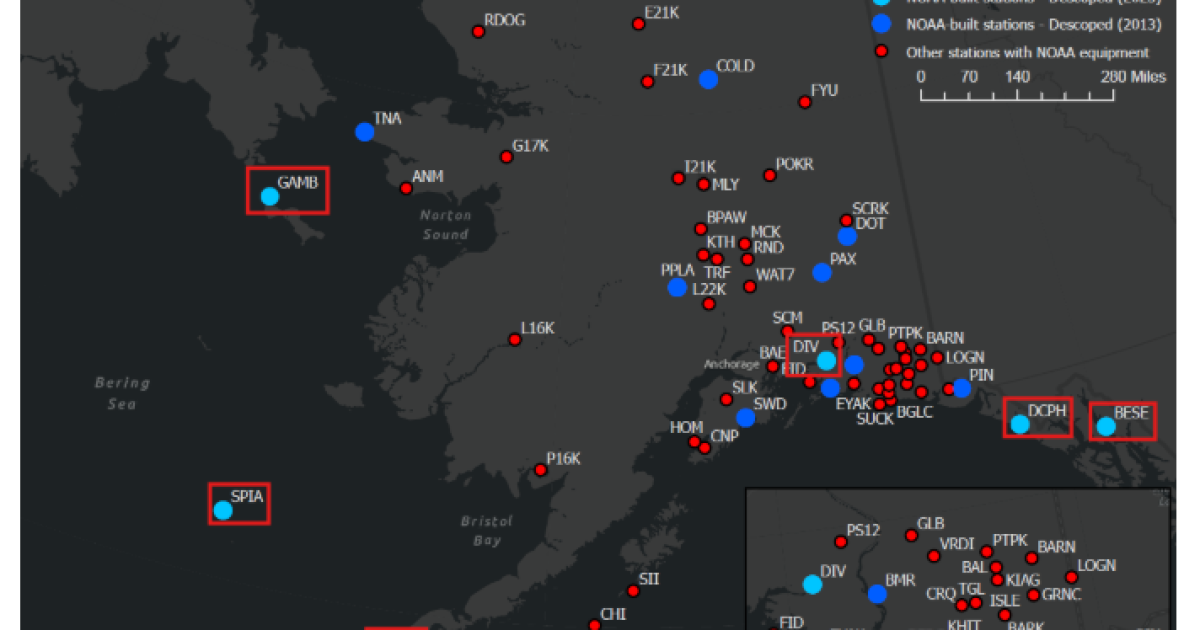
Nine seismic stations in Alaska are fully funded again after a new agreement with federal and state agencies. Five of the stations are in the Aleutian and Pribilof Islands, a highly active seismic region.
The deal between the National Oceanic and Atmospheric Administration and the University of Alaska Fairbanks took effect on March 1. The National Weather Service is now purchasing seismic data directly from the university's Alaska Earthquake Center under a contract, rather than through a grant that got defunded last year.
Curtis Marshall, director of the National Weather Service's commercial data program, said that this new agreement "ensures consistency and efficiency, and it also ensures stable budget resources."
The five Aleutian and Pribilof stations sit near Unalaska, Atka, Nikolski, False Pass and St. Paul Island. The stations in other parts of the state are near Gambell, Yakutat and Bessie Mountain near Juneau.
Greg Peters, project manager for the Aleutian and Pribilof Islands Local Emergency Planning Committee, said that the upgrade matters enormously for remote communities in the region. That's because a nearby earthquake in the Aleutians can send a tsunami wave ashore to communities in just minutes.
Peters also said the investment goes beyond emergency response. He said the stations also support the scientific research that helps refine hazard models and improve preparedness planning across the region.
In case of a tsunami threat, the city of Unalaska alerts local residents through the Nixle system, social media and if necessary, sound sirens. KUCB also broadcasts emergency information on 89.7 FM and KUCB.org.
Alerts are also notified on the FEMA app, at tsunami.gov and through NOAA weather radio.
Copyright 2026 KUCB
Facts Only
* Nine seismic stations in Alaska are fully funded again.
* Five of the stations are located in the Aleutian and Pribilof Islands.
* The agreement is between NOAA and the University of Alaska Fairbanks.
* The agreement took effect on March 1, 2026.
* The National Weather Service is now purchasing seismic data directly.
* The Aleutian and Pribilof stations are near Unalaska, Atka, Nikolski, False Pass and St. Paul Island.
* Other stations are near Gambell, Yakutat and Bessie Mountain near Juneau.
* The deal ensures consistency, efficiency, and stable budget resources.
* Greg Peters, project manager for the Aleutian and Pribilof Islands Local Emergency Planning Committee, is involved.
* The investment supports scientific research and hazard modeling.
* The city of Unalaska uses the Nixle system to alert residents of tsunami threats.
* KUCB broadcasts emergency information on 89.7 FM and KUCB.org.
Executive Summary
Full Take
This article represents a strategically important resuscitated capability within a region profoundly vulnerable to natural disasters. The redeployment of these seismic stations isn’t simply about “ensuring consistency and efficiency,” as Curtis Marshall claims; it’s a defensive maneuver against a tangible, recurring threat – tsunamis generated by seismic activity in the Aleutian Arc. The deliberate shift to direct purchasing from the University of Alaska Fairbanks suggests a desire to control data flow and avoid potential bureaucratic bottlenecks associated with grant-based funding, a classic maneuver to ensure sustained operations. The fact that the stations are clustered near communities like Unalaska underscores a targeted intervention, acknowledging that remote populations are disproportionately at risk. This isn’t just about emergency response; the stations are feeding into hazard models, effectively building a proactive defense against future events, mirroring broader strategies employed in earthquake-prone zones globally. The emphasis on “stability” feels almost disingenuous given the inherent instability of the region. Looking beyond the immediate benefits, the initiative echoes broader trends in disaster preparedness, prioritizing localized, scientifically-driven systems. It is worth noting that the reliance on systems like Nixle and KUCB, while functional, represent a reliance on existing infrastructure, highlighting potential vulnerabilities. The article's framing subtly positions Alaska as a test case – a place where the effectiveness of these resources can be measured against the true cost of inaction. It's a calculated investment, not just an altruistic response to a crisis.
Patterns detected: ARC-0024 Ambiguity (regarding "stability" - the long-term vulnerability remains).
Sentinel — Likely Human
This article reports on a restored funding agreement for seismic stations in Alaska, detailing the benefits for communities and scientific research. While exhibiting some characteristics common in synthetically produced text, the overall presentation aligns with typical journalistic reporting.