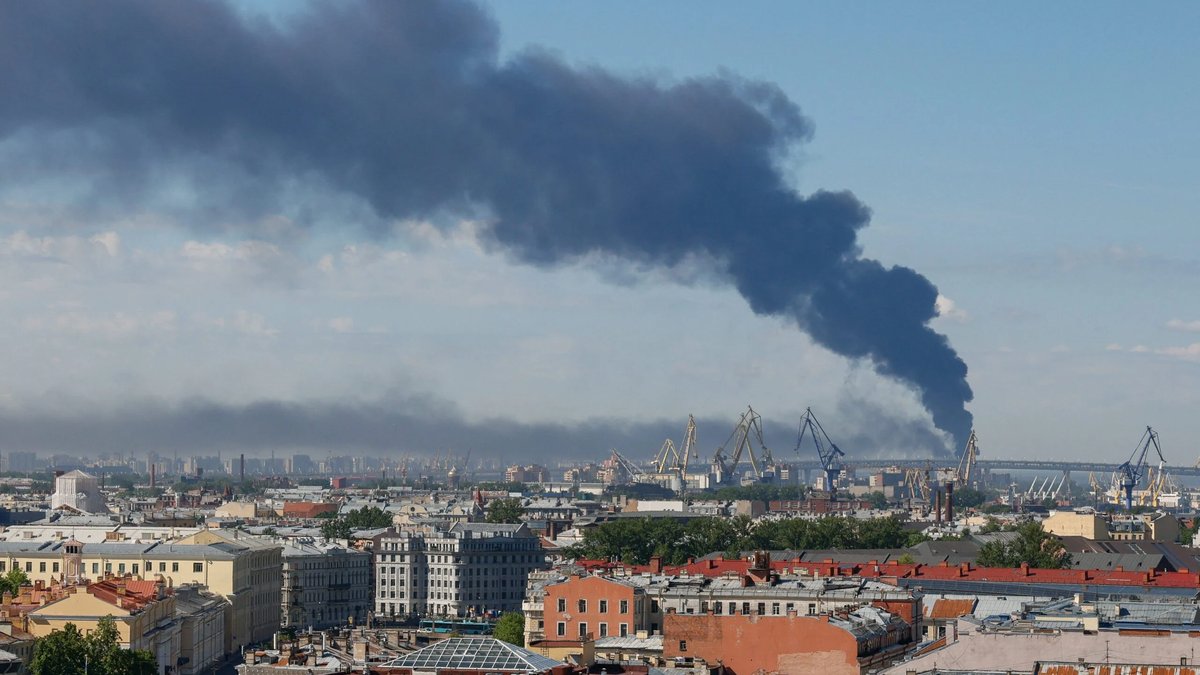
MOSCOW, July 4 (Reuters) – Russia’s second city of St Petersburg and the surrounding region came under a major Ukrainian drone attack overnight on Saturday, with a local port and oil infrastructure hit, Russian and Ukrainian authorities said, as Kyiv’s drone strikes continue to deepen fuel shortages in Russia.
St Petersburg Governor Alexander Beglov said the city of 6 million had been subjected to a “large-scale” drone attack, with the city’s oil terminal struck. He said there were no casualties and that the aftermath of the attack had been dealt with.
Alexander Drozdenko, governor of the surrounding Leningrad region, said a drone had struck the area of Vysotsk port, about 170 km (105 miles) northwest of St Petersburg on the Baltic Sea. The port handles oil, grain, coal and liquefied natural gas.
Drozdenko said 72 drones had been shot down over the region, and there was minor damage in several settlements. He gave no information on the impact on Vysotsk port.
In a post on Telegram, Ukrainian President Volodymyr Zelenskiy said: “Ukraine’s defense forces struck port oil infrastructure that generates revenue for Russia’s war, and also hit Kronstadt, an important military target more than 850 km (530 miles) from Ukraine’s state border.”
There was no Russian confirmation of a strike on Kronstadt, a major naval base near St Petersburg that Ukraine also targeted in an earlier attack in June.
Ukraine has intensified strikes on Russian energy infrastructure this year, inflicting major damage on refineries and causing gasoline shortages across the country’s 11 time zones.
Russian state news agency TASS reported that President Vladimir Putin on Saturday signed into law tax code amendments aimed at supporting the domestic fuel market, including tax incentives for producing high-octane fuel through blending.
In the Leningrad region town of Gatchina on Friday, a Reuters witness saw long queues at fuel stations, with some outlets entirely out of fuel.
One resident waiting in line, who gave his name as Gennadiy, told Reuters: “Standing in queues after work isn’t exactly fun.”
“And then, in a couple of days, I’ll have to stand in queues again, because I’ll run out of gas again.”
Elsewhere, the governor of Russia’s Bryansk region and the Russian-installed governor of Crimea said that drone strikes had killed one person in each region, with several more wounded.
South of St Petersburg, the governor of Pskov region said more than 30 drones had been shot down overnight. He reported minor damage and injuries, including at a factory in the town of Velikiye Luki.
(Reporting by Reuters. Writing by Felix Light; Editing by Mark Potter; Editing by Ros Russell)
(c) Copyright Thomson Reuters 2026.
Editorial Standards · Corrections · About gCaptain
This article contains reporting from Reuters, published under license.
Sentinel — Human
This text exhibits the structure and stylistic variance of professional journalism, successfully synthesizing multiple conflicting claims while relying on specific attributions, indicating a high degree of human editorial oversight.