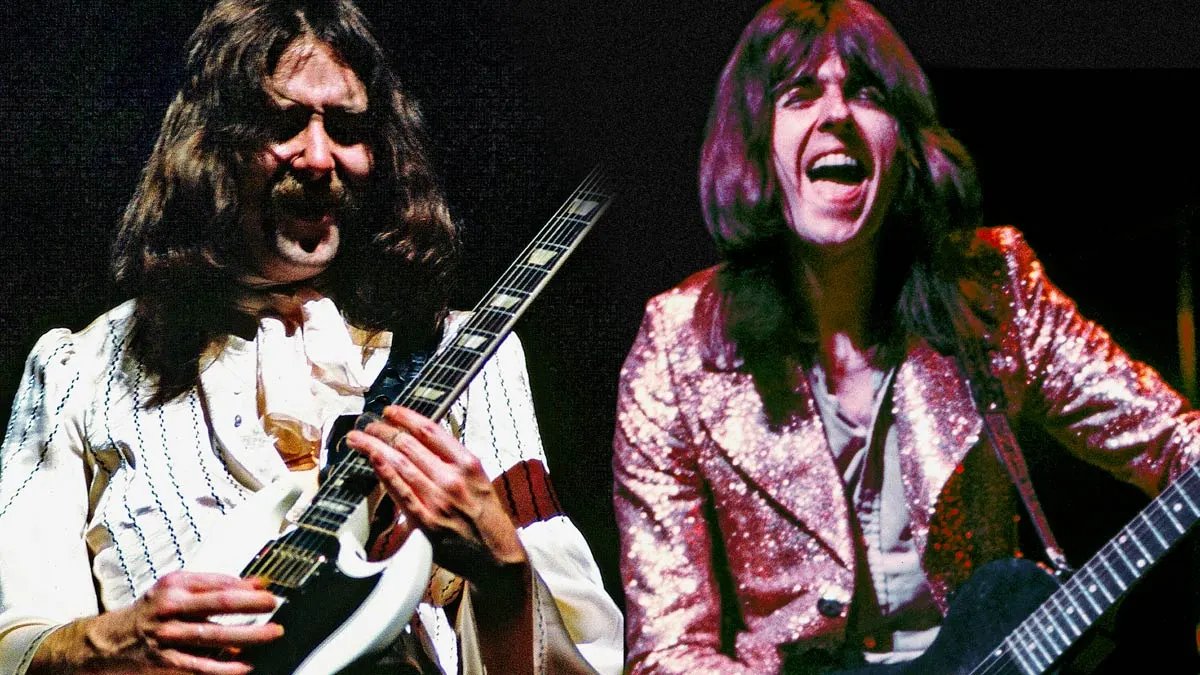
From its opening drum beats, swaggering guitar riffing, bass thumps, and sing-along chorus, Foghat’s “Slow Ride” is one of rock’s enduring epics, anchoring an album that sizzles with blues-rock boogie gusto.
Formed in 1971, Foghat was an offshoot of the British band Savoy Brown; vocalist/rhythm guitarist “Lonesome” Dave Peverett, bassist Tony Stevens, and drummer Roger Earl left Savoy to join lead/slide guitarist Rod Price. Relentless touring promoted the band’s first four albums, starting with 1972’s Foghat and its blistering cover of Willie Dixon’s “I Just Want to Make Love to You.” Success was building, but the grueling pace led Stevens to depart. Nick Jameson joined as bassist informing the band he would stay on for one year. With Jameson also serving as producer, sessions for Fool for the City took place in 1975 at Suntreader Studios in Sharon, Vermont.
“It was the first time the band took three months off,” Earl told Vintage Guitar. “Nick had just joined and we rehearsed at a house Rod and I had in Long Island. We soundproofed the basement. Nick was an absolutely brilliant arranger, with a vast knowledge of all things music and [the ability to] play dozens of different instruments.
“It was a lot of fun making the album. Everybody was also at the top of their game, musically. Dave was as good a writer as he was a guitar player, and Rod was just absolutely brilliant – he knew he was at the top of his game, which I think put a lot of pressure on him. The band didn’t, but he wanted to be the best that he could, and he pressured himself.”
The rollicking title track was a team effort.
“I remember Dave had the basic lyrics and sort of how it was going to go,” said Earl. “Nick added the arrangement. Rod’s guitar playing was fantastic and turned it all around; every time we’d play the song, we’d find something new to put in, or Nick would say, ‘Let’s try this next time.’ But it was fun.”
The song reached #45 on the Billboard singles chart. “My Babe” was a minor 1963 hit for The Righteous Brothers.
“We were on the road supporting Humble Pie. Dave and I would hang out with (vocalist/guitarist) Stevie Marriott,” remembered Earl. “He recommended it to us, and Nick said he did that song in his first band. Stevie and Dave, musically, were like two peas in a pod.”
The album’s first single, “Slow Ride” came from a jam recorded in two sessions because power went out in the first.
“It’s basically a John Lee Hooker riff played in a straight 4/4 instead of a shuffle,” said Earl. “Dave had some lyrics, Nick did all the arranging. To be fair, Nick should’ve got credit for co-writing it, and probably Rod, as well, but that’s another story. The song took on a life of its own.”
Despite running more than eight minutes, the song was getting radio airplay even before its actual release as a single. Cut down to 3:56, it reached #20 on Billboard.
The band’s take on Robert Johnson’s “Terraplane Blues” includes extensive slide soloing from Price.
“Rod was a Robert Johnson fan, as was Dave,” Earl said. “Rod’s playing on that was beautiful. Nick recently told me he played bass with a slide.”
“Take it or Leave It” is a soulful ballad featuring Jameson’s warm keyboard sound.
“Before Nick was in the band, Dave never sang or wrote anything in such a high, full voice. But Nick encouraged him. It’s a beautiful song.”
Earl praises Jameson’s overall musicianship and production skills. In fact, his talent and Peverett’s love of saxophone led to a now-lost track.
“Nick could pick up an instrument and in half an hour, he’d be playing it. When we were on the road, you always knew where Dave’s room was because you could hear him practicing sax. In Vermont, Dave wrote a song called ‘Going to the Mardi Gras.’ We got to the studio and Nick came in with a soprano sax and decided that we were going to do a horn section on a song, so he wrote some charts. I don’t think Dave could actually read them, but the two of them played horn parts. That’s typical of Nick.
“Unfortunately, the song never made it onto the record, but it was an R&B kind of thing. Nick bought a soprano sax and was playing it within 15, 20 minutes. He is an absolute genius and tons of fun to make records with.”
Fool for the City – with Earl pictured on the cover fishing down a manhole on a Manhattan street – reached #23 on Billboard and went platinum. It has just been reissued for its 50th anniversary with previously unreleased live tracks from two 1975 Chicago shows.
Today, Earl leads Foghat as the lone original member. In 2000, Peverett died of kidney cancer and pneumonia, age 56. Price passed away in ’05 at 57, after a heart attack and suffering head trauma when he fell down a flight of stairs at his home. Jameson, who worked on the Fool for the City reissue, has a varied creative career as an actor, comedian, and voice-over artist.
Earl has many fond memories of the Fool for the City era.
“We were having a blast. Everybody took their music seriously, but we were having fun with it. We were enjoying every moment onstage. It was a good time.”
This article originally appeared in VG’s November 2025 issue. All copyrights are by the author and Vintage Guitar magazine. Unauthorized replication or use is strictly prohibited.
Sentinel — Human
The text reads like authentic biographical journalism, relying heavily on specific anecdotal quotes and deep context that strongly suggests human authorship rather than pure synthetic generation.