Bummerland Sends Up Austin’s MAGA Tech-Bro Culture
A new essay collection by Randolph Lewis chronicles how Elon Musk, Joe Rogan, an Apple campus, and scorched-earth MAGA capitalism killed Austin's famous weirdness — and finds unexpected glimmers of hope even in big-box America.
MAGA may not deliver material benefits for the vast majority of its adherents, but it does provide them with a coherent worldview, demonizing dark-skinned groups (lately Somalis), snooty liberals, and anyone Donald Trump doesn’t like. Sections of the electorate can at least enjoy a flush of superiority while MAGA’s main beneficiaries — the ultrarich, particularly the tech oligarchs who gathered at the White House on Inauguration Day 2025 — wreak havoc on regions and communities that backed Trump.
That’s hardly a formula for long-term sustainability, but it does befit the era of scorched-earth capitalism. Randolph Lewis’s Bummerland: Ruin and Restoration in Trump’s New America is a collection of dispatches from Austin, Texas, and beyond exploring the culture of the transformative moment.
A fluid stylist with a keen eye for detail, Lewis states at the outset that his collection of thirty-five short essays aims to illustrate why the contemporary United States “often feels more like a woodchipper for the soul than a safe place to call home.” Although he is more interested in diagnosis than prescription, Lewis advocates what he calls a “soft revolution,” one that emphasizes “networks of neighborliness and compassion.”
Randolph, whose previous books have profiled radical documentary filmmakers, is a professor of American studies at the University of Texas at Austin. The climate is increasingly hostile to his kind. In mid-February, the university system’s board of regents decreed that faculty should steer clear of “unnecessary controversial subjects” in their classrooms, which many interpret as an attempt to chill left-leaning instruction.
In Bummerland, Lewis ruminates on how Austin’s once-famed “weird” iconoclasm became a thing of the past. These days, he notes, the city is “home to super bros like Elon Musk, Joe Rogan, and thousands of California transplants who have turned ramshackle hippie cottages into multimillion-dollar acquisitions.” In 2019, Trump visited the North Austin site of Apple’s second campus, which opened in 2022.
Apple’s billion-dollar project produces an ivory tower of a different sort. As Lewis describes it, building “surfaces are as white and perfect as a new set of dentures, and everything feels precisely engineered in a way that is overpowering.” Lewis contrasts the presence of the now-multitrillion-dollar company with the homeless encampments that have sprouted up nearby. “There’s something broken in this place’s soul!” lamented Texas Monthly about its hometown not long after Apple opened its doors.
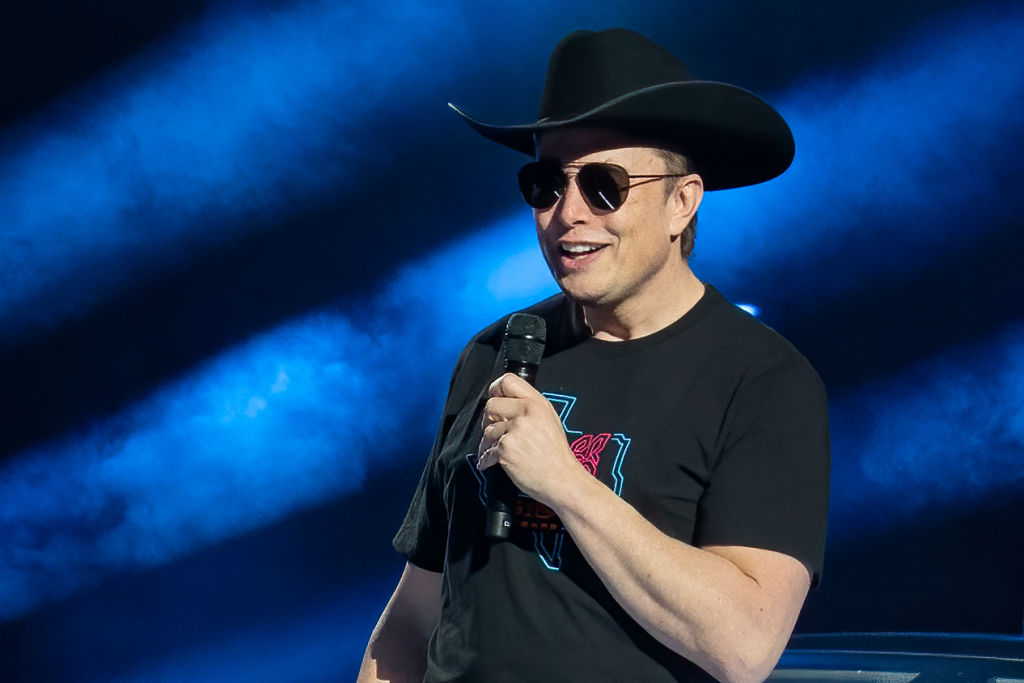
In a separate entry, Lewis visits the imposing Tesla Gigafactory near Austin, which is the second largest building in the world (trailing only a Boeing factory in Everett, Washington). Musk’s enthusiasts, Lewis surmises, live vicariously through his exploits. Above all, Musk has shown how an “ordinary human male” can experience a “metamorphosis from unloved wanker to glorious tech god soaring above the multitudes.” Musk, who is the world’s richest man and on track to be its first trillionaire, splits time between Austin and the Texas coast. The archetypal podcaster Joe Rogan, who has lived in Austin since 2020, is always ready to absorb and disseminate his buddy’s babbling self-aggrandizement.
Lewis later journeys to Las Vegas, where he checks out Musk’s ongoing Loop project, which shuttles people around in tunnels via Teslas. “In a chauffeured electric car,” Lewis reports, passengers “ride around for a few minutes, then emerge a few blocks away, not much faster than a person can walk.” The project has not delivered anything close to metro-level throughput. In other words, Musk took over $80 million of public money to try and fail to replicate the efficiency of an ordinary urban subway. Many cities are falling under the spell of what Lewis usefully labels Muskism, “a charismatic new strain of techno-capitalism” ramming through overhyped megaprojects that advance oligarchs’ private agendas.
In addition to his insightful sketches of our dystopian present, Lewis finds seeds of a more hopeful future planted in unexpected places. On a hot Sunday in Austin during the pandemic, Lewis seeks the cool air inside a Target, wryly noting that like most Texans, his motto is “no AC, no me.” In the “bright, clean” aisles, he finds “existentialist drama,” where customers graze and gather “stuff you don’t really love but are willing to accept as good enough.” It’s far from utopia, but like his fellow shoppers, he writes, “I am grateful that Target is tidy, air-conditioned and safe.”
Target’s main competitor also provides a dose of unexpected comfort. During the pandemic, Lewis and his wife traveled to a Walmart Superstore in Buda, one hour from Austin, to get vaccination shots. Instead of the long line he expected, friendly staff escorted Lewis to his appointment, and “an elegant man with an Indian name” boosted both the writer’s immune system and his spirits. Even in soulless surroundings like big-box stores, Lewis suggests, there are building blocks of community and what he refers to as our shared “emotional infrastructure.” His Target and Walmart entries make it clear that Lewis is determined not to write off big-box America as devoid of humanity or beyond hope.
About two years after the 2022 mass shooting in Uvalde, Lewis visited the indelibly scarred small town eighty miles west of San Antonio. In November 2023, Uvalde’s town square unveiled twenty-one murals honoring the lives of the nineteen students and two teachers killed. The tributes provide a “powerful expression of collective mourning,” Lewis says, adding that their “homemade qualities make them even more poignant.” The author juxtaposes the murals’ “brilliant expressions of love” with Uvalde’s other tourist attractions, including a machine-gun amusement park that allows patrons to fire weapons such as a Vietnam War–era flamethrower with a range of 260 feet.
It would be easy to fault Lewis for not ending his collection with a programmatic list of policy remedies to address the many ills he describes. The problems that he presents, however, are colossal in scope. Incisive and witty, Bummerland instead urges readers to reflect on both the weirdness and promise of everyday experience and to make authentic contact with fellow witnesses to stay sane amid the current madness.
Facts Only
Randolph Lewis is a professor of American studies at the University of Texas at Austin.
The article discusses Austin's transformation from a city known for its "weird" iconoclasm to one dominated by wealthy transplants like Elon Musk and Joe Rogan.
Apple opened a campus in North Austin in 2022, following a billion-dollar project started in 2019.
Tesla operates a Gigafactory near Austin, the second largest building in the world.
Musk splits his time between Austin and the Texas coast.
Joe Rogan has lived in Austin since 2020.
The article mentions a Target Superstore in Texas and a Walmart Superstore in Buda, one hour from Austin.
In November 2023, Uvalde's town square unveiled twenty-one murals honoring victims of a 2022 mass shooting.
Executive Summary
Full Take
The article presents a narrative of the transformation of Austin, Texas, from a unique and eccentric city to a hub for tech oligarchs, with Musk and Rogan serving as prime examples. This shift is framed as a loss of Austin's "weird" identity and a reflection of MAGA capitalism's impact on local communities. Lewis's critique extends to big-box stores like Target and Walmart, where he finds pockets of humanity amid soulless surroundings. In Uvalde, he encounters both powerful expressions of community mourning in the form of murals and a jarring contrast in the form of a gun amusement park. Throughout the piece, Lewis emphasizes the importance of neighborliness, compassion, and finding hope in unexpected places.
Patterns detected: ARC-0024 Ambiguity (Lewis's call for a "soft revolution" is not explicitly defined), ARC-0038 Emotional Exploitation (the article uses emotional language to describe the loss of Austin's "weird" identity and the presence of big-box stores).