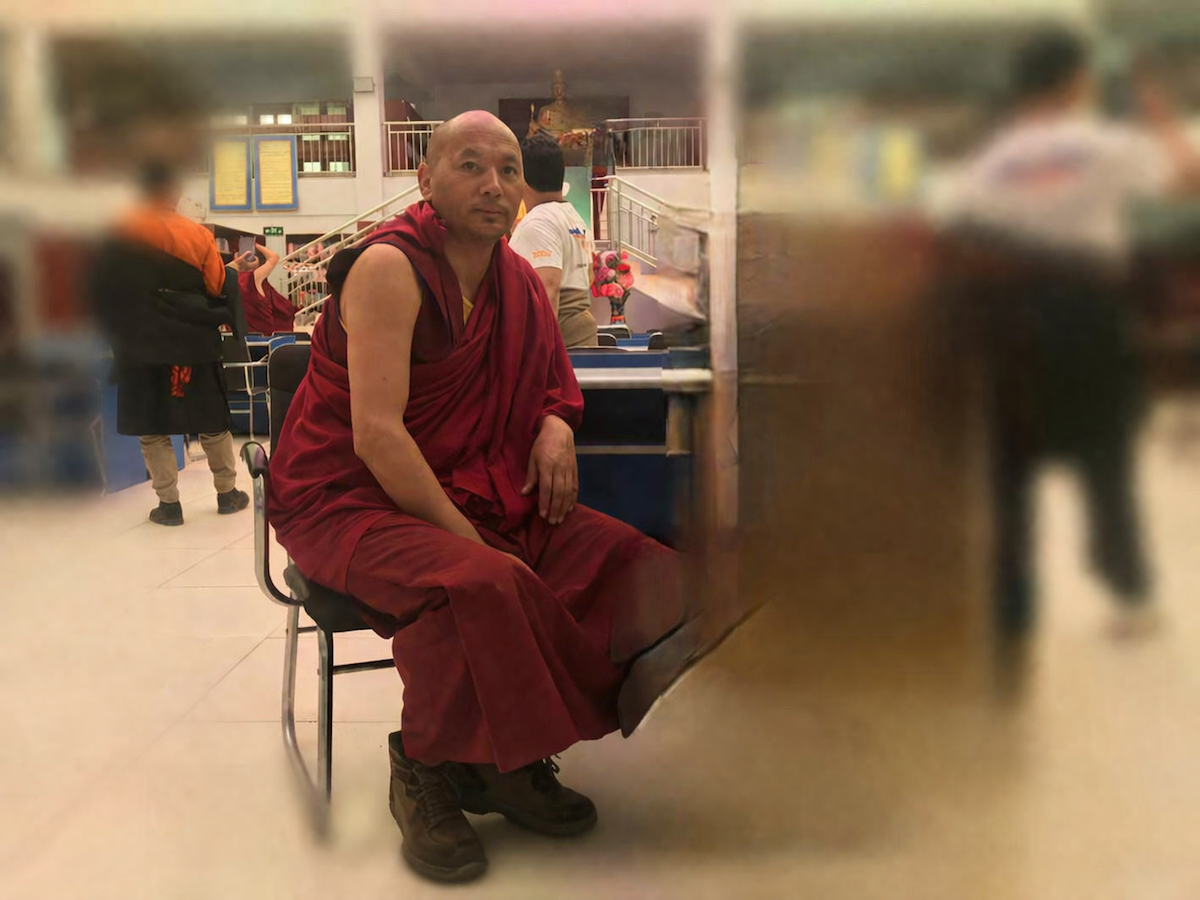
Tenzin Nyidon
DHARAMSHALA, March 23: Ven. Zega Gyatso, a Tibetan monk from Tsang Monastery in Ba County, Tsolho (Hainan Tibetan Autonomous Prefecture), has reportedly been released after six months of detention by Chinese authorities. However, he continues to suffer from deteriorating health and strict state surveillance, according to a Dharamshala-based Tibetan media outlet, Tibet Times.
The 48-year-old monk, a native of Sog County in Malho (Huangnan), was detained around July 2 last year on allegations of sending money abroad. At the time of his arrest, he had traveled to Xining city to seek treatment for an existing health condition. Sources state that Chinese police apprehended him there and forcibly took him away, after which he was held incommunicado and subjected to extended interrogation for nearly six months before being released on January 2 this year.
According to the report, his health has significantly worsened during his detention. He is reportedly suffering from joint pain, knee problems, and severe deterioration in his eyesight. While he had no prior history of vision issues, it is believed that prolonged exposure to intense electric lighting during detention contributed to the damage to his eyes. Despite his condition, access to detailed medical information remains limited due to ongoing restrictions.
Following his release, authorities have imposed stringent surveillance measures on the monk, closely monitoring his movements and daily activities. Just three days after returning home, he was summoned again to Xining, where he was reportedly compelled to sign a document pledging that he would not engage in any activities deemed contrary to the interests of the Chinese government.
Although Zega Gyatso is said to have returned to his monastery after the Tibetan New Year (Losar), his current condition and circumstances remain unclear. Sources cite the pervasive climate of fear and tight restrictions as major obstacles preventing further information from emerging.
The monk’s family has long been under scrutiny by Chinese authorities. Since the detention of his cousin, Khedrup Gyatso, in 2008, several relatives and associates have been subjected to heightened surveillance, repeated interrogations, and warnings over alleged contact with individuals abroad. They have also faced ongoing harassment, including arbitrary summons to local police stations.
Zega Gyatso, the eldest of six siblings born to his father, Sowang, and mother, Tashi, traveled to India in 2002, where he studied for approximately a year at Sera Monastery before returning to Tibet in 2003. He later continued his education at Ragya Sherig Norling School. Prior to his detention, he served as a Tibetan language teacher at the Tsang Monastery’s Lekshe Ling School, an institution dedicated to the study of the Five Major Sciences.
Facts Only
Ven. Zega Gyatso, a 48-year-old Tibetan monk from Tsang Monastery in Ba County, Tsolho (Hainan Tibetan Autonomous Prefecture), was detained by Chinese authorities around July 2, 2023.
He was released on January 2, 2024, after nearly six months of detention.
The detention was reportedly linked to allegations of sending money abroad.
At the time of arrest, he was in Xining city seeking medical treatment for a pre-existing health condition.
During detention, he was held incommunicado and subjected to extended interrogation.
His health deteriorated during detention, with reported joint pain, knee problems, and severe eyesight deterioration.
Authorities imposed strict surveillance on him post-release, monitoring his movements and daily activities.
Three days after his release, he was summoned to Xining and compelled to sign a document pledging not to engage in activities against Chinese government interests.
His family has faced long-term scrutiny, including the 2008 detention of his cousin, Khedrup Gyatso.
Relatives and associates have been subjected to heightened surveillance, interrogations, and warnings over alleged foreign contacts.
Zega Gyatso studied in India at Sera Monastery in 2002 and later at Ragya Sherig Norling School.
Prior to detention, he worked as a Tibetan language teacher at Tsang Monastery’s Lekshe Ling School.
Executive Summary
Ven. Zega Gyatso, a 48-year-old Tibetan monk from Tsang Monastery in Ba County, Tsolho (Hainan Tibetan Autonomous Prefecture), was detained by Chinese authorities around July 2, 2023, on allegations of sending money abroad. He was held incommunicado for nearly six months before being released on January 2, 2024. During his detention, his health deteriorated significantly, with reports of joint pain, knee problems, and severe eyesight deterioration, possibly due to prolonged exposure to intense lighting. Upon release, he remains under strict state surveillance, with authorities monitoring his movements and compelling him to sign a document pledging not to engage in activities deemed contrary to Chinese government interests.
Zega Gyatso’s family has faced long-term scrutiny, including the 2008 detention of his cousin, Khedrup Gyatso, and ongoing harassment of relatives. Before his detention, Zega Gyatso served as a Tibetan language teacher at Tsang Monastery’s Lekshe Ling School. His background includes studies in India at Sera Monastery and Ragya Sherig Norling School. The broader context involves systemic surveillance and restrictions on Tibetan monks and their families, with limited access to medical care and persistent fear of reprisal for perceived dissent.
Full Take
The strongest version of this narrative highlights systemic repression of Tibetan religious figures under Chinese rule, with Zega Gyatso’s case exemplifying broader patterns of arbitrary detention, health neglect, and coercive surveillance. The report credibly documents his deteriorating physical condition, the lack of due process, and the state’s use of forced pledges to suppress dissent. The inclusion of family history—such as his cousin’s 2008 detention—reinforces the generational nature of this repression, while his educational background in India adds context to potential motivations for targeting him.
Patterns detected: ARC-0043 Motte-and-Bailey (state justifies actions under "national security" while obscuring specific evidence), ARC-0024 Ambiguity (vague allegations like "sending money abroad" without clarity on legality or intent).
Root cause: The narrative reflects China’s paradigm of securitizing ethnic and religious identity, where Tibetan autonomy is framed as a threat to state stability. Unstated assumptions include the presumption that any foreign contact or financial activity is inherently suspicious, echoing historical patterns of colonial control over minority regions.
Implications: Human agency is severely constrained—Zega Gyatso’s forced pledge and surveillance illustrate how dissent is preemptively crushed, not just punished. The costs are borne by individuals and communities, with second-order effects including self-censorship and erosion of cultural institutions like monasteries. The state benefits from a climate of fear, while international observers face limited access to verify conditions.
Bridge questions: How might China’s legal framework justify detentions like this, and what recourse exists for those targeted? What role do educational ties to India play in shaping Chinese authorities’ perceptions of Tibetan monks? What would it take to shift this dynamic—diplomatic pressure, internal reform, or something else?
Counterstrike scan: A coordinated influence campaign would amplify emotional appeals (e.g., framing this as "religious persecution" without nuance) or omit context (e.g., China’s broader security policies). This report avoids such tactics, presenting verifiable details without overt manipulation. The content does not align with a hypothetical attack playbook.
Sentinel — Human
The article shows strong signs of human authorship, with specific details, erratic sentence structure, and contextual depth that are inconsistent with AI generation.