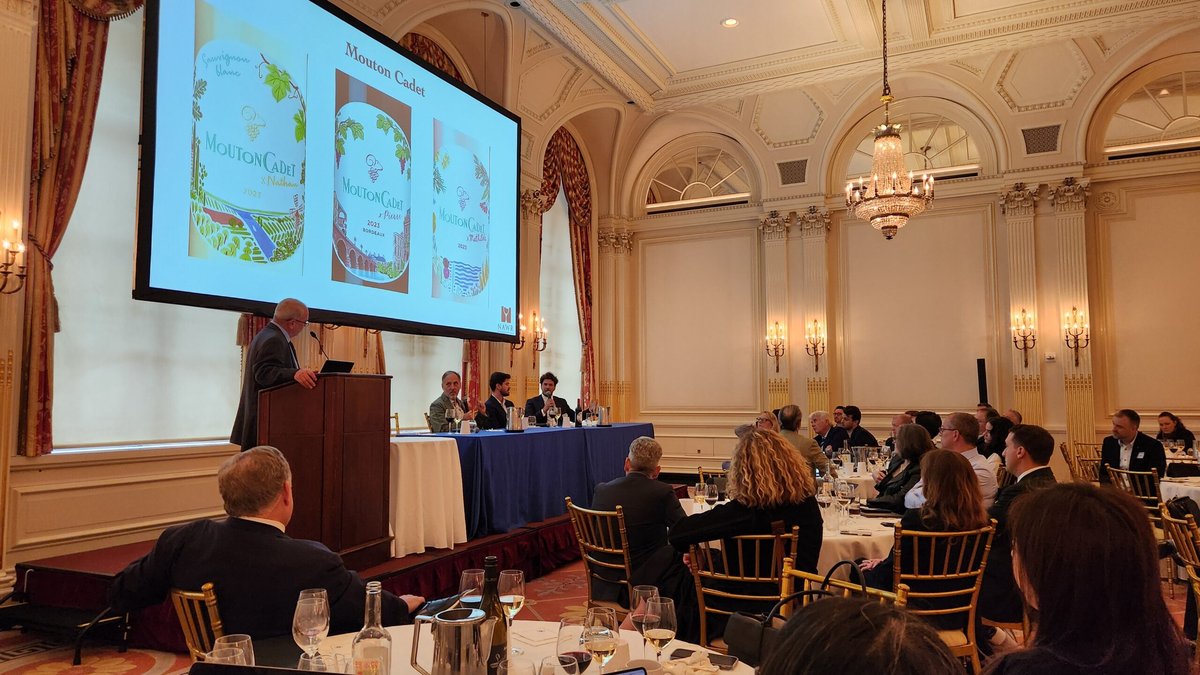
Robbie Stevens, Head of Broking at Liv-ex presented at NAWR (National Association of Wine Retailers) to discuss where Bordeaux is, and where it’s heading.
NAWR is the National Association of Wine Retailers, and they hold an Annual Summit in the US each year. I’ve now attended and been invited to speak at the last five NAWR summits, and this years event was certainly one of the most memorable – strong attendance, coupled with excellent content, and most importantly, fantastic engagement from the US wine trade.
Around 100 people were in the room, representing 50 to 60 businesses. As expected, retailers dominated, but there was a mix: logistics providers, lawyers, tech platforms, ERP systems, and press.
For Liv-ex, it was a valuable audience with a mix of members, service providers as well as plenty of new faces.
A recurring theme: the wine industry continues to struggle with data
One of the standout sessions came from Andrew Sussmann, CTO and co-founder of Preferabli. Andrew’s keynote was centred around AI and its adoption within the wine trade. One of his principal points will be familiar to most: the wine industry still struggles with data standardisation -particularly naming conventions.
What was interesting was where the conversation went next.
An audience member asked whether Andrew had heard of LWIN, and asked why the industry hasn’t coalesced around it in the same way publishing settled on ISBN. Sussmann’s response was ‘we love LWIN, it is by far the best standardisation out there and we encourage all our users to adopt it, but coverage remains a constraint.”
It’s always nice to hear other people championing Liv-ex, without the need to weight in.
Regulation, restriction, and the shifting US retail landscape
NAWR’s focus remains consistent: tackling the inefficiencies and barriers created by interstate shipping restrictions and the three-tier system – bureaucratic legislature dating back to the post-prohibiltion era.
If anything, the urgency is increasing.
Alongside structural constraints, US retailers are now dealing with a broader cultural and regulatory shift. The rise of anti-alcohol lobbying continues to gather momentum, with increasingly visible campaigns – particularly in cities like New York. At the same time, changing consumer behaviours, partly influenced by GLP-1 drugs, are seemingly having an impact on demand.
Several retailers reported softness in lower price points, while fine wine remains comparatively resilient.
There’s also growing competition from adjacent categories. CBD drinks, currently operating under a much looser regulatory framework, are expanding quickly, creating an uneven playing field. That said, many expect tighter regulation to follow.
The net effect is a market that is becoming increasingly complex to operate in, particularly for businesses reliant on volume-driven models.
A market adapting to tariffs, and looking to what’s next
The broader mood across the US trade felt cautiously stable.
Tariffs remain in place, but with a big question mark over them. Businesses have largely adapted. Compared to 2024, there’s a sense that operators are finding ways to manage the impact. There is some optimism following the Supreme Court ruling earlier this year declaring certain tariffs illegal, although uncertainty remains around enforcement and refunds. Many also fear that with the liberation day tariffs in question, other tariff triggers such as Digital Services Taxes might resurface; there is also the question of the unresolved Boeing/Airbus dispute.
From a supply perspective, there are early indications the auction market is beginning to recover, suggesting that previously imported European stock has largely worked its way through the system. If sustained, that should be a positive signal for import demand as a gap in the market begins to appear, and then grow.
Bordeaux: a timely conversation
I joined a panel alongside Jeff Zacharia and Pierre Ogden de Rothschild to discuss where Bordeaux is, and where it’s heading.
As we were in the midst of a Bordeaux En Primeur campaign, it was a timely discussion.
For many in the room, this was an opportunity to engage more directly with market data and pricing dynamics. The level of audience participation suggested strong interest – not just in Bordeaux as a category, but in how it’s evolving within a broader global market context.
Encouragingly, the conversation didn’t stop when the panel ended. Over the following 24 hours, there were multiple follow-ups on the topic itself, and on how tools like Liv-ex can help inform decision-making.
To download Robbie’s presentation slides, please fill out the form here.
Lasting Takeaways
What NAWR reinforced is that US wine retail is becoming more nuanced:
- Regulation remains a defining constraint
- Consumer behaviour is shifting at the lower end
- Competition is broadening beyond traditional wine
- Data, and the ability to use it effectively, is increasingly critical
For businesses navigating this, access to accurate pricing, liquidity, and global supply is no longer a nice-to-have – it’s fundamental.
The US remains one of the most dynamic, and complex, wine markets globally. Events like this are a useful reminder that while the challenges are evolving, so too is the industry’s willingness to adapt.
Sentinel — Human
The text functions primarily as reflective industry reporting, successfully blending specific event details with high-level market trends. It displays human-like flow and experience rather than the generalized uniformity typical of pure AI output.