The Indian subcontinent, home to more than 1 billion people, has produced some of the great philosophers, mystics, and spiritual traditions in the great human cultural patrimony.
The so-called Dharmic traditions of India share to some degree core notions of cosmic order and duty (dharma), moral and cosmic justice (karma), belief in reincarnation (samsara), and spiritual enlightenment (nirvana or moksha).
Religions and philosophical schools as diverse as Hinduism, Buddhism, Jainism, and Sikhism are among the Dharmic traditions, but what do these traditions have in common with Western philosophical and religious thought, and is mutual understanding possible even when beliefs are ultimately incompatible?
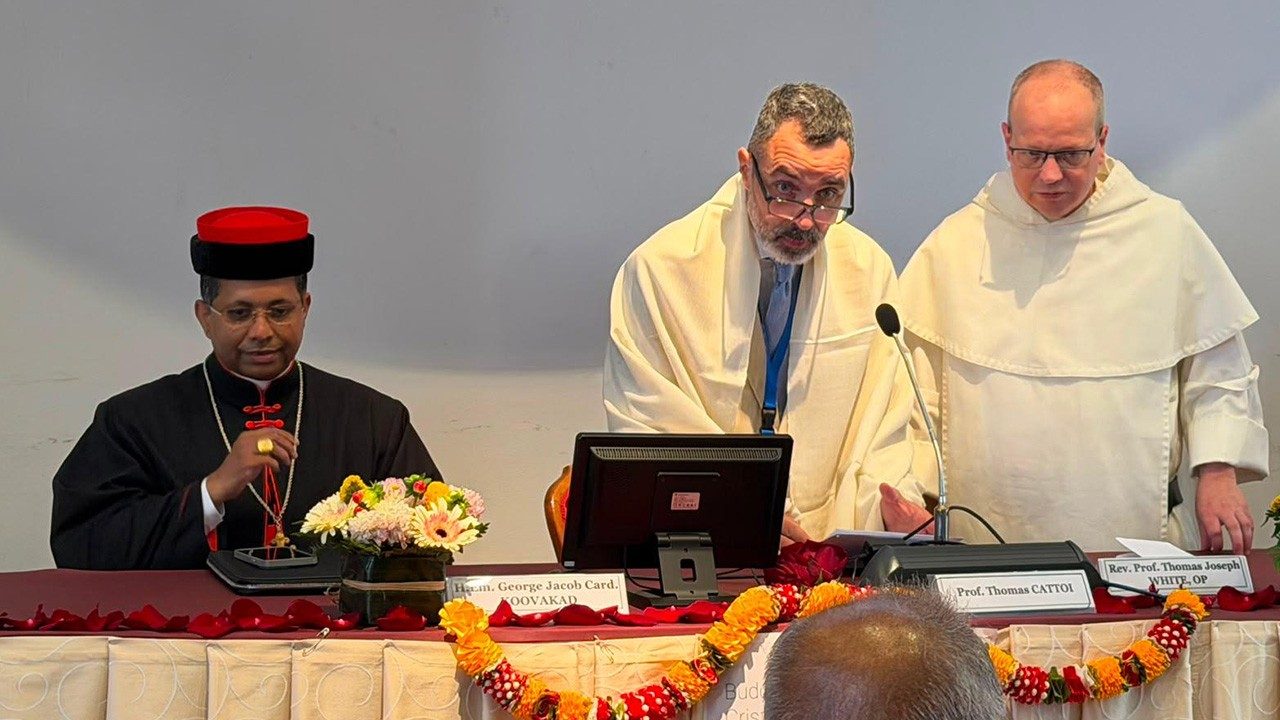
That was a question facing participants in a conference earlier this month at the Pontifical University of St. Thomas Aquinas – the Angelicum – who gathered to explore theme: “Buddhists, Christians, Hindus, Jains and Sikhs in Europe: Building Fraternity through Dialogue and Collaboration.”
The conference was organized by the Dicastery for Interreligious Dialogue in partnership with the Council of European Bishops’ Conferences, the Focolare movement, the Institute for Interreligious Relations at the Angelicum, the Hindu Forum of Europe, the European Buddhist Union, the UK-based Institute of Jainology, and the Sikhi Sewa Society of Italy.
This month’s conference was the sequel to another held last year at Rome’s Pontifical Gregorian University, which focused closely on the cross-cultural realities of life and dialogue in Italy.
The June 23 – 24 gathering at the Angelicum brought together religious leaders, academics and representatives of Christian and Dharmic traditions throughout Europe to promote human fraternity through dialogue and cooperation.
Monsignor Michael Santiago, responsible for the dicastery’s dialogue with the Indian and broadly Asian civilizational areas, told Crux Now the event was to mark the 40th anniversary of the 1986 World Day of Prayer for Peace convened by St. John Paul II in Assisi.
“The conference,” Santiago said, “underlined the need for Christians and adherents of Dharmic religions in Europe to build bridges.”
“Pope Leo XIV has been exhorting people from Day One of his pontificate to ‘defend and promote peace, justice and human fraternity” through dialogue, collaboration and social friendship’,” he said, explaining that the conference aimed to do just that.
Discussions centered on the challenges confronting contemporary societies, including armed conflicts, social fragmentation and increasing cultural tensions.
Participants stressed dialogue and collaboration across religious and cultural communities as indispensable for fostering mutual understanding, solidarity and hope, and affirmed fraternity as the cornerstone of peaceful, inclusive and cohesive societies.
“The concept of fraternity is often considered a utopian idea,” said the prefect of the Dicastery for Interreligious Dialogue, Cardinal George Koovakad, in his opening address.
Fraternity, he said, is certainly “seriously undermined” in the present “by crimes against humanity, wars, violence, conflicts, divisions, discrimination and hatred in various parts of the world.”
“Yet [Fraternity remains a concrete and lived reality,” the cardinal said, “able to endure even in a world marred by hatred and conflict.”
Koovakad also recalled the “Spirit of Assisi” in his remarks, noting both the 40th anniversary of the first World Day of Prayer for Peace in the Umbrian city of St. Francis and the coming 800th anniversary of the saint’s death, on October 3rd of this year.
For Koovakad, both Pope Francis’s encyclical, Fratelli Tutti, and Leo XIV’s appeals for bridge-building dialogue and collaboration work from a core premise: Lived fraternity is “stronger than conflicts, differences and tensions,” and can turn cultural and religious diversity into opportunities for mutual enrichment.
Regarding Europe, Koovakad said the continent and its peoples boast “a cultural and religious heritage that proudly testifies to the flourishing of diverse groups and their integration throughout history.”
Today, Europe is “a rich melting pot” of cultures, peoples, languages, and religious traditions.
Koovakad said it is crucial to appreciate this European heritage in order to foster “an inclusive, cohesive, and harmonious society,” in which the rights and dignity of every human person are respected, “including the right to profess and practice one’s religion.”
Among the representatives of the Dharmic traditions was Parabhakti Dasa of the International Society for Krishna Consciousness, founded by an itinerant Hindu spiritual teacher in New York in the mid-1960s.
Rapid growth gave way to controversy roiled the broader movement of which the Society was an outgrowth, while financial turmoil in the 1980s and radical social experimentation contributed to crisis and reform within the movement, which began in the 1990s to adopt a family-centered and congregational approach to its organization.
The International Society for Krishan Consciousness has a million members worldwide.
There are roughly 100 temples and cultural centers of the Society serving several thousand congregants throughout Europe, many of them part of the Indian diaspora.
Dasa wrote a travelogue of his experience in Rome for his organization’s news agency, ISKCON News.
Dasa wrote of the moving experience conference participants shared when they attended Pope Leo XIV’s weekly General Audience on June 24, calling it “a deeply significant moment that gave an added spiritual dimension to the gathering.”
“For many of the participants,” Dasa wrote, “standing together in one of Christianity’s most sacred spaces, having spent two days in dialogue about fraternity and peace, was itself a powerful living testimony to what interreligious encounter can look like in practice.”
Sentinel — Human
This is a well-sourced report detailing an interreligious conference, characterized by balanced reporting of official statements and a focus on themes of peace and cooperation across diverse belief systems.