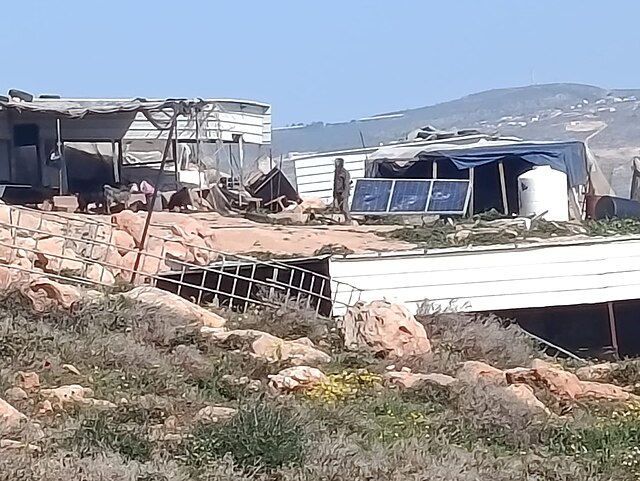
Israel has killed at least 26 Palestinians in the West Bank since the beginning of the year, of whom at least eight were murdered by settlers.
By Ashley Miller
Common Dreams
As Muslims around the world celebrated an end to the holy month of Ramadan, Palestinian communities across the West Bank were violently assaulted by Israeli settlers in what witnesses describe as coordinated attacks.
Masked settlers — many under military protection — carried out raids in at least 12 locations, according to multiple reports and video footage. They burned cars, homes, and used weapons, including guns, grenades, rocks, live fire, and pepper spray, to inflict pain on Palestinians.
The West Bank is one of two enclosed regions where Palestinians live under Israeli control, the other being the war-torn Gaza Strip.
But Israeli settlers, with the support of a far-right government and the silent complicity of many Israelis, have sought to take this land. Israel has killed at least 26 Palestinians in the West Bank since the beginning of the year, of whom at least eight were murdered by settlers.
Palestinian communities across the West Bank were violently assaulted last weekend by Israeli settlers in what witnesses describe as coordinated attacks. On Monday, the widespread violence continued.
In Hebron, the largest city in the West Bank, Israeli soldiers detained six Palestinians, including a journalist, after raiding and vandalizing their homes. The Israel Defense Forces also set up checkpoints around the city and surrounding villages, “closing multiple main and secondary roads with iron gates, concrete blocks, and earth mounds,” according to the Palestinian News Agency Wafa.
Attacks by Israeli settlers and soldiers have become more brazen since America and Israel escalated their war in the region. The United Nations estimates that Israeli soldiers and settlers have murdered at least 15 Palestinians since the start of the Iran war in late February.
In a brutal report in The New York Times on March 18, for example, a Palestinian man had his genitals mutilated — in front of his family — and 400 sheep stolen by some 20 Israeli settlers. The account is almost too harrowing to put to words.
Suhaib Abu Kbash reported being sexually assaulted and beaten by approximately 80 masked Jewish settlers during an attack on the Bedouin community of Humsah on March 13.
More Here ? https://t.co/TNSSAOXrGn pic.twitter.com/1QWLjJdGCV
— PiQ Newswire (@PiQNewswire) March 20, 2026
Imagine you are a Bedouin: a nomad, a villager in the Middle East. In Israel, this often means you are looked on as a peasant — and there’s no doubt you are Palestinian. You’re a woman, a mother. You live in a tent. Your life is seen as a threat by men across a border they built — the separation wall enclosing Palestinians in the West Bank.
A group of settlers arrives. Some 20 men beat you, slap your children, pull you out of your tent — your home — by your hair. They demean you for existing. They tie up your husband, strip him naked, cut his boxers with a knife, and tie his penis with a zip tie. Imagine that. Can you?
That’s the story of Suhaib Abualkebash, 29, in the report I mention above in the Times. “This is slow death,” Niama Abualkebash, 28, said of the attack on her husband. “Doing this to a man is to kill him.”
Human rights activists staying in the Bedouin community — a common tactic used to deter settler attacks in the past — were among those beaten by the settlers. Ava Lang, a 24-year-old American activist, recalled what the settlers said: “They were asking our names, where we’re from, saying, ‘We’re going to kill you,’ and ‘This is our land; we’re Jewish.’”
After beating the family, including a 3-year-old, the settlers stole family wedding rings, cellphones, cash, and identification papers. The brother of the man who had his penis mutilated, Muhammad Abualkebash, 40, recalls what the settlers said next.
“They said; ‘If you don’t leave, we will burn you. We’ll hit you. We’ll take your children, and we will rape your women,” he said to the Times. “’Go to America, go to Jordan or anywhere else, but go.’”
Israel has killed more than 72,000 Palestinians — mostly women and children — in Gaza since October 2023. About 1,000 have been killed in the West Bank, where, as the U.N. has reported, young men and boys are at a higher risk for harassment and mistreatment by Israeli settlers and soldiers.
How do Israelis feel about this? From what journalists have observed in the country, only a small portion of Israelis openly oppose violence against Palestinians.
A new poll featured on Israel’s Channel 12 reveals that first-time Jewish Israeli voters, between 18 and 21 years of age, are more right-wing and religious-nationalist in their outlook than older voters.
The poll found that 75 percent of voters described themselves as “right-wing” compared with 68 percent among older voters. The self-identified “left” accounts for only 5 percent.
‘Ethnic Cleansing’
Justice is unlikely for the Abualkebash family — or any of the Palestinians harmed, intimidated, and mutilated by Israeli settlers in the West Bank. Let’s not forget: beyond murder, abuse can extend to injuries, displacement, and destruction of Palestinian homes and farmland.
“Most of the international community views Israel’s presence in the West Bank as illegal,” wrote The Times of Israel on March 17, “though the U.S. under President Donald Trump has been more tolerant.”
Also on March 17, the U.N. unveiled an investigation into settler violence in the West Bank, covering a 12-month period up to November 2025, warning of an “ethnic cleansing” of Palestinians at the hands of Israelis.
The report denounced the Israeli government’s role in aiding settler expansion in the West Bank.
“The Israeli government has accelerated unlawful settlement expansion and annexation of large parts of the occupied West Bank, including East Jerusalem, forcibly displacing over 36,000 Palestinians and increasing violence by Israeli security forces and settlers,” U.N. Human Rights spokesperson Thameen Al-Kheetan said at a briefing in Geneva.
Israel, responding in their usual tone, via the Israeli diplomatic mission in Geneva, accused the U.N. of being anti-Israel. “It does not function as an impartial and neutral human rights office, but as the epicenter of vile anti-Israel activism,” the mission said in a statement.
How can Israel dispute the facts of genital mutilation reported in none other than the Times — a paper often accused of holding sympathy for Israel? I guess just like Donald Trump: by doing it.
Meanwhile, in Gaza, where it’s been less than six months since the so-called ceasefire between Israel and Hamas was brokered, some 680 Palestinians have been killed.
On Sunday, four Palestinians were killed in Israeli strikes in Gaza. At least 10 others were wounded. And last week, the military killed twelve Palestinians in an urban refugee camp. One family of four was among the slain, including a woman who was pregnant with twins.
“We were sleeping and got up to the strike of a missile. The strike was strong,” said Mahmoud al-Muhtaseb, a neighbor. “There was no prior warning.”
Ashley Miller is a freelance journalist and Pulitzer traveling fellow at Columbia University in New York.
This article is from Common Dreams.
Views expressed in this article and may or may not reflect those of Consortium News.
Facts Only
Israeli settlers have killed at least 26 Palestinians in the West Bank since the beginning of the year, with at least eight murders by settlers.
Violent assaults by Israeli settlers involved burning cars, homes, and use of weapons such as guns, grenades, rocks, live fire, and pepper spray.
The West Bank is one of two regions where Palestinians reside under Israeli control, with increased violence since the escalation of conflict in the region with American and Israeli forces.
Israel Defense Forces have detained Palestinians, set up checkpoints, and vandalized homes in the West Bank.
The United Nations estimates that at least 15 Palestinians have been murdered by Israeli soldiers and settlers since February.
Executive Summary
Full Take
The surge of violence against Palestinian communities in the West Bank can be attributed to a combination of factors, including the support of a far-right government in Israel and complicity from many Israelis. The attacks have been coordinated and systematic, involving the use of brutal tactics such as mutilation, beatings, theft, and destruction of property. The Israeli Defense Forces' actions have further escalated tensions, with checkpoints set up around cities and villages, leading to detentions and vandalism of homes. The United Nations has warned of an "ethnic cleansing" of Palestinians in the West Bank, citing the Israeli government's role in aiding settler expansion and annexation.
In this context, it is essential to question the motives behind the violence and consider the implications for human agency and dignity. Who benefits from these attacks, and who bears the costs? What are the second-order consequences of the escalating violence in the West Bank? It's crucial to recognize that a coordinated influence campaign could exacerbate tensions and manipulate perceptions, making it essential to remain vigilant and promote principles of intellectual honesty and principled analysis.
Bridge questions: What role does the Israeli government play in the violence against Palestinian communities in the West Bank? How can human agency be used to challenge and counteract these acts of aggression? What alternative narratives are missing from this story, and how might they change our understanding of the situation?
Sentinel — Human
This text is likely human-written, showing signs of stylometric variance, emotional coherence, and lack of coordination indicators. However, the use of personal anecdotes, emotional appeals, and unique storytelling style suggest that it's a genuine human account.