The Conference of the Left was not a solution to the crisis of the South African left, but an opening. What follows must be built differently from what came before.
The heated debate about the Conference of the Left has once again revealed a recurring weakness in South African left politics: we often start from the question of political form before we have sufficiently confronted the question of social forces. We ask whether there should be a party, a front, a coalition, a movement, a council, an electoral platform or a new socialist formation. These are necessary questions. But taken on their own, they quickly become abstract, voluntarist and organizationally sterile.
The deeper question is this: what social forces, rooted in what struggles, with what organizational capacities, with what ideological clarity, and with what material program, can become strong enough to challenge neoliberalism, capitalism, liberal hegemony, conservative nationalism, white supremacy and the rising Black right wing?
This question cannot be answered by nostalgia for the 1980s and early 1990s, by purist denunciation of the present, or by a schematic call for a new left party. It requires historical honesty, social formation analysis, political humility and a sober appraisal of why previous moments of possible left renewal did not become a sustained counter-hegemonic force.
The Conference of the Left must be understood in this wider perspective. It was not, and could not be, the solution to the crisis of the left. It was an opening—contradictory, uneven, contested, even fraught with weaknesses, but real. Its value lies not in having resolved the organizational question, but in having reopened the strategic question of how diverse forces might begin to relate to one another more deliberately and directionally.
The mistake would be to reduce the Conference either to a messianic breakthrough or to a failed gathering because it did not conform to an imagined purity. The real task is to locate it within the long, uneven and difficult history of left renewal in South Africa.
The historical record
The mass struggles of the 1980s produced one of the most powerful working-class and popular upsurges in South African history. The Congress of South African Trade Unions (COSATU) was not merely a trade union federation. It was part of broader social forces rooted in factories, townships, civic structures, youth formations, women’s organizations, street committees, education struggles, consumer boycotts and local organs of people’s power. Because it carried mass weight, it could confront capital, negotiate with the liberation movement, discipline political leadership, and shape national strategy.
But we must not romanticize this period. The power of COSATU and the mass democratic movement did not automatically translate into a post-apartheid socialist project. The old anti-apartheid historic bloc dissolved under the pressures of post-1994 bourgeois capitulation, demobilization, state incorporation, elite transition, capital’s strategic offensive, global neoliberalism and the ideological authority of the ANC-led national liberation project. The leading personnel of the labor movement were drawn into the state, parliament, state-owned enterprises, policy institutions and managerial structures. The organized working class entered the democratic transition with immense moral and organizational authority, but without sufficient independent strategic power to prevent neoliberal restructuring.
This is why any call to emulate the “heyday of COSATU” must explain why that power was not sustained. What happened to the social movements of the 1980s when the neoliberal project consolidated in the late 1990s and early 2000s? Why did a new historic bloc of popular classes not crystallize in place of the dissolving anti-apartheid bloc? Why did organized labor, despite its militancy and size, become vulnerable to bureaucratization, state incorporation and political dependency? These questions are not historical curiosities. They speak directly to the present.
The first major post-apartheid resistance to neoliberalism emerged through struggles against privatization, cost recovery, service cut-offs, evictions, HIV/AIDS denialism—the Mbeki government’s catastrophic refusal to provide antiretroviral treatment, which cost hundreds of thousands of lives—unaffordable medicines, water commodification and electricity disconnections. The Anti-Privatization Forum (APF), the Soweto Electricity Crisis Committee, the Treatment Action Campaign (TAC), the Landless People’s Movement, Jubilee South Africa, land and housing movements, anti-eviction struggles and other formations expressed the refusal of poor and working-class communities to accept the neoliberal restructuring of the democratic transition.
This period produced important lessons. Movements can emerge outside the formal ANC-SACP-COSATU tripartite Alliance when material conditions compel people to organize. They do not wait for perfect political programs. They arise from the immediate contradiction between people’s needs and the system’s refusal to meet them. The TAC succeeded not only because it litigated or had a good media strategy, but because it combined treatment literacy, mass/grassroots mobilization, legal strategy, international solidarity, scientific knowledge, and moral clarity. Its campaign for access to antiretroviral treatment became a wider struggle over the right to health, the role of the state, pharmaceutical capital, public goods and human dignity. But movements can win reforms without necessarily becoming a durable anti-capitalist historic bloc. These experiences show both the power and limits of issue-based mobilization.
The Marikana massacre of August 2012—in which South African police killed 34 striking mineworkers at Lonmin’s platinum mine in the North West province, the most deadly use of state force against workers since apartheid—marked a rupture in the post-apartheid order. It exposed the violence of the democratic state when confronted by militant workers outside established bargaining and political structures. It shattered illusions about the ANC as an uncomplicated vehicle of working-class liberation. It also opened space for the break between the National Union of Metalworkers of South Africa (NUMSA) and the ANC, and the possibility of a new left initiative.
The “NUMSA moment” was historically important. The union’s break from the Alliance reflected a real crisis and a real search for independent working-class politics. But it also revealed the difficulty of converting a militant union rupture into a mass-based political project without a connection with popular classes as a social force. The United Front initiated by NUMSA could have been a vehicle for broad left renewal. But it never took root as a bottom-up movement of strong local mass formations. It was too nationally convened, too dependent on NUMSA’s initiative, too weakly grounded in sustained local struggles, and too unclear about whether it was a movement, a front, a pre-party, an electoral instrument or a campaign platform.
There is a debate about whether NUMSA collapsed the United Front into the Socialist Revolutionary Workers Party (SRWP). One view is that the United Front had already collapsed around 2015/16 before the formal SRWP process took shape in late 2018. Another view, which we share as an important correction, is that NUMSA’s electoralism and substitutionism appeared much earlier—visible when the United Front was pushed into contesting local government elections in municipalities such as Nelson Mandela Bay, Bitou and Sterkspruit in 2016, without a properly developed municipalist strategy from below and without the necessary consolidation of mass organizations. The deeper lesson is that a union cannot substitute itself for a movement. Nor can a party substitute itself for a historic bloc.
The Democratic Left Front (DLF), initiated in October 2008 and eventually formed in 2011, represented another attempt to build a broad anti-capitalist platform. It carried important eco-socialist, feminist, democratic and anti-neoliberal impulses. But it too failed to become a serious national pole. It did not have a significant mass base. It was heavily shaped by limited activist networks, two major left NGOs, untransformed Trotskyist currents, a few eco-socialists and university-based intellectuals. These forces were valuable, but insufficient on their own. The DLF also lacked a major unifying campaign capable of anchoring it in mass consciousness. Without a campaign, without strong local mass organizations, and without a nationally resonant material program, the DLF could not become the embryo of a new historic bloc.
Any account of left renewal that dismisses Fees Must Fall—the 2015/16 student movement that began as a campaign against university fee increases and expanded into a broader struggle around free decolonized education, outsourcing, and university transformation—as a caricature of US university protest completely misunderstands the history of education struggles in South Africa. The demand for free education has deep roots in the tradition of people’s education for people’s power. Fees Must Fall was uneven, contradictory and sometimes politically incoherent. It carried radical, progressive, nationalist, feminist, Black Consciousness, decolonial, liberal and even conservative elements. But this is exactly what mass movements are. They are not born pure. The left failed to consolidate Fees Must Fall into a durable youth-student-worker alliance. The lesson is not that Fees Must Fall was inadequate. The lesson is that the left was inadequate to the possibilities it opened.
The social formation today
Left renewal must begin with the society we are in, not the society we remember. Post-apartheid capitalism has restructured the working class in keeping with the main positions of neoliberalism: privatization, deregulation, market expansion to public goods, flexible labor markets, trade and industrial liberalization, and fiscal and monetary austerity. The old organized industrial working class has weakened under deindustrialization, casualization, labor broking, outsourcing, factory closures, technological change, globalization and the decline of union density. Alongside it has grown a vast, feminized, precarious, and informalized working class. This includes workers hustling at the roadside, care workers, domestic workers, informal traders, platform workers, unemployed youth, community workers, migrant workers, self-employed survivalists, grant-dependent households and women carrying the unpaid labor of social reproduction. This is not outside the working class. It is the working class today.
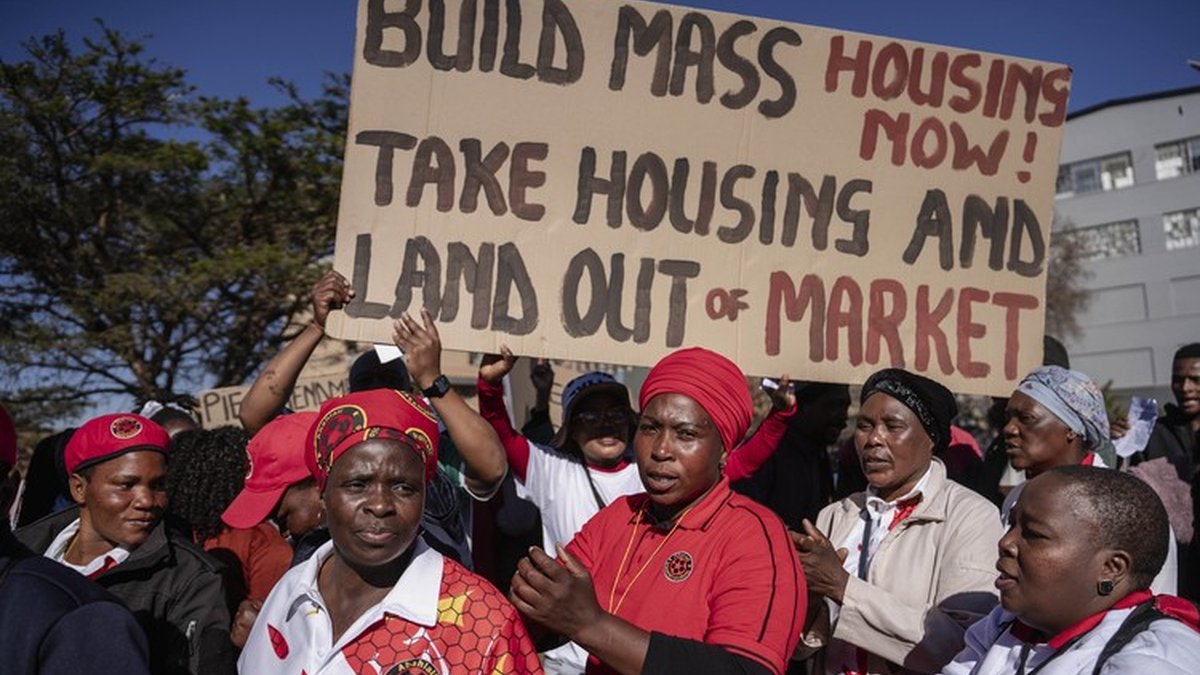
Factory struggles are increasingly inseparable from township struggles for survival, livelihoods and political change. The crisis of social reproduction—food, water, electricity, transport, care, education, health, safety, housing and dignity—has become a central terrain of class struggle. The township, informal settlement, hostel, rural village, farm, inner city and peri-urban settlement are now as important to working-class organization as the factory floor. This is why a left renewal strategy centered only on formally employed workers in existing unions will fail. Trade unions remain indispensable, but insufficient. They must be rebuilt, politicized and reconnected to the broader popular classes.
Gunnett Kaaf’s work on Rosa Luxemburg—the Polish-German Marxist theorist whose analysis of capitalist accumulation and imperialism remains foundational to socialist thought—and Samir Amin—the Egyptian economist who developed a theory of unequal exchange between the capitalist center and the periphery—reminds us that South Africa’s crisis cannot be understood only within national borders. Luxemburg understood capitalism as a global system dependent on expansion into non-capitalist spaces, accumulation by dispossession, militarism and external markets. Amin, working from the Global South, deepened this analysis through unequal exchange, delinking, and the structural asymmetry between center and periphery.
South Africa is not a normal national capitalist state waiting to be managed more fairly. It is a peripheral capitalist formation deeply shaped by settler colonialism, mining, migrant labor, imperial finance, racialized dispossession, monopoly capital, unequal development and global value chains. As Amin argued, it is a microcosm of the world capitalist system: first-world wealth, third-world industrial labor, and fourth-world rural dispossession coexisting in one territory. A left strategy that ignores imperialism will lapse into reformist nationalism. A left strategy that ignores internal class formation will lapse into abstract anti-imperialism. We need both.
What a new historic bloc requires
The left cannot succeed by crystallizing political forces without social forces. In Gramscian terms—drawing on the Italian Marxist Antonio Gramsci’s concept of a ruling coalition that combines economic power with cultural and ideological leadership—the task is to build a new historic bloc of popular classes. This bloc must be conscious of its situation, rooted in material struggles, capable of generating a minimum program, and organized enough to fight. It must include workers, the unemployed, women, youth, students, informal workers, migrants, farm workers, rural communities, shack dwellers, civics, cooperatives, solidarity economy actors, climate justice movements, land movements, feminist formations, LGBTQIA+ struggles, progressive faith communities, radical intellectuals and public-sector workers. But such a bloc will not emerge by declaration. It requires patient work: political education, campaigns, local assemblies, alternative media, popular research, organising schools, cadre development, trade union renewal, community organizing, land struggles, municipal transformation, cooperative experiments, worker-community alliances, anti-austerity mobilization.
A recurring weakness in left debates is the centralization of state power as the ultimate proof of seriousness. Of course, the left cannot ignore elections, the state or local government. But state power without organized popular power becomes either reformism, bureaucratic substitution, or incorporation into the very system we seek to transform. The historical record of the left and the state is sobering. Social democratic projects have often been defeated by capital, global markets, state discipline and their own moderation. Former “actually existing socialist” projects degenerated through bureaucratic domination and frequently ended in capitalist restoration. The recent left experiments in Latin America often fail to sustain themselves along a revolutionary path because of poor delinking sovereign projects and a weak connection between the state and popular forces. National liberation movements often deracialized state power without transforming property relations. South Africa’s ANC is a classic case: the democratic state was won, but economic power remained substantially intact.
This does not mean abstention from elections. It means electoral work must be subordinated to movement-building. Local government elections, for example, can become a platform for campaigns to reclaim municipalities from below. But if electoral work becomes a seat-seeking exercise detached from movements, it will weaken left renewal. The strategic formula must be: with the state, against the state, and beyond the state. Work with the state where reforms can be won. Struggle against the state where it imposes austerity, repression, privatization and corruption. Build beyond the state through cooperatives, community economies, mutual aid, popular assemblies, land-based production, food sovereignty, social ownership and institutions of working-class power.
The tasks ahead
The Conference of the Left should be judged by whether it helps build the kind of mass-rooted renewal described above. Its value lies in the fact that it brought together diverse forces and reopened the possibility of coordination. Its danger lies in the possibility that it becomes either an elite platform or an electoral support mechanism. The Council of the Left must therefore develop as an action-oriented, democratic and movement-building platform. It must not become a command center, a new party by stealth, or a talking shop. It must engage absent forces, including the South African Federation of Trade Unions (SAFTU), the Mining Affected Communities United in Action (MACUA), Abahlali baseMjondolo, climate justice formations, feminist movements, Trotskyist groups and independent left intellectuals. It must be honest about contradictions, including the presence of forces with problematic positions on xenophobia, nationalism, constitutionalism, patriarchy and authoritarianism.
Left renewal cannot begin from the assumption that a small group of enlightened actors already possesses the correct program and must simply deliver it to workers and communities. Marx’s insight remains instructive: new principles must be developed from the contradictions, aspirations and emergent practices already present within society. The task is not to tell people that their struggles over work, land, housing, public services, gender violence, ecological destruction and democratic accountability are misguided, and then substitute an abstract “correct line” for them. It is to help reveal the common structures against which these struggles are already directed, connect their fragmented demands, and develop the political consciousness, organization and strategy required to transform them into a coherent socialist project.
In the present South African conjuncture, this means learning from the actual movement of working-class and popular resistance rather than approaching it with prefabricated slogans inherited from an earlier period. Communities resisting municipal collapse, workers confronting casualization and unemployment, women sustaining households and organizing against violence, young people demanding a viable future, and movements defending land, food, water and the climate are already generating elements of a new politics. Left renewal must help these forces understand what they are collectively fighting against and what their struggles could become when joined together. Consciousness is not imported into struggle from outside; it is developed through struggle, political education, collective reflection and organization.
The building blocks for renewal are several. The first is sustained socialist political education—a critical mass of organizers, activists, organic intellectuals, researchers, facilitators and leaders rooted in struggle and capable of connecting immediate demands to systemic critique. The second is a strategy to build a new common sense: making radical ideas popular, accessible and emotionally resonant, speaking to hunger, fear, debt, unemployment, broken municipalities, crime, gender-based violence, racism, xenophobia, landlessness and climate crisis in ways that people recognize as their own experience. Alongside these, the left needs renewed organizing capacity: patient work to map existing struggles, build local structures, connect campaigns, train organizers, and rebuild the social weight of popular forces.
Transformative reforms must go together with anti-systemic alternatives from below. The left must fight to win: against austerity, for a basic income grant, public employment, free quality public services, land redistribution, housing, public transport, healthcare, education, food sovereignty and democratic municipalities. Cooperatives, solidarity economies, community energy, agroecology, social housing, local production, food systems, worker ownership and public-community partnerships must become part of socialist practice, not side projects. The left must also confront patriarchy internally and externally. The unpaid care work and social reproduction labor carried by women is not secondary to class struggle; it is central to capitalism and to socialist transformation. And it must rebuild pan-African and internationalist solidarities, starting with the domestic fight against xenophobia.
There is no socialist nirvana waiting somewhere above us. We must begin from what we have. While the Conference of the Left is an important development, we cannot ignore that exhausted left theories and strategies are still present and dominant. Left renewal is only at its beginning. We have fragmented unions, weakened movements, uneven community struggles, contradictory parties, NGOs with skills, radical intellectuals, local campaigns, youth anger, feminist struggles, land occupations, informal worker formations, anti-austerity initiatives, cooperative experiments and the still restless working class. But we must not merely add these together. We must transform them into a new historic bloc.
The lesson from the past is not that left renewal is impossible. It is that it cannot be proclaimed from above, substituted by a party, reduced to elections, romanticized through nostalgia, or purified through denunciation. It must be built through struggle. The mass movements of the 1980s and early 1990s teach us the power of organized people. The TAC teaches us the power of combining knowledge, law, direct action and grassroots organization. The DLF teaches us the limits of activist networks without mass anchoring. The NUMSA moment teaches us the limits of union substitutionism and premature electoralism. Fees Must Fall teaches us that youth revolt can open new terrains if the left has the capacity to organize them. The Unemployed People’s Movement (UPM) of Makhanda has waged sustained popular struggles over 20 years, becoming a force to be reckoned with in the 2021 local elections as part of the Makana Citizens Front—demonstrating the necessary link between social and political forces.
The current crisis teaches us that reaction will advance where the left is absent. The Conference of the Left must now learn these lessons. The left will not be renewed by desktop commentary, by purity, or by yet another organizational shortcut. It will be renewed by popular struggles, by building the power, confidence, movements, consciousness and institutions of the popular classes—combined with renewed theory, strategy and unifying program. We need to build what we need. Act we must.