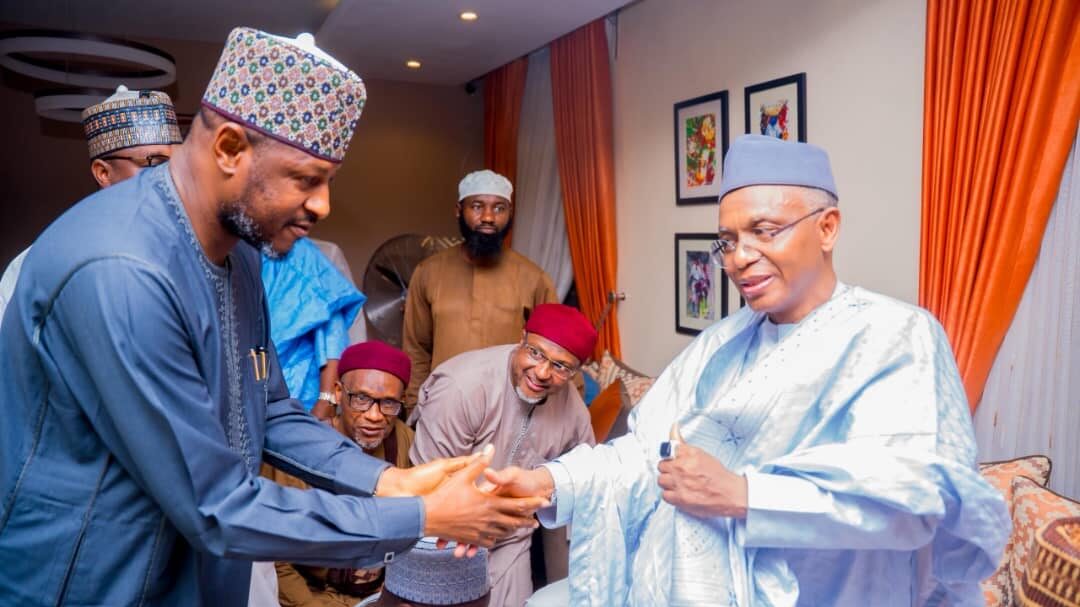
Katsina State Governor, Dikko Umaru Radda on Saturday evening paid condolence visit to former Kaduna State Governor Nasir El-Rufai, following the demise of Mr El-Rufai’s mother, Hajiya Umma El-Rufai.
During the visit in Abuja, Governor Radda offered prayers for the repose of Hajiya Umma’s soul and encouraged Mr El-Rufai to find comfort in family support and faith.
PREMIUM TIMES had earlier reported that the El-Rufai matriarch died on Friday in Egypt where she was receiving treatment in a hospital. Following her passing, Mr El-Rufai was released from detention reportedly on compassionate ground.
Governor Radda expressed deep sorrow over the passing of Hajiya Umma El-Rufai, describing her as a respected matriarch. He said her death was not only an irreplaceable loss to the El-Rufai family but also to all who were touched by her life of compassion, humility, and service.
|
|
|---|
“I received with deep sadness the news of the passing of Hajiya Umma El-Rufai. The loss of a mother is irreplaceable, and I extend my condolences to Mallam Nasir El-Rufai and the entire family during this difficult time,” the Governor stated.
He noted that the late Hajiya Umma El-Rufai lived a life defined by grace, moral strength, and unwavering dedication to the well-being of others, adding that her legacy of kindness, wisdom, and unity will continue to inspire generations.
“She was not only a devoted mother and matriarch but also a woman of rare dignity and compassion, whose life reflected the enduring values of faith, patience, and generosity. Her passing is indeed a great loss,” Governor Radda added.
“In this moment of grief and trial, please be assured of my prayers and solidarity. I stand with you and your family, praying that Almighty Allah grants you the strength and fortitude to bear this painful loss,” he assured Mr El-Rufai.
On behalf of the Government and people of Katsina State, Governor Radda extended condolences to the entire El-Rufai family and all those mourning the late matriarch.
He prayed to Almighty Allah to forgive her shortcomings, accept her righteous deeds, and grant her eternal rest in Aljannatul Firdaus, while also granting the family the strength to bear the loss.
Facts Only
Katsina State Governor Dikko Umaru Radda visited former Kaduna State Governor Nasir El-Rufai in Abuja on Saturday evening.
The visit was a condolence call following the death of El-Rufai’s mother, Hajiya Umma El-Rufai.
Hajiya Umma El-Rufai died on Friday in Egypt, where she was receiving medical treatment.
Nasir El-Rufai was released from detention on compassionate grounds after his mother’s death.
Governor Radda offered prayers for the deceased and expressed condolences to the El-Rufai family.
Radda described Hajiya Umma as a respected matriarch known for compassion, humility, and service.
He stated that her legacy would inspire future generations.
The condolence message was extended on behalf of the Government and people of Katsina State.
Radda prayed for Allah’s forgiveness for the deceased and strength for the family.
Executive Summary
Katsina State Governor Dikko Umaru Radda visited former Kaduna State Governor Nasir El-Rufai in Abuja to offer condolences following the death of El-Rufai’s mother, Hajiya Umma El-Rufai. The matriarch passed away on Friday in Egypt, where she was undergoing medical treatment. El-Rufai, who had been in detention, was reportedly released on compassionate grounds to attend to family matters. Governor Radda expressed deep sorrow over the loss, describing Hajiya Umma as a respected figure known for her compassion, humility, and service. He emphasized her legacy of kindness and wisdom, extending prayers for her soul and strength for the grieving family. The visit underscored solidarity between political figures during a personal tragedy, with Radda representing both himself and the people of Katsina State in his condolences.
The circumstances surrounding El-Rufai’s release from detention remain unclear, though the timing suggests a temporary measure tied to the family’s bereavement. The public expressions of sympathy highlight the cultural and political significance of such gestures in Nigerian society, where personal and professional networks often intersect. While the focus remains on the family’s loss, the event also subtly underscores the broader context of El-Rufai’s political status and the role of compassion in governance.
Full Take
This narrative presents a moment of political and personal intersection, where a governor’s condolence visit to a former governor—amid the latter’s temporary release from detention—highlights both cultural norms and potential underlying dynamics. The strongest version of this story emphasizes the humanizing aspect of leadership, where political figures set aside differences to offer support during grief. Governor Radda’s words frame Hajiya Umma El-Rufai as a symbol of virtue, reinforcing a narrative of unity and shared values. However, the context of El-Rufai’s detention and sudden release introduces ambiguity. Is this purely a compassionate act, or does it serve a broader political or public relations purpose? The lack of detail about the detention’s circumstances leaves room for speculation, though the article itself avoids overt manipulation.
Patterns detected: none. The content adheres to factual reporting without clear signs of emotional exploitation or distortion. The focus on sympathy and legacy aligns with cultural expectations, but the absence of deeper context about El-Rufai’s legal status could be seen as a missed opportunity for transparency.
Root cause: The narrative reflects a societal paradigm where personal and political identities are deeply intertwined. The assumption that public figures must perform empathy—even amid unresolved conflicts—reveals the tension between human dignity and systemic power structures. Historically, such gestures have been used to soften political edges, but here, the motive remains unclear.
Implications: For human agency, this moment underscores the resilience of personal bonds in the face of institutional pressures. The family bears the emotional cost of loss, while the public witnesses a performative act of solidarity. Second-order consequences may include shifts in public perception of El-Rufai’s detention or Radda’s leadership style, depending on how this event is framed in broader discourse.
Bridge questions: What might El-Rufai’s detention reveal about the intersection of law and politics in Nigeria? How do cultural expectations of grief shape political behavior in moments like this? What perspectives from civil society or legal experts are missing from this narrative?
Counterstrike scan: If this were part of a coordinated influence campaign, the playbook might involve leveraging a personal tragedy to humanize a controversial figure (El-Rufai) while subtly undermining criticism of his detention. The actual content, however, does not exhibit structural alignment with such a strategy. It remains a straightforward report of a condolence visit, with no overt signs of manipulation.
Sentinel — Human
The text shows signs of human authorship, demonstrating an informal tone and idiosyncratic emphasis that are not typically found in AI-generated content.