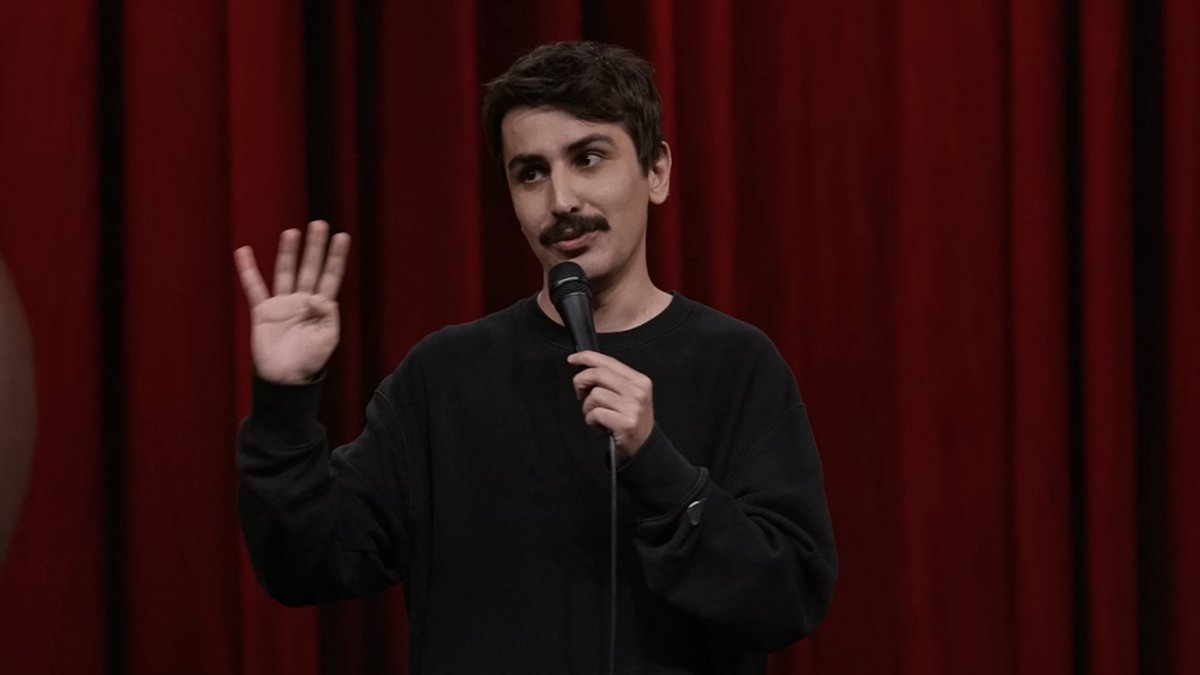
Comedian Deniz Goktas’ arrest comes as Ankara intensifies prosecutions against opposition figures, journalists, artists and critics ahead of a major NATO summit.
A Turkish standup comedian whose latest routine called the country’s president, Recep Tayyip Erdogan, a “reticent dictator who grew into the role" was detained on Thursday at Istanbul's main airport on charges of insulting religious values, a crime punishable by between six months and one year in prison.
Deniz Goktas was handcuffed and taken into police custody after returning from an overseas trip, a move that critics say further highlights mounting repression under the famously thin-skinned Turkish leader who has ruled the country for 24 years. It remains unclear whether he will be formally charged and arrested or freed after interrogation at the Istanbul Security Branch Directorate, where he was transferred.
Goktas’ set, uploaded to YouTube for free viewing, swiftly went viral and garnered more than 8.7 million views by the time he was detained. The office of Istanbul’s chief prosecutor said Goktas was detained following 185 complaints from the public about his content.
His irreverent references to the Quran were cited as the principal cause for a judicial probe and his subsequent detention. Goktas had in fact credited the Quran as being “the best” of holy books revered by different faiths.
In April, a female comedian, Tuba Ulu, was detained after quipping that “even” the Ottoman Sultan Suleiman the Magnificent had married his "fuck buddy." She was referring to Roxelana, a Christian slave from Ukraine, who converted to Islam and became the sultan’s favorite. Ulu was accused of insulting “historical and moral values" and could spend up to three years in prison if convicted as charged.
Few doubt that Goktas’ overt criticism of Erdogan and his ruling Justice and Development Party precipitated legal action against him. It also appears to have inspired millions of Turks who are weary of the government’s relentless suppression of free speech, which has seen a steady stream of journalists, artists and others airing dissident views face prosecution and jail time, according to commentators.
“Deniz Goktas showed the youth of this country that it’s possible to speak out without fear. A very important threshold has been breached,” Ayse Baltacioglu-Brammer, a Turkish historian at New York University, wrote on X.
The sentiment was reflected in viewers' comments on Goktas' video on YouTube. "I will keep watching this until Deniz Goktas is freed. This is my seventh time," wrote a commenter identified as Furkan Celik.
Goktas’ first name, Deniz, means “sea” in Turkish. He appeared to have foreseen his fate during his June 30 performance at an open-air theater in Istanbul. He called it “Dead Sea” and placed a giant cardboard image of his face on its side on the stage, as if decapitated.
There are few signs that the government feels threatened. It is pressing ahead with a slew of legal cases targeting the pro-secular main opposition Republican People’s Party (CHP). The CHP’s Istanbul mayor, Ekrem Imamoglu, has been in prison since May 2025, together with more than a dozen mayors from his party charged with corruption, aiding terrorists and espionage. Imamoglu, who is billed as the man most likely to defeat Erdogan in a future presidential election, denies the charges.
In May, an Ankara court ousted the CHP’s leader, Ozgur Ozel, citing vote rigging during a party congress that brought him to power. The party’s former leader, Kemal Kilicdaroglu, who has repeatedly lost elections, was brought in to replace him. In a July 1 op-ed for the Financial Times, Ozel argued that Erdogan’s “assault on democracy was a threat to Turkey’s allies” and claimed that the Turkish leader sought “a political order in which voting survives while genuine competition disappears,” as witnessed in Russia and Belarus.
NATO leaders — including President Donald Trump — who are due to convene in Ankara on July 7-8 for their annual summit are likely to turn a deaf ear. Turkey’s geostrategic value sharpened by Russia’s invasion of Ukraine has only multiplied as a result of the Iran conflict.
If anything, repression has risen in the run-up to the summit. At least 178 people remain in pre-trial detention and a further 38 under house arrest after being linked to ongoing investigations against terrorist organizations. They include environmentalists, academics and the editor of an LGBTQ rights publication.
Sentinel — Human
This text reads as human-authored journalistic analysis, successfully synthesizing specific legal incidents with broader political repression and international context.