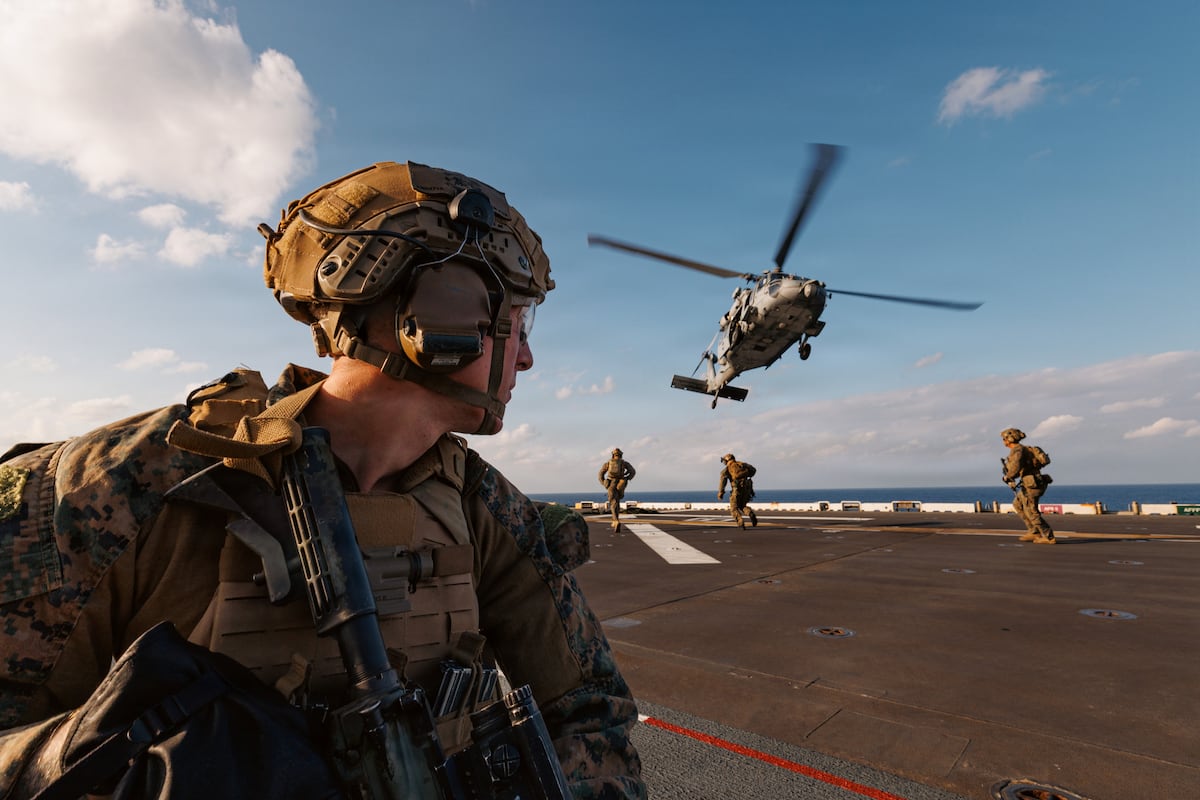
U.S. Marines and sailors assigned to the Tripoli Amphibious Ready Group arrived in U.S. Central Command waters on Friday, the command announced.
The group, led by the America-class amphibious assault ship USS Tripoli, departed earlier this month from its homeport of Sasebo, Japan. Also included in the arriving force are the amphibious transport dock ships USS New Orleans and USS San Diego, and the embarked 31st Marine Expeditionary Unit.
The Tripoli group began steaming toward the Middle East after U.S. Defense Secretary Pete Hegseth reportedly approved a CENTCOM request for additional support to help curtail Iran’s regional attacks.
Announcement of the group’s arrival comes one day after a dozen U.S. service members were wounded in an Iranian missile and drone strike on Prince Sultan Airbase in Saudi Arabia, the Wall Street Journal first reported. Two of the 12 personnel are in serious condition.
That strike, which reportedly damaged multiple U.S. refueling aircraft, comes as the U.S. military continues to pour assets into the region.
The Pentagon on Wednesday confirmed elements from the 82nd Airborne Division headquarters and a brigade combat team are slated to deploy to the Middle East. Based out of Fort Bragg, North Carolina, the 82nd acts as the Army’s rapid-response force and is often among the first units sent to respond to emerging crises.
The 31st MEU, meanwhile, includes a ground combat element, which features a battalion landing team — an infantry battalion and combat support elements — of around 1,100 Marines and sailors.
Also included is the MEU’s aviation combat element, which features tiltrotor and fixed-wing aircraft, transport and attack helicopters, ground support assets and air defense teams.
A combat logistics battalion with equipment and personnel capable of sustaining a MEU in austere environments for up to 15 days will also join the effort.
The 11th Marine Expeditionary Unit, part of the Boxer Amphibious Ready Group, has also been rumored to serve as a potential reinforcement. The group deployed in recent weeks and is currently operating in the U.S. 3rd Fleet area of operations in the eastern Pacific.
The U.S. military on Saturday also announced that the aircraft carrier USS Gerald R. Ford, which had been deployed in U.S.-Israeli operations against Iran, pulled into port in Split, Croatia, for maintenance.
Thirteen service members have been killed in action and nearly 300 wounded during Operation Epic Fury, a joint undertaking by U.S. and Israeli militaries against the Islamic Republic that began on Feb. 28.
The majority of the wounded have since returned to duty, according to U.S. Central Command. Prior to Friday’s attack, 10 U.S. troops reportedly remained in serious condition.
Military Times reporters Riley Ceder and Eve Sampson contributed to this report.
J.D. Simkins is Editor-in-Chief of Military Times and Defense News, and a Marine Corps veteran of the Iraq War.
Facts Only
U.S. Marines and sailors assigned to the Tripoli Amphibious Ready Group arrived in U.S. Central Command waters on Friday.
The group is led by the USS Tripoli and includes the USS New Orleans, USS San Diego, and the 31st Marine Expeditionary Unit.
The group departed earlier this month from its homeport of Sasebo, Japan.
The deployment follows a request from U.S. Central Command for additional support to counter Iran’s regional attacks.
A dozen U.S. service members were wounded in an Iranian missile and drone strike on Prince Sultan Airbase in Saudi Arabia on Thursday.
Two of the wounded personnel are in serious condition.
The strike damaged multiple U.S. refueling aircraft.
Elements from the 82nd Airborne Division headquarters and a brigade combat team are slated to deploy to the Middle East.
The 31st Marine Expeditionary Unit includes a ground combat element of around 1,100 Marines and sailors, an aviation combat element, and a combat logistics battalion.
The 11th Marine Expeditionary Unit, part of the Boxer Amphibious Ready Group, is rumored to serve as a potential reinforcement.
The USS Gerald R. Ford, which had been deployed in U.S.-Israeli operations against Iran, pulled into port in Split, Croatia, for maintenance on Saturday.
Thirteen U.S. service members have been killed in action and nearly 300 wounded during Operation Epic Fury, which began on February 28.
Prior to Friday’s attack, 10 U.S. troops reportedly remained in serious condition.
Executive Summary
The U.S. military has significantly reinforced its presence in the Middle East in response to escalating tensions with Iran. The Tripoli Amphibious Ready Group, led by the USS Tripoli and including the USS New Orleans, USS San Diego, and the 31st Marine Expeditionary Unit, arrived in U.S. Central Command waters on Friday. This deployment follows a recent Iranian missile and drone strike on Prince Sultan Airbase in Saudi Arabia, which wounded 12 U.S. service members, two of whom are in serious condition. The Pentagon has also confirmed the deployment of elements from the 82nd Airborne Division, a rapid-response force, to the region. Additionally, the 11th Marine Expeditionary Unit is rumored to be a potential reinforcement, though it is currently operating in the eastern Pacific. Meanwhile, the aircraft carrier USS Gerald R. Ford has pulled into port in Split, Croatia, for maintenance after participating in joint U.S.-Israeli operations against Iran. Since the start of Operation Epic Fury on February 28, 13 U.S. service members have been killed and nearly 300 wounded, with most of the wounded returning to duty.
The situation reflects a broader pattern of military escalation, with the U.S. bolstering its forces in response to Iranian aggression. The deployment of the Tripoli group and the 82nd Airborne Division underscores the urgency perceived by U.S. Central Command. However, the exact strategic objectives and long-term implications of these movements remain unclear, as does the potential for further escalation or diplomatic resolution.
Full Take
The strongest version of this narrative presents a clear and urgent response by the U.S. military to escalating Iranian aggression in the Middle East. The deployment of the Tripoli Amphibious Ready Group, along with elements of the 82nd Airborne Division, signals a robust and coordinated effort to deter further attacks and protect U.S. interests. The inclusion of detailed facts about the composition of the deployed forces and the casualties suffered in recent attacks lends credibility to the narrative, framing the U.S. actions as necessary and proportional.
However, the narrative also exhibits patterns of emotional exploitation and potential distortion. The focus on casualties and the urgency of the deployments could be interpreted as an attempt to provoke fear or rally support for military action. The lack of context around the broader geopolitical dynamics or the potential for diplomatic solutions may contribute to a simplified, us-versus-them framing. Additionally, the mention of the USS Gerald R. Ford pulling into port for maintenance, while factually accurate, could be seen as an attempt to downplay the scale of ongoing operations or to suggest a temporary pause in hostilities.
The root cause of this narrative appears to be a paradigm of military deterrence and rapid response to perceived threats. The unstated assumption is that a show of force will effectively counter Iranian aggression and restore stability to the region. This echoes historical patterns of U.S. military interventions in the Middle East, where escalation has often led to prolonged conflict rather than quick resolution.
The implications of this narrative are significant for human agency and dignity. The deployment of additional troops and assets increases the risk of further casualties and escalation, with the costs borne primarily by service members and civilians in the region. The second-order consequences could include heightened tensions, potential retaliation from Iran, and a deeper entrenchment of military solutions over diplomatic ones.
Bridge questions to consider: What diplomatic efforts are being pursued alongside these military deployments? How might the presence of additional U.S. forces affect the broader geopolitical dynamics in the Middle East? What alternative strategies could be employed to de-escalate the situation?
Counterstrike scan: If this narrative were part of a coordinated influence campaign, the playbook would likely emphasize the urgency of the threat, the necessity of military action, and the heroism of U.S. service members. The actual content aligns with this pattern to some extent, particularly in its focus on casualties and the rapid deployment of forces. However, it does not appear to be overtly manipulative, as it also includes factual reporting on the composition of the deployed forces and the broader context of Operation Epic Fury.
Patterns detected: ARC-0043 Motte-and-Bailey, ARC-0024 Ambiguity