Interviews
L’Epée 1839’s Objects Of Desire
When Arnaud Nicolas bought L’Epée in 2009, it was not the culmination of a long search, nor the result of a strategic plan. It was, as he puts it, “decided on the corner of a table, drinking a beer with a friend.”
That friend was a watch enthusiast. Nicolas was looking for a gift — a clock interesting enough for a collector, but modern enough to live in a contemporary home. He couldn’t find one. Everything available felt either decorative in the wrong way or locked in the past. A few weeks later, in Switzerland, the conversation came back up. “I told him I was fed up because I couldn’t find the right clock,” Nicolas recalls. “He said, ‘I know a company that could do it — but it’s going bankrupt.’” The company was L’Epée 1839.
At the time, few people paid attention to the company. Mechanical clocks were widely assumed to be a dying category. L’Epée still existed, but only just, supplying a small number of clients. Distribution had collapsed. Product development had stalled. The idea that anyone would step in to revive a near-200-year-old clockmaker felt unlikely. “When my friend said that it was heading into bankruptcy we stayed quiet for almost a minute,” Nicolas says. “Then he said, ‘Are you thinking what I’m thinking?’ And I said, ‘Yes. We could buy it.”
The 5-Minute Decision
The decision itself took minutes. The reality arrived immediately afterwards. They discovered that no buyer had stepped forward because the company was already out of time. Cash reserves were gone. Salaries were due. The transaction took longer than expected, and before the papers were even signed, Nicolas and his friend were paying wages out of their own pockets. “The company was in really bad shape,” he says. “It didn’t have the cash to pay salaries at the end of June. We paid them ourselves. We signed in July.”
His friend, who helped finance the acquisition, never became involved in running the business. That was deliberate. “It’s difficult to have two people running a company,” Nicolas says. “We stayed friends. We never mixed friendship and work.” What Nicolas inherited was not just a weakened operation, but a reputation that had narrowed drastically. L’Epée had once been a prolific and inventive manufacture. In the late 20th century, it became something else: a supplier of formal gifts to royal courts and governments. “The previous owner was only interested in supplying the British Royals,” Nicolas says. “Distribution died. Everything else stopped.”
Yet the historical reach of the brand is far broader than most people realize. L’Epée clocks have sat on the desks of heads of state. They had been offered as diplomatic gifts by European governments and Middle Eastern leaders. One sat on the Pope’s desk. “It was the brand of the powerful,” Nicolas says. “But nobody knew it anymore.” A fire in the late 1990s destroyed a section of the archives. What survived suggested a company whose defining trait had once been invention rather than formality. “That’s what interested me,” Nicolas says. “Not to preserve it, but to restart it.”
Rebuilding From the Inside
By training, Nicolas is a scientist. He studied mathematics, optics, and electronics, and spent his early career in aerospace and satellite engineering in Europe and the United States. His work focused on precision systems, including MEMS devices that improved aircraft positioning accuracy. “I’ve always been involved in science,” he says. “But I was missing something.” What drew him to clockmaking was not tradition, but contradiction: mechanical systems that were allowed to be expressive. “It’s one of the only fields where you can mix art and function,” he says. “Art and technology.”
From the moment he took over, Nicolas made one decision that would define the next decade: everything would go into the product. “When I bought the company, we had one caliber,” he says. “Now we have fifty-four.” Over 16 years, L’Epée developed 53 new calibers. When Nicolas later presented that figure to LVMH, the reaction was disbelief. “They told me, ‘You’re kidding.’ Then I showed them.”
The reason it was possible, Nicolas says, was focus. Marketing was ignored. Communication barely existed. Profits, when they appeared, were reinvested immediately. “We never took a dime out of the company,” he says. “Everything went back into engineering, machines, people.” One of the earliest operational shifts was to internalize manufacturing. Outsourcing components led to quality issues and constant correction. “I got tired of going to suppliers and fixing their problems,” Nicolas says. “So I decided the development guy should be next to my door.”
Machines were purchased. Specialists hired. Knowledge was retained in-house. Today, L’Epée employs 12 engineers in a company of roughly 100 people — a ratio closer to a high-tech firm than a traditional manufacture. The effects were not immediate, but they were visible. “After two years, we were at Baselworld and people stopped and said, ‘These are beautiful,’” Nicolas recalls. “That was new.” Sales followed. Limited pieces sold out in weeks, then days. But Nicolas never believed clocks would return as a mass market object. “I was sure it was a small business,” he says. “But I knew I couldn’t be the only one crazy enough to want this.”
From Blank Page to Partnership
Crucially, L’Epée did not position itself as nostalgic. From the beginning, Nicolas understood that survival depended on design and animation. “What kind of object would someone want in a modern home?” he asks. “That was the question.” Collaboration became part of the answer, though Nicolas insists this was not a reinvention. While researching the archives, he discovered that L’Epée’s first major collaboration had taken place in the 1970s, with Hermès. “It was very rare,” he says. “But it was already there.”
‘The difference was how collaborations were approached. L’Epée does not start with a finished movement and wrap design around it. “We start with a white page,” Nicolas explains. “We engineer the movement and the housing together. Nothing is hidden.” What Nicolas brought was an explicit creative dimension. “I added the art part,” he says. “Something a bit more funky. The rest was already in our history.”
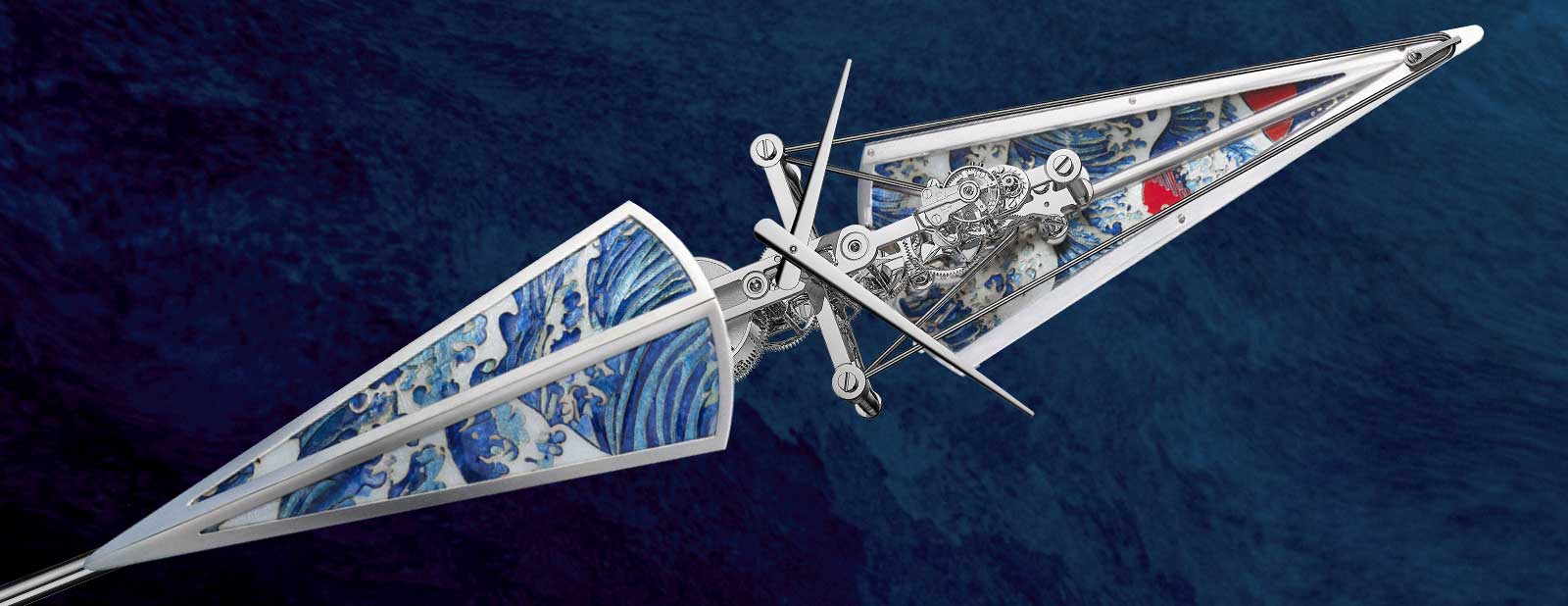
Modern collaborations followed organically. MB&F became a pivotal partner, not only creatively but culturally. Chanel brought visibility at a time when L’Epée could not afford communication. Longstanding work for Tiffany & Co. anchored the business historically and commercially. The most monumental project undertaken during Nicolas’s tenure was L’Epée’s collaboration with Vacheron Constantin and automaton maker François Junod. The result was La Quête du Temps, unveiled at the Louvre in 2025: a seven-year undertaking, with two years spent defining the concept and five devoted to engineering and manufacture, and the most complex object L’Epée has produced to date.
By the mid-2010s, the problem was no longer survival, but capacity. “My partner and I realized we were the limiting factor,” Nicolas says. “Not demand, but investment.”
When Growth Becomes Risk
Then in 2024, LVMH, an existing client, approached L’Epée seeking increased production. Nicolas refused to allow any group to dominate output. “Twenty percent maximum,” he told them, adding, “risk mitigation is the first job of a CEO.” A week later, however the conversation changed when the representative from LVMH returned to the manufacture. “He came back, sat in my office and pushed a piece of paper across the table,” Nicolas says. “There was a number written on it.” Nicolas called his partner, and the next day, they accepted the offer to be bought by the world’s leading luxury group.
Today, LVMH owns L’Epée outright. Operationally, Nicolas says, little has changed. “They told me: don’t lose your entrepreneurial spirit. They let us run independently.” What the group provided was stability and controlled growth — the ability to increase production without compromising exclusivity. “We don’t want L’Epée everywhere,” Nicolas says. “We just want to be able to supply properly — for Tiffany, for Louis Vuitton and for partners outside the group as well.”
If interest in mechanical clocks has risen sharply in recent years, Nicolas does not attribute it to fashion. “They answer a different need,” he says. Watch collectors want something beyond the wrist. Interior designers want objects that surprise. Art collectors respond instinctively. “At exhibitions, art collectors come to our booth,” Nicolas says. “Sometimes more than watch collectors.”
For Nicolas, the explanation is simple. “A clock gives time, light, movement and emotion in one object,” he says. “That’s why it works.” Not as nostalgia. Not as utility. But because it still does something that nothing else quite can.
L’Epée
Facts Only
* Nicolas bought L’Epée 1839 in 2009.
* The purchase was initially a gift idea.
* The company was close to bankruptcy.
* Distribution had collapsed.
* Product development had stalled.
* The company had focused on supplying royal courts.
* Nicolas was a former aerospace engineer.
* He invested heavily in product development (53 new calibers).
* LVMH acquired the company in 2024.
* The company employed 12 engineers.
* L’Epée’s production had increased dramatically over 16 years.
* Nicolas limited external collaborations to 20% of output.
Executive Summary
Full Take
Sentinel — Likely Human
This article presents a chronological account of L’Epée 1839’s revival, emphasizing the founder’s meticulous approach and strategic decisions. While the presentation of information is largely coherent, the stylistic uniformity raises a moderate probability of AI assistance in structuring the narrative.