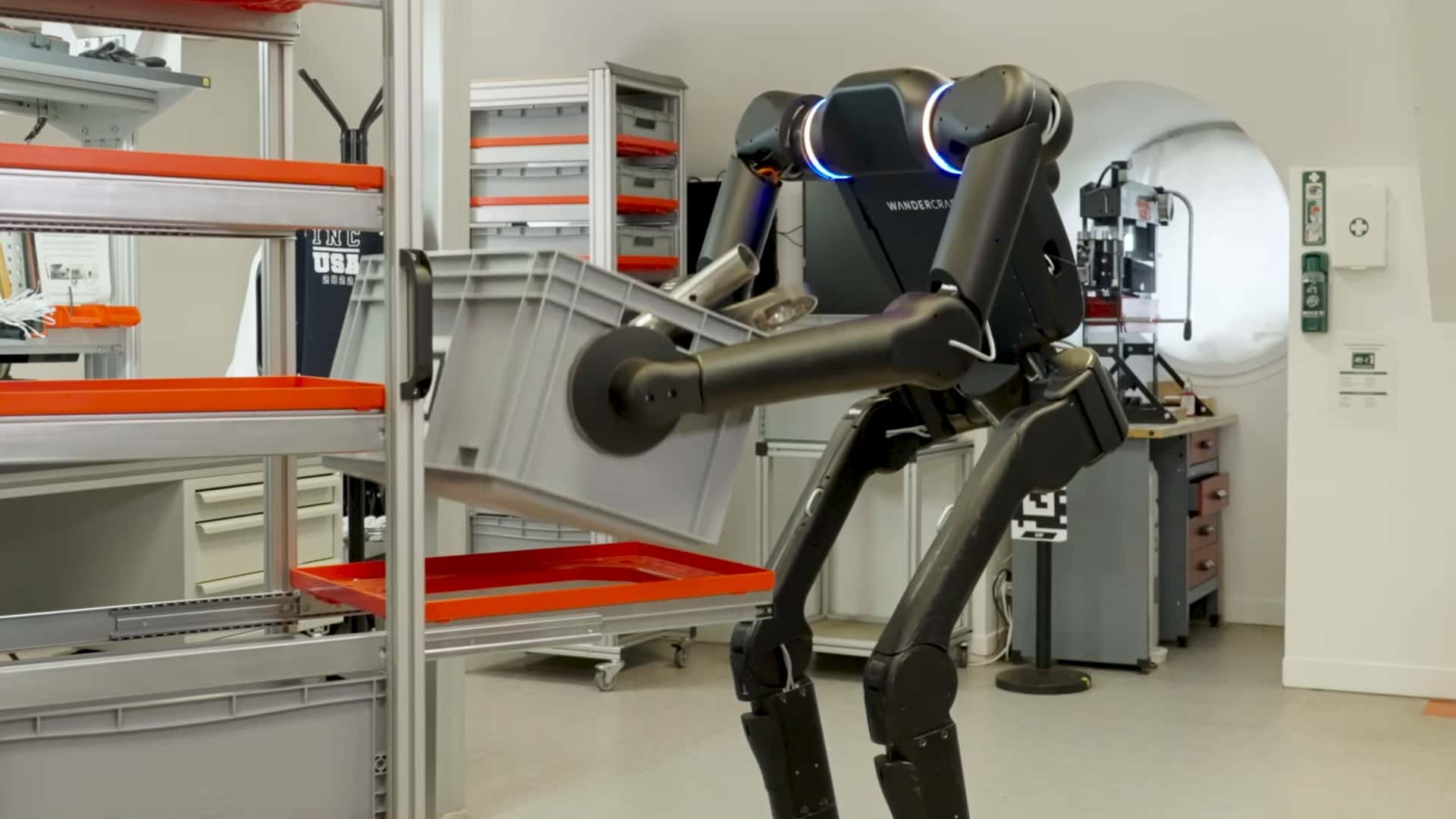
Renault is deploying 350 humanoid robots at its Douai EV factory in France.
- Humanoid robots are helping Renault build EVs more efficiently.
- The first two-legged robots were deployed at the factory that builds the retro Renault 5 EV.
- Hundreds more will be added throughout the plant in the next 18 months.
French automaker Renault is deploying hundreds of humanoid robots at its electric car factory in France to remove backbreaking tasks from employees’ job descriptions. The first two-legged, headless robot is already hard at work putting tires on the conveyor belt that takes them to the assembly line.
That number will go up to 350 in the following 18 months as Renault sets its plan to cut production hours per vehicle by 30% in motion. The car company also wants to cut production costs by 20% over the next five years as it looks to become the go-to European automaker globally.
Gallery: Renault Wandercraft Calvin-40 humanoid robot
Developed by New York-based startup Wandercraft, the Calvin-40 robot can lift up to 90 pounds (40 kilograms) several hundred times a day without needing to rest. It has waist-mounted video cameras and uses LED lights to communicate its status.
In other words, this is not a fancy human-like robot like Tesla’s Optimus, but it’s not meant to be one. Calvin was designed to work independently and integrate safely and reliably into any industrial setting. This is the second generation of the robot, and its maker, Wandercraft, boasts that it was developed in just 40 days.
Its predecessor was developed in April 2025, but by using artificial intelligence training, the startup doubled the machine’s speed in just half a year. Just a few months later, in June 2025, Renault bought a minority stake in the company, investing $75 million to boost development.
The Calvin-40 robot can be trained to pick out mixed parts from bins, but for now, it is restricted to lifting tires and carrying panels in the body shop, as the limiting factors are speed and dexterity.
Thierry Charvet, Renault’s head of production, reassured human workers that the robot will not take their place anytime soon. “There are no robots replacing people on the final assembly line, where you put all the parts in the car, because [they lack] speed and dexterity,” he said.
The French car company claims its implementation of the Calvin-40 robot is an industry-first. “Lots of companies are using humanoids for a display at the Consumer Electronics Show; we like to put them on the line,” said Renault Group CEO Francois Provost.
RECOMMENDED FOR YOU
BMW iX3 Demand Is So High That The Factory Is Already Doing Double Shifts
All The EVs That Got Canceled Or Delayed In 2025 And 2026 (Updated)
Stellantis, Battled And Bruised, Will Build Chinese EVs In Europe
Watch Donut Lab's Mysterious Solid-State Battery Charge In An Actual EV
Volvo EX60 Demand Is So Strong That 2026 Production Is Already Increasing
This Camouflaged Volkswagen EV Is Way More Important Than It Looks
Europe Is Learning An Uncomfortable Truth About Local Battery Production
Facts Only
Renault is deploying 350 humanoid robots at its Douai EV factory in France.
The first robot is already operational, handling tires on the assembly line.
The robots are developed by Wandercraft, a New York-based startup.
The Calvin-40 model can lift up to 90 pounds (40 kg) repeatedly without rest.
Renault plans to expand robot deployment over the next 18 months.
The goal is to reduce production hours per vehicle by 30%.
Renault aims to cut production costs by 20% over the next five years.
Renault invested $75 million in Wandercraft in June 2025, acquiring a minority stake.
The Calvin-40 uses AI training to improve speed and efficiency.
The robot is currently limited to lifting tires and carrying panels due to speed and dexterity constraints.
Renault states the robots will not replace human workers on final assembly lines.
The initiative is described as an industry-first for practical humanoid robot use in manufacturing.
Executive Summary
Renault is deploying 350 humanoid robots at its Douai EV factory in France to automate physically demanding tasks, starting with tire handling and panel transport. The robots, developed by New York-based startup Wandercraft, are part of Renault’s strategy to reduce production hours per vehicle by 30% and cut costs by 20% over five years. The Calvin-40 model, the second generation of these robots, can lift up to 90 pounds repeatedly without rest, using AI-trained systems to improve speed and efficiency. Renault has invested $75 million in Wandercraft, acquiring a minority stake to accelerate development. While the robots are currently limited to specific tasks due to speed and dexterity constraints, Renault emphasizes they are not replacing human workers on assembly lines. The initiative is framed as an industry-first, contrasting with other companies that showcase humanoid robots primarily for publicity rather than practical use.
The deployment reflects broader trends in automotive manufacturing, where automation is increasingly used to enhance efficiency and reduce labor strain. However, the long-term impact on employment and workforce dynamics remains uncertain. Renault’s approach balances technological innovation with reassurances about job security, though the economic and social implications of widespread robotic integration in factories warrant further scrutiny.
Full Take
The strongest version of this narrative positions Renault as a pioneer in practical automation, leveraging humanoid robots to enhance efficiency while explicitly reassuring workers about job security. The focus on backbreaking tasks—like lifting tires—frames the technology as a tool for improving labor conditions rather than replacing humans. Renault’s investment in Wandercraft and the rapid development of the Calvin-40 robot (from prototype to deployment in months) underscore a commitment to innovation. The contrast with Tesla’s Optimus, which is portrayed as more of a publicity stunt, reinforces Renault’s claim of being the first to integrate humanoid robots into real-world manufacturing.
However, the narrative invites scrutiny of several patterns. The emphasis on "industry-first" and "practical use" could be seen as a form of **ARC-0024 Ambiguity**, where the novelty of the deployment is highlighted without addressing potential long-term workforce disruptions. The reassurance that robots "will not replace people on the final assembly line" is a **ARC-0043 Motte-and-Bailey**—a narrow claim that avoids broader questions about job displacement in other areas. The framing of automation as purely beneficial also risks **ARC-0012 Emotional Exploitation**, appealing to progress and efficiency while downplaying the human cost of technological transition.
Root cause: This narrative reflects the tension between automation as a productivity tool and its societal impact. The unstated assumption is that efficiency gains will outweigh job losses, a common refrain in tech-driven industrial shifts. Historically, such transitions have led to both economic growth and labor displacement, raising questions about who truly benefits. Renault’s workers may see reduced physical strain, but the long-term implications for employment stability remain unclear.
Implications: For human agency, the deployment could empower workers by removing hazardous tasks, but it also risks eroding job security as automation expands. The beneficiaries are likely Renault’s shareholders and Wandercraft’s investors, while the costs—potential job losses or deskilling—may fall on the workforce. Second-order consequences could include accelerated adoption of humanoid robots across industries, further blurring the line between human and machine labor.
Bridge questions: What safeguards are in place to ensure workers displaced by automation are retrained or reassigned? How might this deployment reshape labor negotiations in the automotive sector? Would the narrative change if the robots eventually replaced more complex assembly tasks?
Counterstrike scan: A coordinated influence campaign might exaggerate the robots’ capabilities while downplaying job risks, using phrases like "industry-first" to create hype. The actual content aligns with this pattern but stops short of outright deception, focusing on verifiable facts while omitting deeper workforce implications. No overt manipulation is detected, but the framing leans toward corporate optimism.
Sentinel — Human
The article shows strong signs of human authorship, with specific attributions, technical details, and stylistic variability inconsistent with typical AI generation.