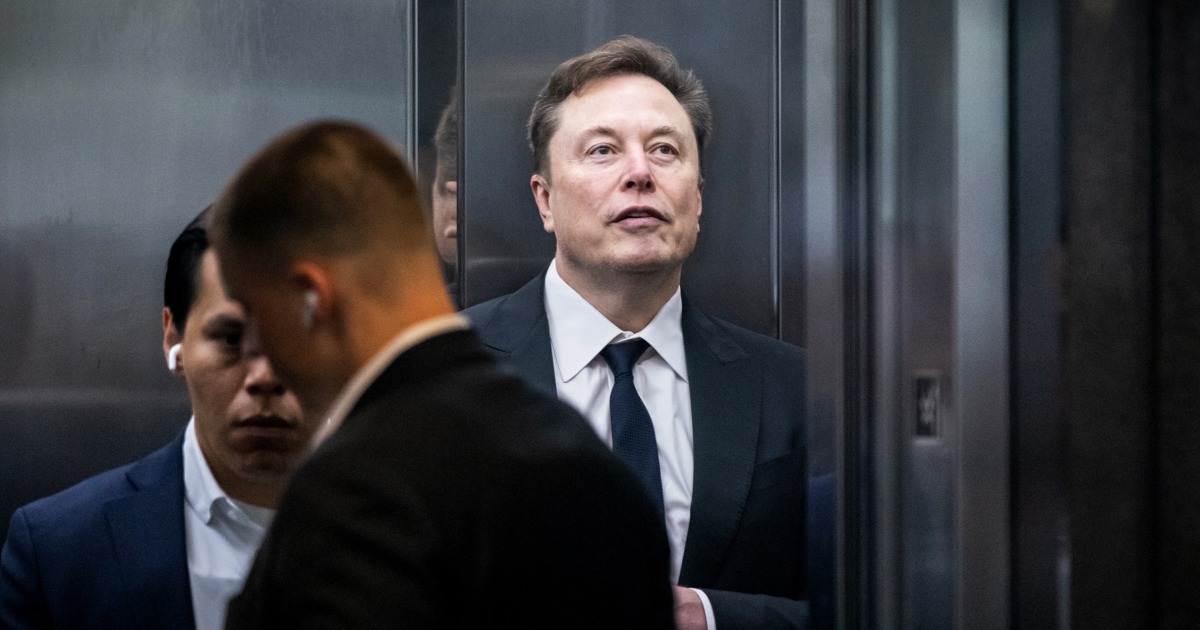
Elon Musk traveled to China with President Donald Trump this week, despite his ongoing trial over his lawsuit with OpenAI and a federal judge’s order that he remain at the ready to be recalled to testify at short notice.
The trial is for a lawsuit that Musk filed against artificial intelligence startup OpenAI. Musk, a co-founder of OpenAI, alleges that the company has betrayed its original nonprofit mission by creating a for-profit arm. He testified in the trial in Oakland, California, over three days last month.
Before Musk left the witness stand April 30, U.S. District Judge Yvonne Gonzalez Rogers asked the parties if there was any reason to hold Musk in “recall status,” meaning that he should be available to testify again if called upon to do so. OpenAI lawyers said, “Yes.” The judge instructed him: “OK, Mr. Musk, you are not excused, but you can leave for the day.”
But Musk is now in China with Trump on a state visit.
Two sources familiar with the matter told NBC News that Musk didn’t obtain permission from the judge before leaving the country and was still subject to recall as a witness.
The apparent conflict highlights the ambiguous rules around recall status and its relevance in a trial that’s been peppered with globe-trotting billionaires. The judge didn’t explicitly tell Musk not to travel or give him an exact definition of what it means to be on recall status.
The situation is atypical, said Jeffrey Bellin, a law professor at Vanderbilt University and an expert in the rules of evidence.
“A typical witness would not leave the country if they were subject to recall,” he said.
Bellin said there’s no hard-and-fast rule for how near to the courthouse a witness should be if they are subject to recall. He said it’s up to the individual judge and that, typically, the witness’ attorney would talk the matter over with the judge.
“If I were the attorney, I would have made sure that if my witness is subject to recall and he’s left the country, that the judge is OK with that,” he said.
A spokesperson for the court said she didn’t know whether Musk obtained permission to leave the area or whether his travel could present a problem for the trial.
Musk’s travel would only potentially be an issue if OpenAI, co-defendant Microsoft or the judge herself called Musk back to the stand Wednesday, which is scheduled to be the final day of evidence in the trial. As of midday Wednesday, he had not been recalled. Closing statements are scheduled for Thursday.
Bellin said it’s unusual for a witness to be recalled in a trial but that it does sometimes happen.
“He’ll either have to show up on very short notice, which will be logistically challenging, or the judge will be very aggravated if the judge didn’t give permission in advance,” he said.
And he said that Musk’s wealth may give him more flexibility in practice.
“Maybe he has the kind of resources where, even if he’s in China, he can get there the next day,” he said.
Facts Only
* Elon Musk traveled to China with President Donald Trump this week.
* Musk was involved in a lawsuit against the AI startup OpenAI.
* Musk, a co-founder of OpenAI, alleged the company betrayed its nonprofit mission by creating a for-profit arm.
* Musk testified in the trial in Oakland, California, over three days last month.
* The U.S. District Judge asked parties if there was reason to hold Musk in “recall status.”
* OpenAI lawyers confirmed that there was a reason to hold him in recall status.
* The judge instructed Musk that he was not excused but could leave for the day.
* Two sources indicated that Musk did not obtain permission from the judge before leaving the country and remained subject to recall.
* Musk had not been recalled as of midday Wednesday, which was the final day of evidence in the trial.
* A law professor suggested that a typical witness would not leave the country if they were subject to recall.
* The travel would only potentially be an issue if Musk were called back to the stand.