The European open source industry answers the moment
The EU Tech Sovereignty Package, published on 3 June, put a question to the European open source industry before it put one to anyone else. The Commission’s Open Source Strategy and the Cloud and AI Development Act say, in effect, that open source can be Europe’s route to sovereignty if the industry organises into a real alternative at scale. For most of the last decade, the honest answer to any procurement fight was “not yet.” Between 23 June and 1 July, across three events in three countries, that answer changed. These are early reflections on what the change looks like.
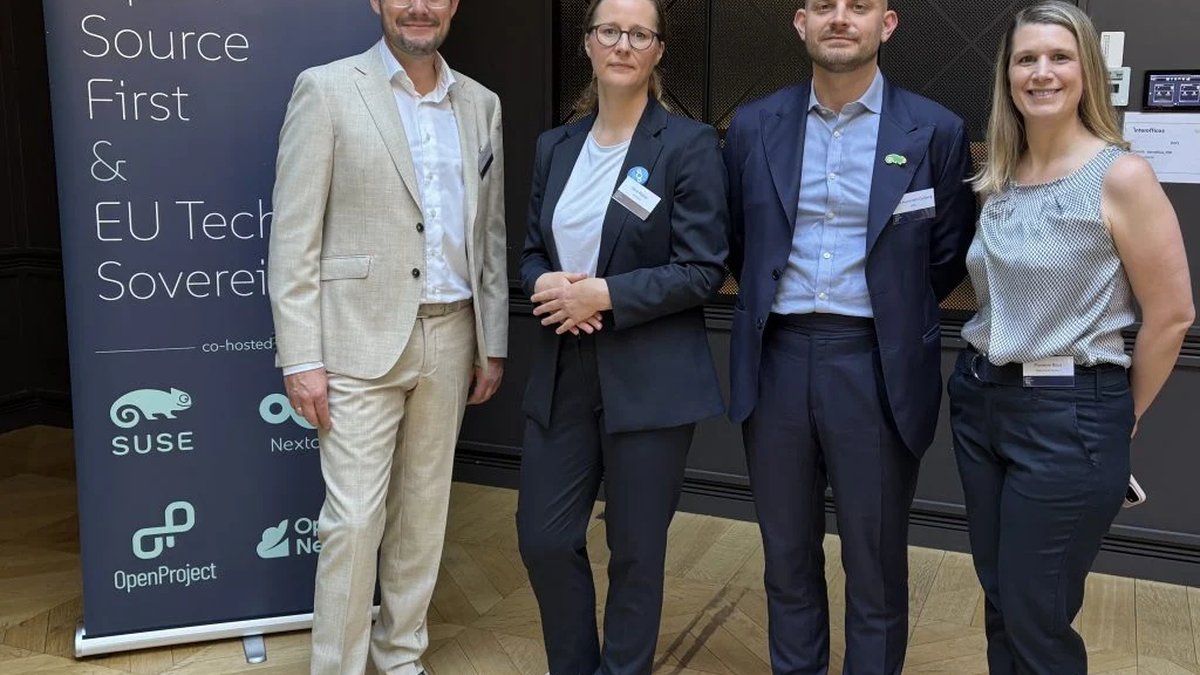
The first observation is our event in Brussels. On 23 June, SUSE convened a forum with Nextcloud, OpenProject and OpenNebula, behind the 130-plus signatories of the open industry letter on Open Source First. The room did not ask for a subsidy or a new budget line. It named the mechanism that decides whether the Package changes anything. Article 41 is headed “open source first,” yet its binding text asks public bodies only to be encouraged to use open source. The heading promises a default; the verb delivers an aspiration. Closing that gap means a binding, comply-or-explain requirement, with a documented assessment before procurement and an audit trail after it. The cost falls on suppliers, not on the taxpayer.
The full assessment following the forum, Open Source First and the Architecture of European Sovereignty, sets out the market-structure case and five operational pillars in detail.
The second observation is Utrecht. On 30 June the APELL Conference turned the argument inward, onto the industry itself. The lobbies defending the non-sovereign proprietary default are the best-funded in Brussels, and a sector that means to win a procurement policy fight cannot meet them with the informal goodwill. What Utrecht showed was an industry organising deliberately: hundreds of European companies coordinating through APELL as a backbone, dividing the legislative terrain, and starting to behave like one actor rather than a hundred. SUSE was present as a platinum sponsor and as one voice among many making the same case. The underlying model is familiar to everyone in open source. Many smaller parts, joined by a shared layer of open interfaces, outperform and out-scale a vertically integrated incumbent.
|
Photo: Sebastian Raible / APELL |
Photo: Sebastian Raible / APELL |
The third observation is Paris. The next morning, the push carried to Paris, where Caisse des Dépôts opened EuroCommons, convening on the order of 300 large European organisations and their CIOs into coalitions to plan, finance and execute migrations away from proprietary dependencies, together and in project mode. This matters because it moves the other half of the market. Utrecht was the supply side organising to deliver. Paris was the demand side organising to buy. Within twenty-four hours, both sides of the same market declared that they intend to move.
|
Photo: Sebastian Raible / APELL |
Jutta Horstmann, Co-CEO of the Heinlein Group, presenting. Photo: Sebastian Raible / APELL |
That convergence is the point, and it is why this reads as more than three good events in a busy week. What the Commission described in its EU Open Source Strategy is now being answered on both sides at once. The industry’s ask to the co-legislators is precise: close the Article 41 gap and make Open Source First a binding default. The industry’s own commitment is the other half of the same bargain: invest, integrate and scale, so that a public buyer acquires a sovereign environment with the convenience it expects from a proprietary cloud. Neither half works alone. Together they are the working definition of industrial policy: a public default that creates a contestable market, and an industry that steps forward to serve it.
SUSE is putting its weight behind both halves. We are convening the argument, funding the organising, and building the stacks that make the choice real. The moment the Commission set out is being met. The work now is to keep all three of these rooms pointed at the same result.
Related Articles
Aug 20th, 2024