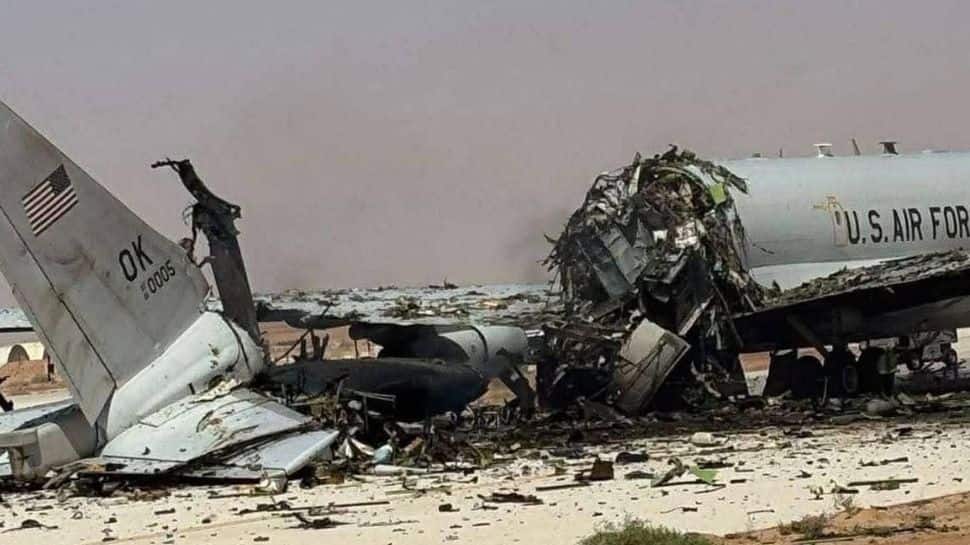
US flying radar damaged in Iranian strike at Saudi air base- Reports
The mighty E-3 Sentry provides radar surveillance essential for detecting drones, missiles, and aircraft hundreds of miles away.
Trending Photos
As the US-Iran-Israel war enters 2nd month, an Iranian missile and drone attack targeted Prince Sultan Air Base in Saudi Arabia on March 27, damaging several American KC-135 refueling aircraft and injuring US troops.
At least 10 U.S service members were wounded in the attack, with two suffering serious injuries, various reports confirmed.
Apart from KC-135 refueling aircraft, Iranian strikes also inflicted damage on an E-3 Sentry airborne warning and control system (AWACS) critical for battlespace management and tracking threats over long distances, according to a report by the Wall Street Journal.
The mighty E-3 Sentry provides radar surveillance essential for detecting drones, missiles, and aircraft hundreds of miles away.
Meanwhile, Israel warned on Friday that it would intensify its strikes against Iran.
US President Donald Trump postponed his earlier threat to destroy Iran's energy infrastructure following Tehran's de facto blockade of the Strait of Hormuz by 10 days.
With stock markets in turmoil, Trump extended the deadline for reopening the Strait until April 6 on Thursday. He noted Iran's request for this extension and described ongoing talks as "very well," despite Iran's public denials of negotiating over a U.S 15-point proposal to resolve the conflict.
US Marines enter the war front
Approximately 3,500 U.S. Marines have entered the U.S. Central Command (CENTCOM) area of responsibility aboard USS Tripoli. This deployment brings one of America's largest amphibious assault ships into an active combat theater in West Asia during the ongoing conflict.
This follows U.S threats and planning for potential "boots on the ground" in Iran, including operations at Kharg Island to secure oil routes amid Hormuz disruptions.
Houthi enters the West Asia War
Iranian-backed Houthi rebels joined the monthlong West Asia war on Saturday, launching two missiles at Israel.
Houthi Brig. Gen. Yahya Saree announced on the rebels’ Al-Masirah TV that they fired missiles at “sensitive Israeli military sites” in southern Israel.
Escalated Houthi attacks on commercial shipping, as seen previously, could spike oil prices and undermine global maritime security.
The Bab el-Mandeb Strait, at the Arabian Peninsula’s southern entrance, remains vital for ships bound for the Suez Canal via the Red Sea.
Saudi Arabia relies on it to export millions of barrels of crude oil daily, given the effective closure of the Strait of Hormuz.
With their involvement, risks disrupting global shipping further if they resume attacks on vessels in the Bab el-Mandeb Strait off the Red Sea, a chokepoint for about 12% of world trade.
Stay informed on all the latest news, real-time breaking news updates, and follow all the important headlines in india news andworld News on Zee News.
Live Tv
Facts Only
Actors: US, Iran, Israel, Saudi Arabia, Houthi Rebels
Events: Iranian missile and drone attack on Prince Sultan Air Base in Saudi Arabia on March 27, damage to American KC-135 refueling aircraft, injury of US troops, deployment of approximately 3,500 U.S. Marines in response, potential involvement of Houthi rebels
Timeline: March 27 (attack), April 6 (deadline for reopening the Strait)
Locations: Saudi Arabia (Prince Sultan Air Base), West Asia, Arabian Peninsula's southern entrance (Bab el-Mandeb Strait)
Executive Summary
Full Take
An analysis of this article reveals several patterns:
* ARC-0043 Motte-and-Bailey: The article presents both the immediate impact of the attack on military assets and infrastructure, as well as the potential long-term effects on global shipping routes. This creates a fortified position with an easy retreat to a less controversial argument.
* ARC-0024 Ambiguity: The article does not explicitly state Iran's motivations for the attack or the extent of their involvement in West Asia conflicts, leaving room for interpretation and speculation.
In terms of root cause, this incident can be seen as a continuation of the ongoing tensions between the US and Iran, with Saudi Arabia serving as a proxy battleground. The deployment of U.S. Marines further escalates the situation, raising questions about potential "boots on the ground" in Iran.
The implications of this conflict are significant, with potential disruptions to global shipping routes and energy infrastructure posing economic risks for various countries. It is crucial for readers to consider not only the immediate consequences but also the broader geopolitical implications of this ongoing conflict.
Bridge questions:
What are the specific motivations behind Iran's actions in this incident?
How will the deployment of U.S. Marines impact the ongoing tensions between the US and Iran?
What long-term effects could these disruptions have on global shipping routes and energy infrastructure?
Sentinel — Human
The analysis suggests that this text is likely human-written, with some indications of repetitive structural patterns and lack of perfectly matching argumentative skeleton or talking points across sources. However, the deviation from uniform rhythm in sentence length and advanced vocabulary usage, clear emphasis on specific events, balanced reporting, and accurate historical references suggest a human writer.