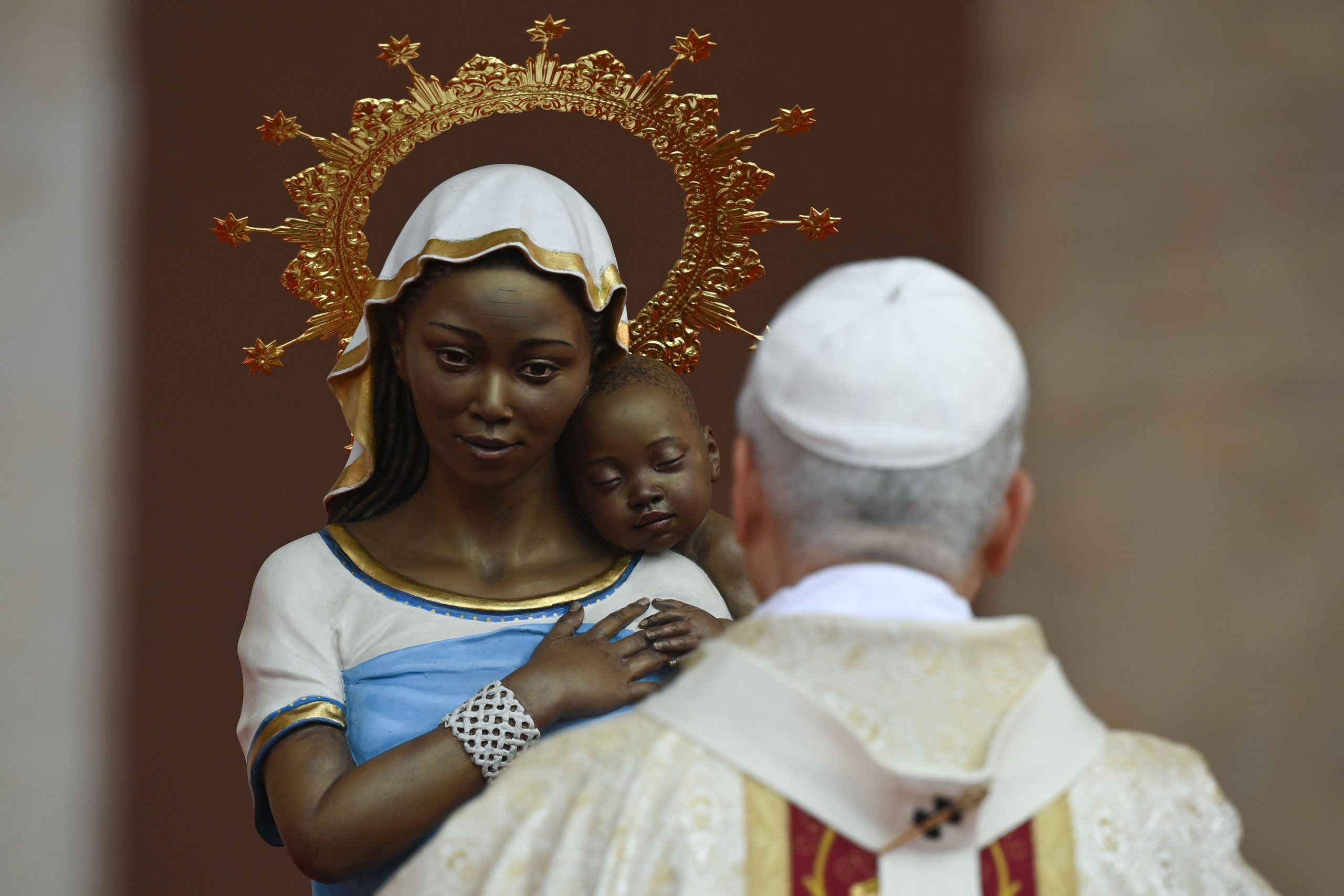
Pope Leo’s visit this year to Africa made the news for many reasons, but my social media blossomed with one image from his trip: the unfamiliar (to me) but magnetic image of Our Lady of Bisila, Mother and Patroness of Equatorial Guinea. A radiant statue of Our Lady with the Infant Jesus was depicted behind the pope as he joined the assembled crowd in Malabo to sing the Regina Caoeli at his final Mass of the trip.
Reactions online abounded: “stunning,” “striking,” “uniquely beautiful.” These words reflected both the excellence of the statue’s craftsmanship and the fact that seeing a Madonna and child with African features, and with the child carried on the mother’s back, remains a rarity in many parts of the world.
But there was something else at work here that is more than the sum of these parts. The image exists at the intersection of Mary’s cultural specificity and the very real humanity she and her infant exude. The image evoked love from those who gazed upon it—one commentator declared, “I’m utterly smitten”—which is exactly the reaction any image of the Virgin should inspire.
Inculturation and the Communion of Saints
The folding of Our Lady of Bisila into a papal Mass is an example of representation and inculturation. Centuries of European Christian art have made many Catholics accustomed to seeing light-skinned versions of biblical figures. However, this narrows our understanding of who these figures were and of what regions of the world are most associated with them. As the church’s center has shifted toward the global south, it is crucial for people everywhere to joyfully make space for a broader understanding of our communion of saints. Our God’s church, as Pope Francis proclaimed and Pope Leo recently affirmed, is for “Todos, Todos, Todos.” Meaningful representation backs up that assertion.
So does inculturation. At its best, the Catholic Church understands that to “make disciples of all the nations” is to enter into dialogue with the established traditions that give different corners of the globe their distinctive identity. The story of Our Lady of Bisila speaks to this. Well before the advent of Christian missionaries in Africa, legend tells us, a plague struck the island of Bioko. One day a beautiful woman carrying an infant appeared to a young girl. Through the girl, the woman instructed medicine men on how to restore the local Bubi people to health. It worked, and from then on, the Bubi felt the invisible nearness of this woman, whom they called “Bisila.”
According to an analysis by the Kenyan priest John Kivosyo, the transformation of pagan legend into Marian devotion was both miraculous and inevitable. Though hard to translate directly, he writes, the meaning of bisila revolves around motherhood, compassion and nurturing. A “quiet presence woven into the lives of women, into childbirth, into the fragile breath of newborns…. She was invoked in moments of fear and hope; when a child fell ill, when a woman labored through the night, when life itself seemed uncertain.”
When Europeans came to Africa and talked of the Blessed Virgin, “The people began to recognize something familiar in this new mother. The missionaries, too, began to understand that Bisila was not an obstacle, but a bridge…both memory and presence.”
A bridge. That is Mary: a bridge between this embodied life and the one we are promised in Christ, between our earthly relationships and the hope of heavenly communion, between what it is to live in a specific time and place (memory) and what it is to be a child of the Eternal God (presence). That Marian apparitions have occurred across the world and Our Lady has appeared, in different instances, with the features and dress of diverse peoples, shows us again her role as a connector. She wears fabrics and colors rooted in each of these specific localities on the planet, while on her lips she carries the message of the Lord of the universe.
She stretches herself from the darkness of sin toward the light of her Son. Human beings have the physicality of creatures but the breath of the divine inside us. In the mother and child gestalt—that love of complete belonging, in which each side loses itself in the other—we see human existence at both its most vulnerable and its most elevated.
Art concerning the Virgin and Child should take this truth as its starting point. The Christ Child and his mother are perfection beyond our greatest aspirations, yes. But bridges open a path from here to there. The most affecting depictions of our Blessed Mother manage to show us, in one way or another, pockets of human realness in which we can find a foothold.
The Mother of Us All
Realness, in the case of the Bisila statue, presents itself through the faces. The Virgin’s expression is one of ethereal calm, but at the edge of her lips hovers the faint suggestion of a smile, perhaps tender amusement. Her almond eyes are fully attentive and fathomlessly patient. There is grace in the way her right arm is folded across her chest, two fingers touching the dimpled left hand of her baby Jesus. That light touch is enough to reassure her son, wholly. As he rests his chubby face on her shoulder, eyes closed, he embodies the bliss of one whose every need has been fulfilled—that is, every infant surrendering to the pure joy of being in Mom’s arms.
Each face casts me back: Mary’s, into my earliest memories as a small child, delighted by the smile and embrace of my mother; Jesus’, into the wondrous experience of witnessing my own children as infants finding comfort in me. Not everyone is a mother, not everyone has been raised by a loving mother themselves, but in the contemplation of these irresistible faces, anyone could be smitten. Realism is the entry point; contours that gesture at pure beauty move us toward the celestial.
In so many Marian images, the bridge is less clear. Through the ages, artists have tended to paint or sculpt a recognizably human form that is also the avatar of some key quality: tranquility, luminousness, generosity. Somehow, the small details in which we would recognize our Mother are lost.
I don’t mean to downplay the power of Renaissance works, Orthodox icons or other representations of the Virgin that have endured and moved people for centuries. But I’m struck by how reliably an element of accessibility can unlock new dimensions of relationship between viewer and subject. The Blessed Mother is all intimacy; her ineffable closeness with the infant she carries is her closeness to every one of us, her nearness to those in suffering, her counsel in crisis, as immediate as an inner voice.
To know someone intimately is to know their particularities. As any good storyteller understands, the particular is the portal to the universal. Paradoxically, specific details help a wide audience connect with a narrative. Maybe this is because we know instinctively that God is revealed in the glorious individuality of God’s handiwork. The theologian Ilia Delio, O.S.F., reflected on this while also reflecting on a line from the Trappist monk Thomas Merton: “‘A tree is holy,’ he wrote, ‘simply by being a tree;’ flowers are saints gazing up into the face of God. We humans are no less called to be ourselves and in being ourselves to radiate the glory of God. However, very few people grasp the holiness of their lives.”
I wonder if more people would achieve that realization by seeing the Mother of us all more often with her infant in a certain type of sling, her head at a particular angle of tilt, her eyes perceiving something they have not looked on before.
It will make this Virgin of Bisila no less unique if we see more like her.
Facts Only
Pope Leo visited Africa this year, with a notable stop in Malabo, Equatorial Guinea.
A statue of Our Lady of Bisila, depicting Mary and the Infant Jesus with African features, was displayed during his final Mass.
The statue shows Mary carrying Jesus on her back, a representation uncommon in many parts of the world.
Online reactions described the statue as “stunning,” “striking,” and “uniquely beautiful.”
Our Lady of Bisila is the Mother and Patroness of Equatorial Guinea.
The statue’s craftsmanship and cultural representation were widely praised.
The legend of Bisila predates Christian missionaries in Africa, originating from the Bubi people of Bioko Island.
According to legend, Bisila appeared as a woman carrying an infant who instructed medicine men on healing a plague.
The Bubi people associated Bisila with motherhood, compassion, and nurturing.
European missionaries later recognized Bisila as a bridge to introducing the Virgin Mary.
The name "Bisila" is linked to themes of motherhood and care in Bubi tradition.
The statue was incorporated into a papal Mass, symbolizing the Church’s embrace of inculturation.
Pope Francis has emphasized the inclusivity of the Church with the phrase “Todos, Todos, Todos.”
The article discusses how Marian apparitions worldwide often reflect local cultural features.
The statue’s depiction of Mary and Jesus aims to evoke intimacy and human connection.
The Virgin’s expression in the statue is described as calm with a hint of a smile.
The Infant Jesus is shown resting on Mary’s shoulder, embodying contentment.
The article contrasts the Bisila statue with traditional European depictions of Mary and Jesus.
It argues that culturally specific representations can deepen spiritual relationships.
Executive Summary
Pope Leo’s recent visit to Africa drew attention to the statue of Our Lady of Bisila, a Marian depiction with African features, which was prominently displayed during his final Mass in Malabo, Equatorial Guinea. The image, showing Mary carrying the Infant Jesus on her back, sparked widespread admiration online for its craftsmanship and cultural representation. The statue’s significance lies in its inculturation—a blending of local Bubi traditions with Catholic devotion. According to legend, a woman named Bisila, associated with motherhood and healing, appeared to the Bubi people before Christian missionaries arrived, later becoming syncretized with the Virgin Mary. The article highlights the importance of such representations in broadening the global understanding of the Catholic faith, particularly as the Church’s center shifts toward the Global South. It also reflects on how art depicting Mary and Jesus can foster intimacy and connection, emphasizing the universal yet deeply personal nature of Marian devotion.
The discussion extends to the broader theme of inculturation in Catholicism, where local traditions are integrated into religious practice rather than suppressed. The statue of Our Lady of Bisila serves as an example of how cultural specificity can enhance spiritual meaning, making the faith more accessible and relatable to diverse communities. The article contrasts this with the dominance of European artistic depictions of biblical figures, which have historically shaped perceptions of religious imagery. By embracing representations like Bisila, the Church can affirm its inclusivity and the universality of its message, as echoed by Pope Francis’ phrase “Todos, Todos, Todos” (Everyone, Everyone, Everyone). The piece concludes by suggesting that such culturally resonant depictions can deepen personal and communal connections to faith, inviting a more intimate understanding of Mary as a bridge between human experience and divine love.
Full Take
The narrative surrounding Our Lady of Bisila taps into a powerful current of cultural and religious identity, particularly as the Catholic Church navigates its global expansion and the tensions between universality and local expression. At its strongest, the piece makes a compelling case for inculturation as a means of making faith more accessible and meaningful. The statue’s depiction of Mary with African features, carrying Jesus in a manner reflective of local child-rearing practices, challenges the historical dominance of Eurocentric religious imagery. This is not merely about representation but about the Church’s ability to meet people where they are, both spiritually and culturally. The legend of Bisila, predating Christianity, serves as a bridge between indigenous belief and Catholic doctrine, illustrating how faith can be enriched rather than diluted by local traditions.
However, the piece also operates within a broader pattern of cultural correction, where the emphasis on diversity can sometimes risk overshadowing the theological core of Marian devotion. While the article celebrates the statue’s uniqueness, it does not deeply interrogate whether the emotional resonance of such images is universally transferable or if it risks becoming a form of exoticism for Western audiences. The claim that “realism is the entry point” to celestial beauty assumes a universal standard of what constitutes realism, which may not hold across all cultures. Additionally, the framing of European depictions as “narrowing” our understanding of biblical figures, while true in a historical sense, could be seen as a strawman if not balanced with acknowledgment of the artistic and theological contributions of those traditions.
The root cause of this narrative is the Church’s ongoing struggle to reconcile its global identity with local expressions of faith. The assumption that cultural specificity inherently deepens spiritual connection is valid, but it also raises questions about how far inculturation can go before it fragments the shared symbols that unite Catholics worldwide. Who decides which cultural adaptations are authentic and which are appropriative? The article’s focus on the emotional impact of the Bisila statue is compelling, but it leaves unexamined the potential for such representations to be co-opted by political or ideological agendas, either within the Church or by external actors seeking to weaponize cultural identity.
For human agency and dignity, the implications are significant. If the Church embraces inculturation wholeheartedly, it empowers local communities to see themselves in their faith, fostering a sense of belonging and ownership. However, if not managed carefully, it could also lead to a balkanization of Catholic identity, where the universal aspects of the faith are overshadowed by regional particularities. The second-order consequences might include debates over doctrinal orthodoxy, as cultural adaptations could be perceived as altering core tenets of the faith.
Bridge questions to consider: How does the Church balance the tension between cultural specificity and theological unity? What criteria should be used to determine when a local adaptation enhances rather than distorts the faith? And how can the emotional power of images like Our Lady of Bisila be harnessed without reducing Marian devotion to a form of cultural performance?
Counterstrike scan: If this narrative were part of a coordinated influence campaign, the playbook might involve amplifying the statue’s cultural significance to frame the Church as either progressive or out of touch, depending on the audience. The actual content, however, aligns more with a genuine theological discussion about inculturation rather than a manipulative agenda. No structural alignment with a hypothetical attack pattern is detected.
Patterns detected: none
Sentinel — Human
This text is a thoughtful, philosophical reflection that blends specific cultural observation with deep theological and artistic analysis, strongly indicating a human author's interpretive voice.