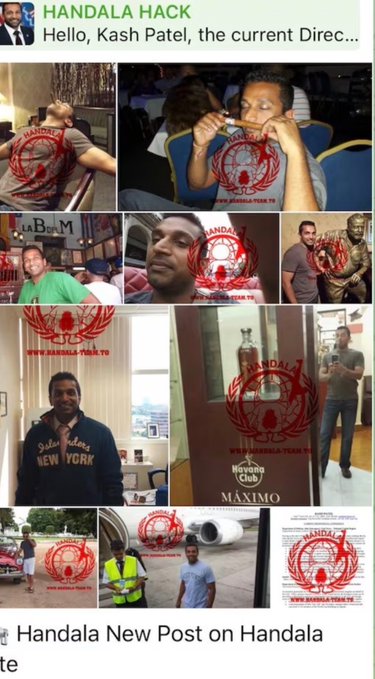
Iran-linked hacking group Handala claims it breached FBI Director Kash Patel’s personal Gmail account and shared alleged data, including photos and files. The FBI confirmed it is aware of the incident and has taken steps to mitigate risks, stressing that the exposed material is old and does not involve any government or classified information.
“The FBI is aware of malicious actors targeting Director Patel’s personal email information, and we have taken all necessary steps to mitigate potential risks associated with this activity,” reads a statement issued by an FBI spokesman. “The information in question is historical in nature and involves no government information.”
Analysis of leaked data confirms that several emails attributed to Kash Patel’s Gmail account are authentic. Some emails were also sent from his former Justice Department account in 2014 and appear genuine.
TechCrunch verified that some leaked emails attributed to Kash Patel’s Gmail account are authentic by analyzing message headers, which confirm the sender and help detect spoofed emails.
The exposed files largely date back to around 2019.
The FBI is offering up to $10 million for information on the Handala hackers.
Since the U.S.-Israeli war with Iran began in February, the Iran-linked group Handala has intensified its cyberattacks. It claimed responsibility for a destructive breach at medical tech firm Stryker that targeted its internal Microsoft environment and remotely wiped tens of thousands of employee devices without using malware.
The group claimed it wiped more than 200,000 servers, mobile devices, and other systems, forcing the company to shut down offices across 79 countries. The hacktivists also claimed they exfiltrated about 50TB of corporate data from the company’s infrastructure.
Handala appears as a pro-Palestinian hacktivist group but is widely seen as a front for Iran-backed Void Manticore, as reported by SecurityWeek. Known for phishing, data theft, extortion, and destructive wiper attacks, they also engage in info operations and psychological warfare. Since the Iran conflict began, they’ve targeted Israeli military servers, intelligence officers, and companies, stealing or wiping data.
The Justice Department accused Iran’s Ministry of Intelligence and Security (MOIS) of operating the Handala group.
Ironically, the FBI director recently said that “Iran thought they could hide behind fake websites and keyboard threats to terrorize Americans and silence dissidents,” “We took down four of their operation’s pillars and we’re not done. This FBI will hunt down every actor behind these cowardly death threats and cyberattacks and will bring the full force of American law enforcement down on them.”
However, he was reportedly unable to protect his own email account.
At this stage, it remains unclear how the FBI Director’s email account was compromised, and whether it was protected by at least two-factor authentication. It is also not known if Google had previously issued any warnings to government officials about potential state-sponsored attacks, as it has done in past cases.
Follow me on Twitter: @securityaffairs and Facebook and Mastodon
(SecurityAffairs – hacking, FBI director)
Facts Only
Iran-linked hacking group Handala claims to have breached FBI Director Kash Patel’s personal Gmail account.
The FBI confirmed it is aware of the incident and has taken steps to mitigate risks.
The exposed material is described as old and does not involve any government or classified information.
Some leaked emails attributed to Patel’s Gmail account were verified as authentic.
The exposed files largely date back to around 2019.
The FBI is offering up to $10 million for information on the Handala hackers.
Handala has intensified cyberattacks since the U.S.-Israeli conflict with Iran began in February.
The group claimed responsibility for a breach at medical tech firm Stryker, wiping tens of thousands of devices and exfiltrating 50TB of data.
Handala is widely seen as a front for Iran-backed Void Manticore.
The Justice Department accused Iran’s Ministry of Intelligence and Security of operating the Handala group.
FBI Director Kash Patel recently criticized Iran’s cyber threats.
It remains unclear how Patel’s email account was compromised or if two-factor authentication was used.
Executive Summary
Full Take
The strongest version of this narrative highlights a significant cybersecurity breach involving a high-profile U.S. official, underscoring the escalating cyber threats from state-linked actors. The FBI’s response—acknowledging the breach while downplaying its sensitivity—aligns with standard damage control, emphasizing that no classified information was exposed. However, the irony of the FBI director’s personal account being compromised while he publicly condemns Iran’s cyber operations adds a layer of complexity, raising questions about the effectiveness of personal cybersecurity measures among top officials.
Patterns detected: ARC-0024 Ambiguity (uncertainty around breach methods), ARC-0043 Motte-and-Bailey (FBI’s dual stance of condemning cyber threats while being vulnerable).
The root cause appears to be the broader geopolitical conflict between the U.S. and Iran, with cyber warfare becoming a key battleground. The assumption that personal accounts of officials are secure—even when not containing classified material—is challenged here. Historically, this echoes past incidents where state-sponsored hacking groups targeted high-profile individuals to undermine trust in institutions.
Implications for human agency include the erosion of trust in digital security, particularly for public figures. The costs are borne by both the individuals targeted and the institutions they represent, while the beneficiaries may include adversarial states seeking to exploit such breaches for propaganda or intelligence. Second-order consequences could include increased scrutiny of personal cybersecurity practices among government officials and a potential shift in public perception of cyber threats.
Bridge questions: How might this breach influence future cybersecurity protocols for government officials? What broader geopolitical strategies might Iran be pursuing through such cyber operations? Would evidence of more sophisticated attack methods change the assessment of this incident?
Counterstrike scan: A coordinated influence campaign would likely amplify the irony of the FBI director’s vulnerability to undermine U.S. cybersecurity credibility. The actual content does not fully align with this pattern, as it presents the breach as a factual event without overt manipulation. However, the framing of the irony could be exploited by adversarial narratives.