Deutsche Oper Berlin 2025-26: Giulio Cesare in Egitto, HWV 17
By Ossama el Naggar(Photo: Nancy Jesse)
Few works have suffered more persistently from the legacy of Orientalist fantasy than Handel’s “Giulio Cesare in Egitto.” Ever since Columbia University academic Edward Said published “Orientalism” in 1978, the intellectual foundations underpinning Europe’s imaginative construction of “the East” have been subjected to relentless and often persuasive scrutiny. Said demonstrated that Orientalism was never merely an artistic vocabulary of turbans, harems and desert palaces, but a political discourse that transformed entire civilizations into Europe’s exotic, irrational and inferior “Other,” thereby furnishing colonial domination with an aura of cultural inevitability.
David McVicar’s Production
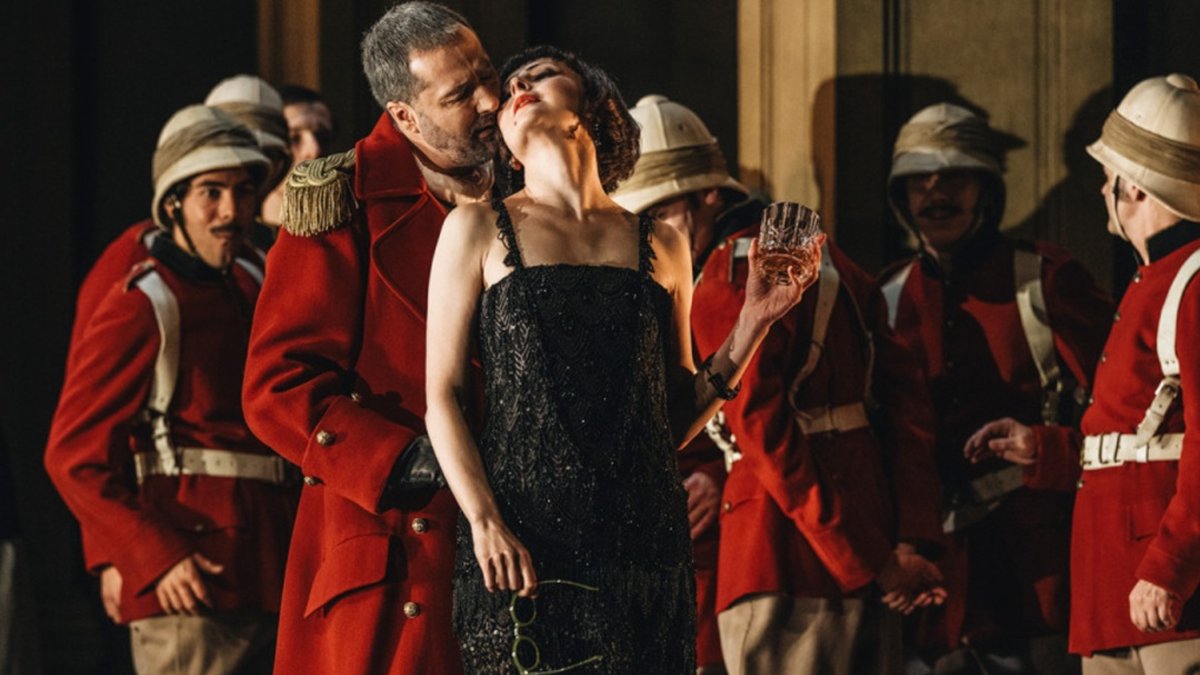
Nearly half a century later, one might reasonably expect so canonical a work as “Giulio Cesare” to invite a more searching engagement with these questions. David McVicar’s celebrated production, first unveiled in 2005 and now imported to the Deutsche Oper Berlin after two decades of international circulation, instead appears remarkably untouched by them. Egypt is rendered through the accumulated visual lexicon of British imperial nostalgia: pith helmets, languid odalisques, pseudo-Ottoman ornamentation, Orientalist caricature and a succession of exotic tableaux that owe considerably more to the Edwardian music hall than to Ptolemaic Alexandria. The production seems to assume that self-conscious theatrical irony somehow neutralizes these images’ ideological implications. It does not. Quotation is not critique, and affectionate parody remains perfectly capable of perpetuating the assumptions it pretends merely to acknowledge.
More troubling still is the production’s cultural promiscuity. McVicar treats the “Orient” as a single undifferentiated aesthetic reservoir from which costumes, dances and rituals may be borrowed indiscriminately. Punjabi choreography appears alongside Moroccan ceremony, hints of Khmer court dance mingle with vaguely Middle Eastern spectacle, while other episodes evoke an imaginary geography assembled from colonial travel literature rather than historical or cultural understanding. Such eclecticism is frequently defended as theatrical exuberance. In practice it resembles depicting Finland through an amalgam of Swiss yodeling and Andalusian flamenco simply because all three belong to a continent called Europe. The comparison would rightly be regarded as absurd; applied east of Vienna, however, such indiscriminate borrowing continues to pass with surprising ease.
Ironically, Handel’s opera requires none of this decorative exoticism. Beneath its Egyptian setting lies one of the composer’s most psychologically sophisticated dramas, exploring conquest, political calculation, grief, ambition and erotic power with extraordinary subtlety. McVicar repeatedly substitutes spectacle for psychology. Cleopatra, among antiquity’s most intellectually formidable rulers, is transformed into a virtuoso entertainer whose succession of dance styles—ranging from Charleston and Weimar cabaret to Punjabi choreography and ersatz belly dance—suggests a variety show rather than the calculated theatrical intelligence with which Handel endowed the character. Even the exuberant “Da tempeste” becomes a theatrical conceit whose ingenuity ultimately distracts from the emotional transformation the aria is meant to celebrate. One leaves with the impression not of Egypt’s last great queen, but of an indefatigable mistress of ceremonies.
Musical Details
Musically, the evening proved scarcely more persuasive. Handel’s “Giulio Cesare in Egitto” (seen July 5) contains one of the richest orchestral fabrics in Baroque opera, its luxuriant scoring—including the celebrated four horns, an exceptional extravagance for its time—demonstrating the composer’s inexhaustible gift for instrumental color. Yet Alessandro Quarta drew remarkably little vitality from either orchestra or score. Dynamic range remained constricted, articulation lacked profile, and the continuo accompaniment seldom generated the rhetorical urgency upon which Handel’s musical drama depends.
Quarta’s consistently expansive tempi compounded these difficulties. Historically informed performances generally rely upon rhythmic buoyancy to sustain the architecture of Handel’s extended da capo forms. Here, almost every number unfolded at a deliberate pace. By dispensing with the customary cuts that have long rendered the opera theatrically viable, Quarta extended the performance to nearly five hours—an endurance that felt considerably longer than the clock suggested. Under such conditions, the da capo arias ceased to accumulate dramatic intensity and instead became exercises in repetition. Handel’s extraordinary capacity to transform recurring musical material through ornament, rhetoric and affect found little encouragement from an accompaniment that remained dutiful rather than imaginatively responsive. The result was an interpretation distinguished less by contemplative grandeur than by dramatic inertia.
Cast Highlights & Lowlights
Among the cast, French countertenor Christophe Dumaux towered above his colleagues as a commanding Giulio Cesare, marrying stylistic authority with genuine theatrical magnetism. His heroic countertenor possessed both amplitude and warmth, while his Italian diction remained exemplary throughout. Iranian-Canadian countertenor Cameron Shahbazi likewise offered an admirably nuanced Tolomeo, resisting the temptation to reduce the character to camp villainy and instead portraying an entitled, manipulative ruler whose cruelty emerged from character rather than caricature. Italian mezzo Martina Baroni contributed an affecting, sensitively sung Sesto, while American bass-baritone Michael Sumuel brought uncommon distinction to the comparatively modest role of Achilla.
Elsewhere, however, standards proved markedly uneven. British mezzo Stephanie Wake-Edwards’ Cornelia suffered from persistent problems of intonation, unfocused tone and laboured phrasing, depriving Handel’s noblest music of its tragic dignity. Russian soprano Elena Tsallagova negotiated Cleopatra’s formidable technical demands with assurance, yet her portrayal remained emotionally elusive. The voice, cool and metallic in colour, rarely projected the intoxicating mixture of intelligence, sensuality and vulnerability that makes Cleopatra one of Handel’s supreme creations. One admired the accomplishment while seldom believing the woman.
Equally regrettable was the characterization of Nireno, which relied upon broad stereotypes of effeminacy for comic effect. Such humor already felt antiquated decades ago; today it appears merely lazy, substituting caricature for wit in a production otherwise eager to congratulate itself on its theatrical sophistication.
That McVicar’s “Giulio Cesare” continues to enjoy canonical status reveals something of opera’s institutional conservatism. Productions survive not because they continue to illuminate great works but because familiarity gradually acquires the authority of tradition. What may once have appeared fresh and irreverent now seems curiously embalmed: meticulously crafted, visually opulent and mechanically accomplished, yet intellectually complacent and dramatically incurious. The Deutsche Oper has revived the staging with evident care and considerable resources. Neither, however, can conceal that beneath its handsome surfaces lies a conception whose aesthetic assumptions—and cultural imagination—belong unmistakably to another era.