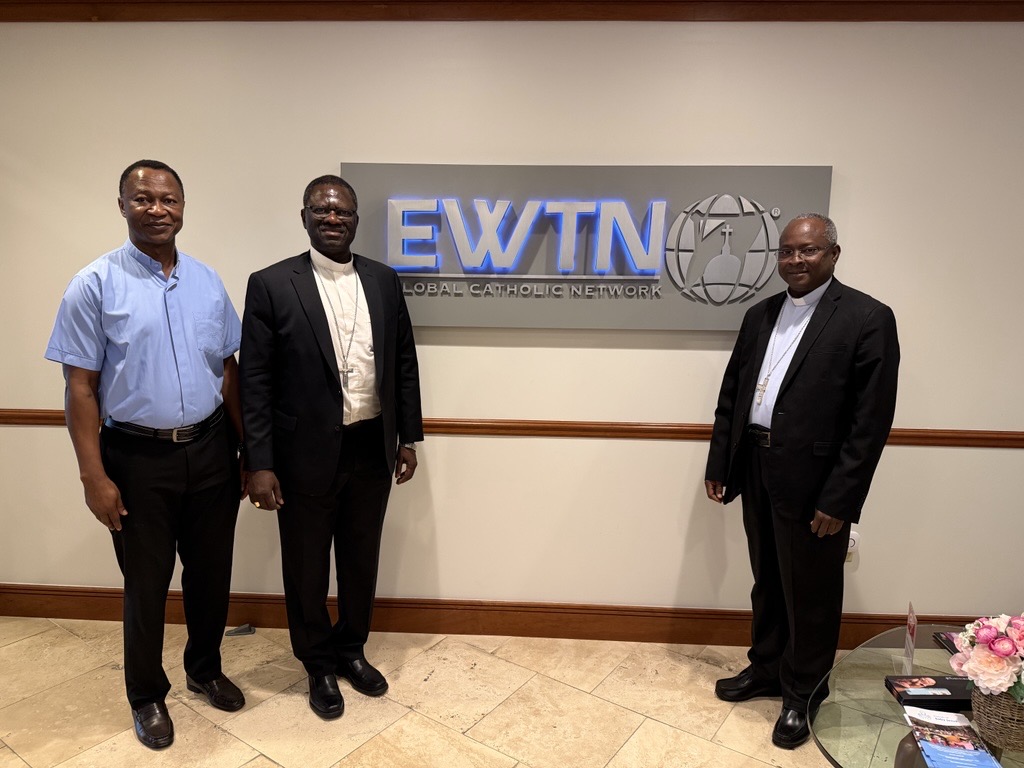
Catholic bishops from West Africa are leading an international effort to develop the Sahel Peace University — a prospective higher education institution to train future leaders in addressing the scourge of terrorism and violence in the region.
The proposed university is borne out of the broader Sahel Peace Initiative, an interfaith advocacy organization working toward peacebuilding in the region. The Sahel is the region sitting directly below the Sahara desert, representing the northernmost part of Sub-Saharan Africa.
According to a concept proposal provided to EWTN News, the initiative is led by the Catholic bishops conferences in Burkina Faso and Niger.
Christians are the minority in both countries, representing slightly more than one-fourth of Burkina Faso and about 1% of Niger. Traditional African religions also represent a minority, while Islam is the most practiced religion.
“While we will envision solutions like buildings and programs, the goal is to foster a robust population engaged in problem solving and developing a sustainable peace in the Sahel,” the proposal states.
Although led by Catholics, the bishops also partner with Muslim clerics and leaders of traditional African faith communities. The proposal notes the university will be grounded in Catholic social teaching, and open to everyone, and expressed a commitment to work with interfaith partners, especially the Muslim community.
“The [university] will serve as a regional hub for peacebuilding, governance research, trauma healing, and community resilience, equipping leaders and communities to address the Sahel’s most urgent challenges,” it adds.
The bishops hope to headquarter the university in Ouagadougou, the capital of Burkina Faso. It will be African- and Catholic-led, but the bishops are looking for international support, including from the United States.
“While the physical requirements include buildings and materials, these are merely tools for the emerging leaders to cultivate a new group of younger and empowered people of all faiths working collaboratively towards the shared goal of lasting peace,” it states.
Burkina Faso bishops seek solidarity
Bishops from Burkina Faso have met with Pope Leo XIV in Rome and have offered information to the U.S. State Department in a recent trip to the United States, hoping to spread awareness about problems in the Sahel and to garner more support for their peace efforts.
Two of the bishops — Archbishop Laurent Dabire, archbishop of Bobo-Dioulasso, and Bishop Alexandre Bazie, auxiliary bishop of Koudougou and head of the Burkina Faso-Niger bishops’ delegation — spoke with EWTN News about the situation on the ground and efforts to gain support for the university.
The bishops spoke in French through a translator, Father Barthelemy Bazemo.
Dabire said he told Leo the bishops have been trying to raise awareness about problems in the region for a long time. He said people globally are aware of the conflicts in Ukraine, Iran, and Gaza, but often Africa and the Sahel are overlooked.
President Donald Trump coordinated with the Nigerian government to strike terrorists in Nigeria — a country in the Sahel, east of Burkina Faso — amid rampant violence, killings, and terrorism that has disproportionately targeted Christians, but also victimized many Muslims and followers of traditional African religions.
Bazie said the U.S. has coordinated with Burkina Faso on separate issues, such as health initiatives, but the terrorism problem has not drawn as much attention from the administration when compared to Nigeria.
He said the violence in Burkina Faso is not one-sided against Christians, but that terrorists target both churches and mosques, and both Christian and Muslim clerics. He warned the people of Burkina Faso, however, cannot afford to wait until the situation reaches the level of Nigeria.
According to a 2025 report from the U.S. Commission on International Religious Freedom (USCIRF) about the Sahel countries, Burkina Faso has “one of the world’s highest rates of civilian attacks and fatalities from insurgent violence.”
It cites actions from violent insurgent groups, including a February 2024 attack by the Islamic State – Sahel Province that killed 12 worshipers at a Catholic Church in Essakane. There was another attack that month on a mosque that killed dozens of people, along with numerous attacks on villages by bandits and insurgents. These attacks have targeted both Christians and Muslims.
In addition to murders, attacks have included kidnappings of priests, religious sisters, imams, and other Christian and Muslim civilians.
“As a result of brutal killings — thousands [have been] killed — there [are] many [in the] community being impacted [and] it takes education,” Bazie said. “It takes several years of training to get people into the [right] mindset, even if we have different solutions.”
Bazie noted that the Church has been working to improve the region through construction of schools and hospitals and other forms of economic development, but that additional support from outside partners can help the region further.
“With limited resources, [we’re] trying to do [our] best,” he said. “But now coming here is to ask for support in what’s already being done.”
Facts Only
* Catholic bishops from West Africa are leading an international effort to develop the Sahel Peace University.
* The university aims to train future leaders in addressing terrorism and violence in the Sahel.
* The initiative is borne out of the Sahel Peace Initiative, an interfaith advocacy organization.
* The initiative is led by the Catholic bishops conferences in Burkina Faso and Niger.
* The proposed university will be grounded in Catholic social teaching but is open to all faiths, committing to interfaith partnership, especially with the Muslim community.
* The university will serve as a regional hub for peacebuilding, governance research, trauma healing, and community resilience.
* Bishops seek international support, including from the United States.
* The bishops hope to headquarter the university in Ouagadougou, Burkina Faso.
* Two bishops spoke with EWTN News about efforts to gain support for the university.
* Insurgent groups have targeted both Christians and Muslims across the Sahel, including attacking churches and mosques.
* Attacks have included murders, kidnappings of priests, religious sisters, imams, and other civilians.
* The U.S. Commission on International Religious Freedom (USCIRF) reported that Burkina Faso has one of the world’s highest rates of civilian attacks and fatalities from insurgent violence in 2025.
Executive Summary
Catholic bishops from West Africa are leading an international effort to establish the Sahel Peace University, a proposed higher education institution aimed at training future leaders to address terrorism and violence in the Sahel region. This initiative stems from the broader Sahel Peace Initiative, an interfaith advocacy group focused on peacebuilding. The project is spearheaded by the Catholic bishops conferences in Burkina Faso and Niger, with hopes of locating the university in Ouagadougou. The proposal emphasizes that while solutions involve physical programs and buildings, the ultimate goal is to foster a robust, problem-solving population engaged in sustainable peace.
The initiative acknowledges the religious diversity of the region, partnering with Muslim clerics and leaders of traditional African faith communities. The proposed university intends to serve as a regional hub for peacebuilding, governance research, trauma healing, and community resilience. Although grounded in Catholic social teaching, the proposal explicitly commits to working with interfaith partners, particularly the Muslim community.
The bishops seek international support, including from the United States, to achieve these goals. While facing limited resources, the effort seeks to cultivate a new group of empowered people of all faiths working collaboratively toward lasting peace. The context for this effort is defined by ongoing violence in the Sahel, where attacks have targeted both Christian and Muslim communities, prompting calls for education and structural change to address community impact.
Full Take
This narrative frames a highly complex security and religious conflict through the lens of educational reform and international partnership. The core tension lies between the urgent need for physical security and the long-term cultivation of social, spiritual, and political cohesion. The strategy deployed is to leverage a shared institutional framework (the university) to bridge deep sectarian divides, positioning peacebuilding as a necessity that transcends specific religious identities.
The reliance on interfaith partnership, particularly involving Catholic leadership with Muslim clerics and traditional leaders, is a strategic move designed to create a coalition capable of addressing violence that targets all groups equally. However, the focus on "equipping leaders" suggests an implicit assumption that structural peace can be achieved through human capital development rather than solely through military intervention or immediate political settlements. This shift risks obscuring the immediate existential threats faced by communities caught in brutal conflict.
The appeal for external support (specifically from the U.S.) links regional suffering to a broader global concern, attempting to attach moral weight to the Sahel’s issues. The reporting on violence highlights that insurgents target both religious groups, suggesting that religious identity is often weaponized within local conflicts rather than being the sole defining factor of grievance. The pattern suggests an attempt to reframe internal security challenges into globally recognized humanitarian and development issues, seeking systemic change through external investment and educational models.
Patterns detected: ARC-0043 Motte-and-Bailey, ARC-0024 Ambiguity, ARC-0109 Authority Games
Sentinel — Human
The text exhibits strong characteristics of human journalistic reporting, marked by specific attribution, contextual nuance, and the natural flow of complex geopolitical and religious material.