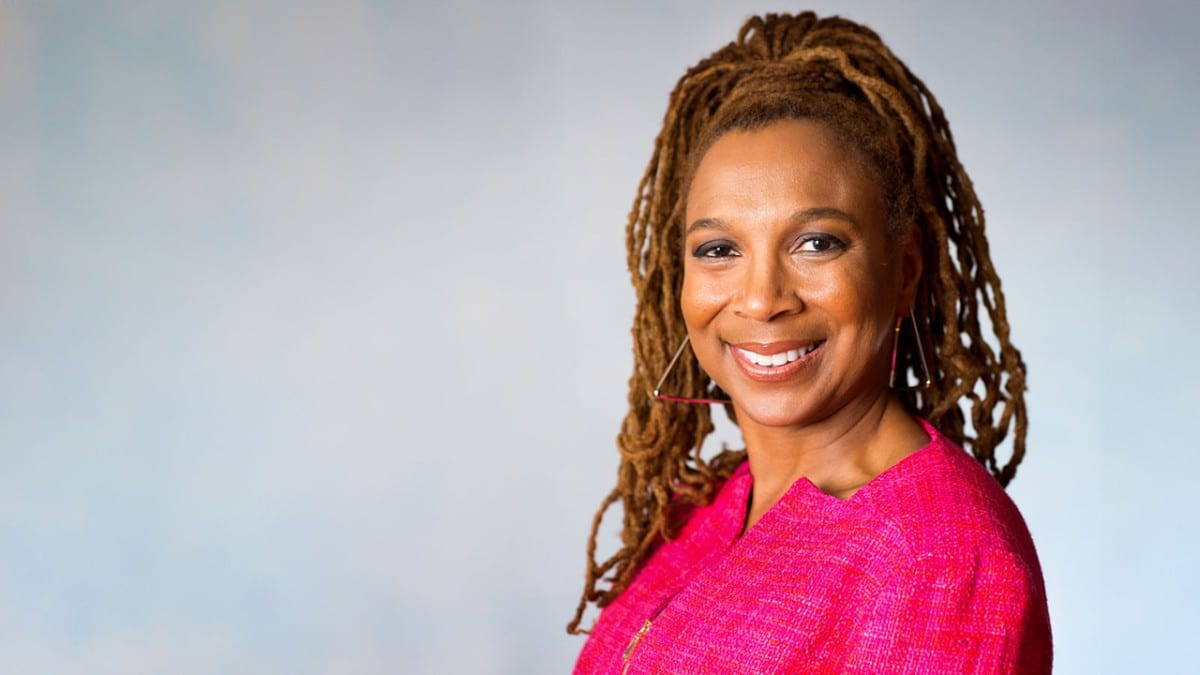
Professor Kimberlé W. Crenshaw, founder and director of the African American Policy Forum, explains why she supports the Zinn Education Project Teach Truth About the American Revolution campaign.
This three and a half minute video clip offers a valuable lesson on the dangers of the mis-representation of the American Revolution. The clip can serve as a prompt for discussion in high school and college courses.
Transcript
The African American Policy Forum is proud to support Zinn Education Project’s Decolonize 1776 initiative. As our nation prepares to celebrate 250 years of the American Revolution, one thing is certain: however loud the fireworks are sure to be, the silences will be louder.
We’ve been reading from the same script for generations, a heroic story of brave colonists achieving liberty against all odds. But from the perspective of Black and Indigenous peoples, that script has always been written over a void.
Today, there’s an organized effort to treat the less salutary parts of our past like an Etch-a-Sketch, shaking the frame to wipe the lines away so they are never discussed again.
These attacks on our accurate, yet difficult history are efforts to cement this narrow narrative into the center of our laws, our classrooms, and our museums. But we have to be honest.
The house America built for our democracy is not simply in need of a renovation. It was built upon a defective cornerstone of white supremacy. Systemic exclusion, it’s not a bug. It’s a foundational feature of the original American project.
That’s why we have to teach the truth to expose that foundation and demand a better one. The American Revolution is sold as an anti-imperial uprising, but independence didn’t stop conquest and dispossession. It merely changed the logo on the land deeds.
The new United States shredded treaties and treated Indigenous communities as obstacles that we needed to have erased.
Today, officials target curricula that name genocide because they know that if you ban the words, you can bless the myth. Then there’s enslavement. We hear of the bravery of soldiers, but less of the enslaved labor that financed them, nor the industrialized sexual abuse of Black women that created their wealth.
We also rarely grapple with the fact that some Black folks made a different revolutionary choice to fight for the British, who promised emancipation long before the founders dreamt of it. Don’t be fooled. These bans on teaching truth are not protecting children from indoctrination. They’re protecting a fragile myth from the light of the truth.
A revolution that censors theft of land, labor, and Black women’s sexual autonomy is taught as mission accomplished rather than as an ongoing project in search of fulfillment.
The choice for this anniversary is clear. We can either have a feel-good pageant, or we can uplift the fact that the revolution was both a promise and a problem. Those of us who embrace the freedom to learn must ensure that the truth is not sacrificed for a comfortable lie. We must teach truth about what was sacrificed for American liberty and ensure those truths are remembered for the next 250 years.
Twitter
Google plus
LinkedIn
Facts Only
Professor Kimberlé W. Crenshaw is the founder and director of the African American Policy Forum.
The African American Policy Forum supports the Zinn Education Project’s "Decolonize 1776" initiative.
The initiative critiques traditional narratives of the American Revolution.
The U.S. will celebrate the 250th anniversary of the American Revolution.
Crenshaw argues that the standard Revolutionary narrative excludes Black and Indigenous perspectives.
She states that systemic exclusion and white supremacy were foundational to the U.S.
The campaign opposes efforts to censor discussions of genocide and enslavement in education.
Crenshaw notes that the British offered emancipation to enslaved people before U.S. founders.
She claims that bans on teaching certain histories protect myths rather than children.
The video clip is intended for use in high school and college discussions.
The Zinn Education Project focuses on teaching accurate, though difficult, historical truths.
Crenshaw calls for remembering these truths for the next 250 years.
Executive Summary
Professor Kimberlé W. Crenshaw, founder of the African American Policy Forum, endorses the Zinn Education Project’s "Teach Truth About the American Revolution" campaign, which challenges traditional narratives of the Revolution as a purely heroic struggle for liberty. She argues that the standard account omits the perspectives of Black and Indigenous peoples, whose experiences reveal systemic exclusion and violence as foundational to the U.S. The campaign critiques efforts to censor discussions of genocide, enslavement, and broken treaties, framing these as attempts to preserve a sanitized national myth. Crenshaw highlights how the Revolution, while framed as anti-imperial, perpetuated dispossession and enslavement, with some enslaved people allying with the British for promised emancipation. She warns that banning such truths protects a fragile myth rather than children, urging a reckoning with history’s complexities as the nation approaches the Revolution’s 250th anniversary.
The debate reflects broader tensions over how history is taught, with critics of the campaign often arguing that such narratives undermine national pride or are divisive. Crenshaw’s stance aligns with a growing movement to "decolonize" historical education, emphasizing that confronting uncomfortable truths is necessary for a more just society. The discussion underscores the role of education in shaping collective memory and identity, with implications for policy, curriculum, and public discourse.
Full Take
This narrative presents a compelling challenge to dominant historical frameworks, emphasizing the need to confront uncomfortable truths about the American Revolution. At its strongest, it highlights how selective memory in education can perpetuate systemic injustices, framing the Revolution not as a singular triumph but as a complex, ongoing struggle with deep moral contradictions. Crenshaw’s argument gains force from its focus on marginalized voices—enslaved people who sided with the British, Indigenous communities dispossessed of land—and its critique of censorship as a tool to preserve power.
Patterns detected: ARC-0024 Ambiguity (in framing "truth" as monolithic), ARC-0043 Motte-and-Bailey (shifting between "teaching truth" as a universal good and specific political interpretations as the only valid truth).
The root cause here is a clash between competing paradigms of national identity: one rooted in aspirational unity, the other in reckoning with historical harm. The unstated assumption is that education must serve either myth-making or justice—but not both. This echoes broader cultural battles over memory, where history becomes a proxy for contemporary power struggles.
Implications for human dignity are profound. If education censors oppression, it risks erasing the agency of those who resisted it. Yet, the framing also risks polarizing audiences by implying that only one narrative can be "true," potentially alienating those who see nuance in patriotism. Second-order consequences include the weaponization of curriculum debates in political campaigns, where education becomes a battleground for ideological control.
Bridge questions: How can historical education balance accountability with unity? What would a curriculum look like that honors both the ideals and the failures of the Revolution? How do we distinguish between teaching difficult history and imposing a single interpretive lens?
Counterstrike scan: A coordinated influence campaign would amplify this narrative to delegitimize traditional institutions, framing all dissent as complicity in oppression. The actual content, however, focuses on expanding historical understanding rather than dismantling systems wholesale—aligning more with educational reform than ideological subversion. No structural match to a malicious playbook.