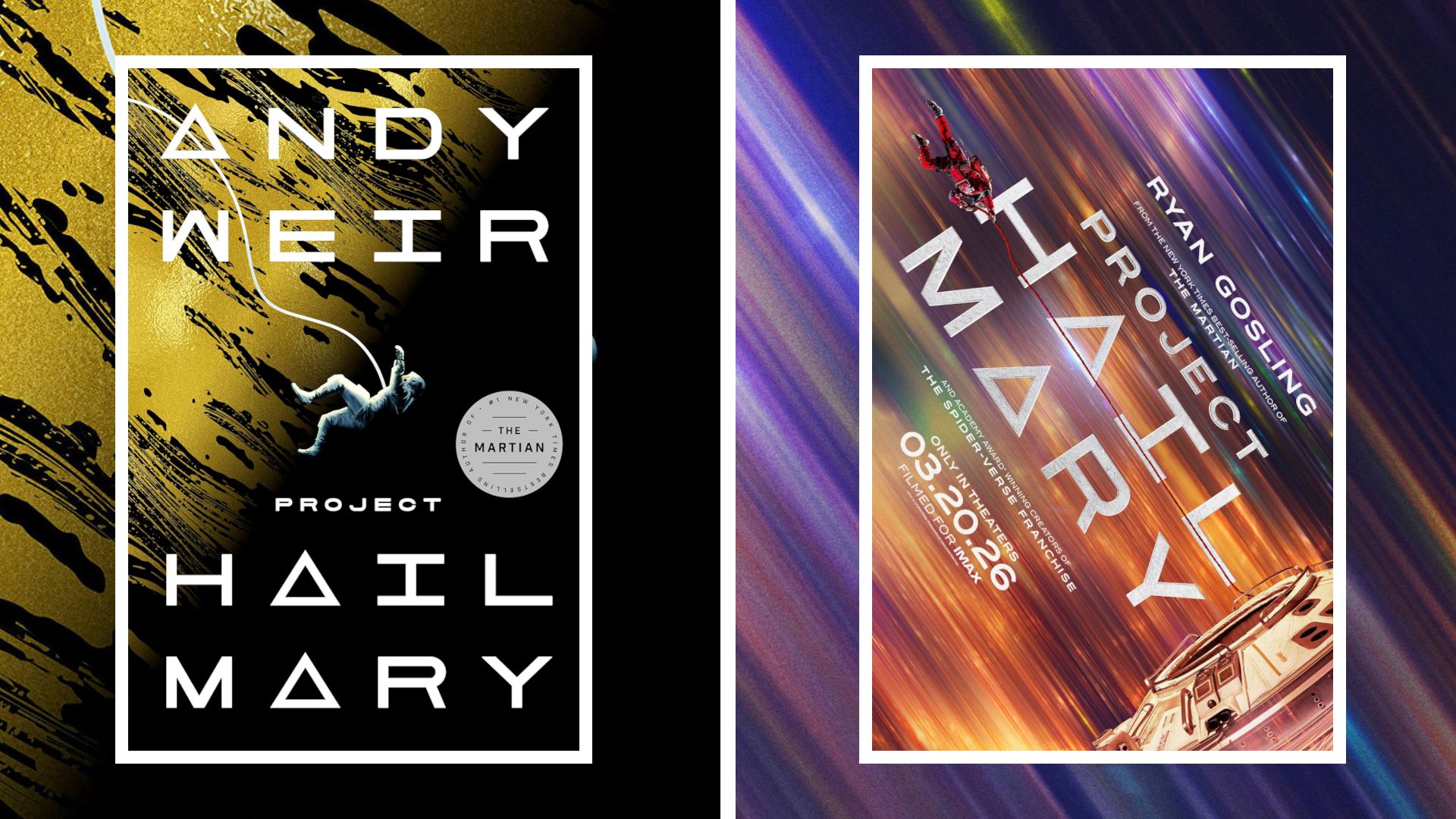
Ryland Grace's world-saving adventure saw a few changes during the jump from the page to the screen; here are ten big differences we spotted.
Breaking space news, the latest updates on rocket launches, skywatching events and more!
You are now subscribed
Your newsletter sign-up was successful
Want to add more newsletters?
"Project Hail Mary" has hit theaters, and it's getting rave reviews (and not just from us). Fans of the book are in for a treat, but there are some major changes between the Ryan Gosling flick and the Andy Weir novel it's based on.
The book was equally lauded when it landed, delivering a delicate balance of speculative and hard science fiction that’s hard to come by. While the book reads easily and is seemingly structured to facilitate a film adaptation, bringing it to the big screen in such a successful way was definitely no easy task.
Changes had to be made to squeeze the 496-page novel into a 156-minute screenplay. Beyond the time constraints, what makes a great novel doesn’t always make a great movie, and sometimes things need to change. Some of those changes are small, while others shifted the entire thematic feel of the story.
Article continues belowHere is every difference we spotted between the "Project Hail Mary" movie and book.
Spoiler warning for both the book and the movie!
1. Carl
In the movie, Carl (Lionel Boyce) is a pretty central figure throughout the first quarter of the film, providing Dr. Grace (Ryan Gosling) with not just security but also inspiration for saving the human race. He’s literally one of the few humans in the film with more than a handful of lines.
Those who haven’t read the book may then be surprised to know that one of the three major human characters in the movie isn’t in the book at all. It’s pretty obvious why Carl was added in, as he acts as both comic relief, a humanizing foil for Grace, and as a verbal sounding board for Dr. Grace as he’s experimenting.
Breaking space news, the latest updates on rocket launches, skywatching events and more!
In the book, all that dialogue takes place in Grace's head, which just doesn’t work all that well in movies.
2. The Hail Mary
The titular spacecraft has had a bit of a redesign and a few rooms added in. In the novel, which comes complete with a handy visualization of the spacecraft, The Hail Mary looks almost like an oversized version of a cartoon rocket ship, with only three rooms and a storage area all stacked on top of each other.
The film’s version of the ship is much different, incorporating a central living pillar with the rockets surrounding it, providing more space for Grace to exist in. This change was probably made to give the ship a cooler visual appearance, and possibly add a bit more realism around the centrifugal spacecraft, making it one of the few areas where the movie feels more scientifically accurate than the book.
The movie version also has a domed entertainment room for watching media, which is not present in the book. This gives us some nice visuals and lets the movie communicate Grace's homesickness.
3. Grace Alone
A surprisingly large chunk of the novel is dedicated to Dr. Grace on his own before he ever meets Rocky. In the film, most of this time period is spent on comic relief, building back story, or showing Grace fumbling around the ship while he gets drunk. In the novel, however, Grace is already well on his way to accepting and understanding his predicament and solving his myriad problems by the time he meets Rocky.
The shift changes his character pretty significantly for the beginning of the film and turns Rocky’s arrival from a major plot twist in the book, considering how far in it takes place, into a minimal surprise for the movie (that is, if the trailer hadn’t already ruined it).
4. Science Stuff
It’s pretty clear that the filmmakers decided that the heart of Weir’s novel was not his meticulously researched attempt at scientific accuracy of the unknown and imagined, but instead the emotional connection between Grace and Rocky. And they were 100% correct.
The film almost completely drops any and all scientific babble from the book in favor of character development, action sequences, and emotional gut punches. It works wonders, pulling out the heart that’s woven through the novel’s science talk and ensuring that the film never feels like it’s just a lecture.
Though for those of us into harder sci-fi, a little bit of techno babble wouldn’t have hurt.
Related: I talked to author Andy Weir about the astrobiology behind 'Project Hail Mary' (interview)
5. Saving Rocky
In both the book and film, Rocky and Grace’s attempt to collect a sample of the atmosphere of Adrian goes wrong, and Grace ends up unconscious, forcing Rocky to leave his protective bubble and rescue him, seriously injuring himself. However, what happens after this is drastically different.
In the book, Grace drags Rocky back to his part of the ship, exposing himself to the Eridian environment; in the film, Rocky crawls back while Grace is unconscious. In the novel, Grace then attempts to rescue Rocky by doing a series of “cleanings” that he believes should help the alien recover (it turns out he was actually doing the wrong thing).
In the film, none of this happens. Instead, Grace does a lot of science while waiting around for Rocky to wake up on his own accord. The change probably stems from the lack of science stuff in the film. Where the book took pains to explain how Rocky’s biology worked in a scientific manner, thus setting up Grace’s attempt at saving him based on this knowledge, the movie does not.
The end result has the same emotional punch; they just got there in different ways.
6. No poop
In the book, Grace takes an interest in how Rocky basically eats, digests, and poops, with him eventually watching Rocky eat and then basically take a dump. They left this out of the film entirely.
Who could possibly guess why?
7. Every character not named Rylan Grace, Carl, or Eva Stratt
While the book isn’t all that jam-packed with other characters in meaningful ways – Stratt is actually better developed in the film than in the novel – the film takes this to an extreme.
Grace befriends multiple other scientists working on the ship with him, and their relationships are unpacked and explored. This is also true for his fellow crewmates, with whom he becomes close friends in the novel while he’s training them. Nearly all of them are reduced to cameos in the movie.
This is just a matter of saving time. The film can’t unpack all of Grace’s life before he blasts off, especially as its focus is far more on Rocky and Grace together, so there’s just not enough time to explore these other characters.
8. Grace visits Rocky’s ship
In the film, there’s a striking moment when Rocky gives Grace a goodbye gift as the pair prepare to return to their home planets: a walk inside Rocky’s ship. Rocky builds Grace the equivalent of an Eridian space suit that allows Grace to enter Rocky’s ship in one of the more poignant and gorgeous moments in the film.
None of this happens in the book. From the gift exchange to the suit to the scene in Rocky’s ship, everything was made up for the film. Given the movie’s deeper emotional focus, it makes sense to add this moment. Plus, by that point in the film, audiences are dying to see Rocky’s ship.
9. The whole timeline
The film's timeline isn’t exactly clear or stated, but overall, it feels much, much faster than the book. In the book, Rocky and Grace spend months together trying to understand the astrophage and find a way to stop it. By the end of that time period, Grace is fluent in Rocky’s sing-song language, and the pair has done a lot together.
The film feels like a much shorter timeline – maybe only a matter of weeks. Grace doesn’t fully understand Rocky until the film’s conclusion, when he’s living on Erid, and the movie isn’t edited to suggest an extensive period of time.
This shortened timeline feeling also hits the flashbacks, with Grace’s time studying and planning for Project Hail Mary on Earth playing out in a faster manner as well. All this may just be attributed to the shorter run time of the movie, but it is noticeable.
10. Astrophage contamination
While this major plot point isn’t changed from the book to the film – the taumeoba eventually affects the astrophage fuel, forcing Grace to rescue Rocky – the build-up to this plot twist is drastically greater in the book.
The novel repeatedly establishes that the taumeoba is dangerous, to the extent that there is an entire storyline where it escapes and destroys a fuel tank of astrophage, forcing Grace to do an extensive cleaning of the entire ship. The book wonderfully foreshadows one of its best moments, but the film doesn’t do this at all, setting up the action with a few lines of dialog instead.
Time constraints once again strike here, but there’s also the fact that the movie drops the plot’s true twist — that Grace is a coward — only a few minutes before. Structurally, there are just too many punches coming to have this moment feel like the shock it was in the book.
There you have it. All the major differences we spotted between the "Project Hail Mary" movie and book. Did we miss any others that you noticed? And what did you think of the movie compared to the book? Sound off in the comments below.
A lone astronaut must save the Earth from disaster in this propulsive, cinematic thriller full of suspense, humor, and fascinating science.
Matthew has more than 30 years of experience talking about movies, TV shows, and video games, and for 20 of those years someone has actually paid him to do it. He's just as surprised as you are.
You must confirm your public display name before commenting
Please logout and then login again, you will then be prompted to enter your display name.
Facts Only
The *Project Hail Mary* film adaptation introduces Carl, a character not present in the original novel, who serves as comic relief and a sounding board for protagonist Ryland Grace.
The Hail Mary spacecraft is redesigned in the film, featuring a central living pillar with surrounding rockets and an additional domed entertainment room, differing from the book’s simpler, stacked-room design.
The film condenses Ryland Grace’s solitary problem-solving phase, reducing the time he spends alone before meeting Rocky compared to the novel.
Scientific explanations and technical dialogue from the book are largely omitted in the film, which instead focuses on character development and emotional moments.
In the book, Grace attempts to save Rocky through a series of "cleanings" based on his understanding of Rocky’s biology, while the film simplifies this to Grace waiting for Rocky to recover.
The novel includes a scene where Grace observes Rocky’s digestive process, which is excluded from the film.
The film reduces the number of supporting characters, minimizing Grace’s relationships with other scientists and crewmates compared to the book.
A new scene in the film shows Grace entering Rocky’s ship using an Eridian space suit, a moment not present in the novel.
The film’s timeline feels compressed, with Grace and Rocky’s collaboration spanning weeks rather than the months described in the book.
The novel foreshadows the astrophage contamination twist through multiple incidents, while the film introduces it with minimal buildup.
The film omits the novel’s subplot about Grace’s cowardice, revealing it only briefly before the climax.
The movie’s runtime is 156 minutes, adapting a 496-page novel.
Executive Summary
The film adaptation of *Project Hail Mary* makes several notable changes from Andy Weir’s novel, primarily to streamline the story for a cinematic audience. Key differences include the addition of Carl, a character not present in the book, who serves as comic relief and a foil for protagonist Ryland Grace. The Hail Mary spacecraft is redesigned with more rooms and a domed entertainment area, enhancing visual appeal and realism. The film condenses Grace’s solitary problem-solving phase, shifting focus to his relationship with Rocky, the alien ally, and reducing the novel’s scientific explanations in favor of emotional and action-driven sequences. Major plot points, such as Grace’s attempt to save Rocky and the timeline of their collaboration, are altered for pacing and dramatic effect. The film also omits some of the book’s more technical or humorous elements, like Rocky’s digestive process, and simplifies the buildup to critical twists, such as the astrophage contamination. While the novel delves into Grace’s backstory and relationships with other scientists, the film prioritizes the core duo’s bond, reflecting its emphasis on character-driven storytelling over hard science fiction.
These changes highlight the inherent trade-offs between literary and cinematic storytelling. The novel’s detailed scientific reasoning and slower character development are condensed or repurposed to fit a two-and-a-half-hour runtime, with the filmmakers prioritizing emotional resonance and visual spectacle. The result is a faster-paced, more accessible narrative that retains the heart of the original while making concessions to the medium’s constraints.
Full Take
The strongest version of this narrative acknowledges the film’s deliberate shifts from the novel as a necessary adaptation to a different medium. The filmmakers prioritize emotional engagement and visual storytelling, recognizing that a hard science fiction novel’s intricate explanations and slower pacing may not translate effectively to cinema. By introducing Carl, redesigning the spacecraft, and condensing the timeline, the film creates a more dynamic and accessible experience while preserving the core relationship between Grace and Rocky. The omission of scientific details and supporting characters is a pragmatic choice, ensuring the story remains focused and engaging within its runtime.
However, this adaptation also reflects broader patterns in how complex narratives are simplified for mass audiences. The film’s compression of Grace’s character arc—particularly his cowardice—and the reduction of scientific rigor could be seen as a form of *ARC-0024 Ambiguity*, where depth is sacrificed for broad appeal. The emotional payoff remains intact, but the intellectual satisfaction of the novel’s problem-solving is diminished. This raises questions about whether such adaptations prioritize immediacy over substance, and whether audiences are being conditioned to expect less complexity in storytelling.
Rooted in the tension between fidelity and innovation, this adaptation echoes historical patterns where literary works are reimagined for new audiences, often at the cost of nuance. The film’s success suggests that emotional resonance can compensate for lost detail, but it also invites reflection on what is gained and lost in translation. Who benefits from these changes? The filmmakers and studios, certainly, as a streamlined narrative broadens appeal. But do audiences lose the opportunity to engage with deeper themes and scientific curiosity?
Bridge questions: How might the film’s changes alter the story’s thematic impact? Could a longer runtime or miniseries format have preserved more of the novel’s depth without sacrificing pacing? What does this adaptation reveal about modern audience expectations for science fiction?
Counterstrike scan: If this were part of a coordinated influence campaign, the playbook would involve simplifying complex ideas to make them more palatable, using emotional hooks to override critical engagement. However, the film’s changes align with standard adaptation practices rather than a deliberate manipulation strategy. The content does not match the hypothetical attack pattern.
Patterns detected: ARC-0024 Ambiguity
Sentinel — Human
The article exhibits strong human stylistic markers, including humor, conversational digressions, and a distinct authorial voice, with no significant signs of synthetic generation.