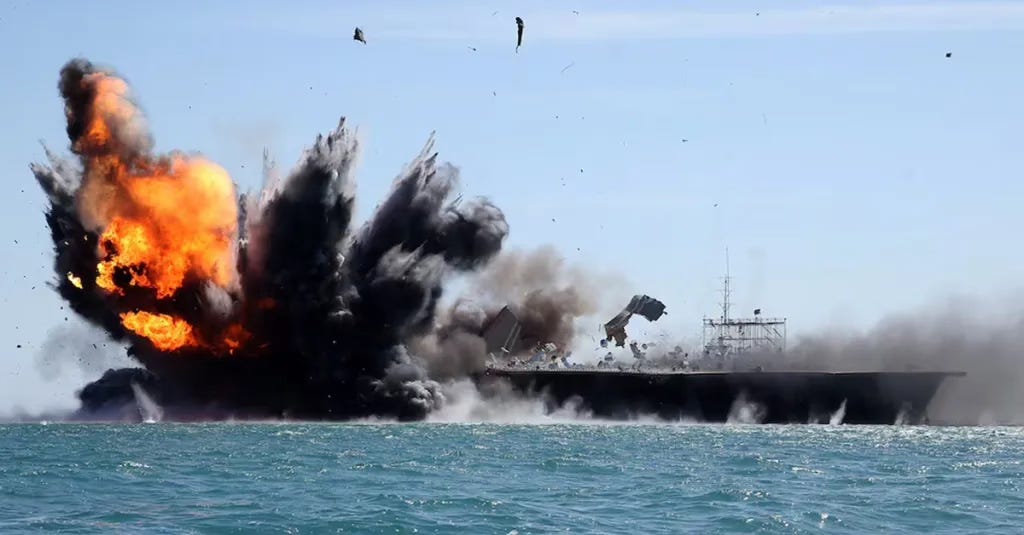
In a 2002 war game simulating an invasion of Iran, a US naval task force was sunk in minutes, so commanders changed the rules to win. Which one has Trump seen?
A wise editor once quipped to me that one definition of news is stuff that people have forgotten.
So it might come as news to President Trump and Pete Hegseth, the so-called Secretary of War, that the Pentagon carried out war games simulating an attack on Iran years ago and it didn’t go so well. In fact, it was a disaster.
Maybe Trump and Hegseth haven’t forgotten them. Maybe they’ve never known, or been briefed.
Whatever, with the 82nd Airborne’s Immediate Response Force kitting up to join the 31st Marine Expedition Unit for what looks like an invasion of Iran’s coastal islands, or maybe more, there’s not a minute to spare for them to dig up the report.
Lucky for them, there’s not much digging to do.
In October, 2024, Nate Jones, The Washington Post’s Freedom of Information director, tracked down a long classified war game the Pentagon conducted at a cost of $250 million in 2002.
Here’s how it went, Jones wrote:
As a U.S. Navy carrier battle group entered the Persian Gulf, it came under surprise attack by adversaries launching missiles from commercial ships and radio-silent aircraft that quickly overwhelmed its missile defense systems. Nineteen U.S. ships, including the aircraft carrier, were destroyed and sunk within 10 minutes.
Fortunately for U.S. forces, this scenario was only a simulation in a massive, $250 million war game named Millennium Challenge 2002. After the unexpected and humbling “loss” in July 2002, military officials at Joint Forces Command in Norfolk paused the war game, “refloated” the ships and restarted the exercise. They also imposed limits on enemy tactics. After the restart, the U.S. forces defeated their adversaries in a more conventionally fought simulation.
Jones went on to write that an after-action report of the exercise revealed that “the surprise defeat triggered internal warnings that the U.S. military was vulnerable to low-tech warfare, foreshadowing the very challenges the United States would face in the 2003 invasion of Iraq and other conflicts since then.”
The after action report was written by retired Marine Lt. Gen. Paul K. Van Riper, a highly decorated combat veteran of the Vietnam War and Desert Shield who had commanded the “Red Team” enemy forces that had thumped the “Blue” U.S. forces the first time around. The revised game, he said, was “rigged” to give the U.S. Blue Team the win. The Blues were given the locations of his fighters and weapons, for starters. His guerrilla style tactics, which had defeated the mighty U.S. task force in minutes the first time around, were also throttled.
“We were directed … to move air defenses so that the Army and Marine units could successfully land,” he said. “We were simply directed to turn [the air-defense systems] off or move them. … So it was scripted to be whatever the control group wanted it to be,” Van Riper told the Army Times’ Sean Naylor way back in 2002. “[t] simply became a scripted exercise. They had a predetermined end, and they scripted the exercise to that end.” Van Riper was so frustrated he quit half way through the “rigged” game.
The Joint Forces Command in Norfolk, Va., which sponsored and ran the war game, thought it went swimmingly. “I want to disabuse anybody of any notion that somehow the books were cooked,” Vice Adm. Marty Mayer said. (You can read Van Riper’s full discussion of the exercises in an oral history he gave to the Hoover Institution in 2024.)
I wonder which version of the war games Trump has seen, if any. Or Sen. Lindsey Graham, the president’s cheerleader and golf buddy, who’s been urging Trump to invade Kharg Island, Iran’s main oil export hub, which lies about 20 miles off the coast of the mainland. (We asked the White House whether Trump had been briefed on the war game but didn’t hear back by press time.)
“We did Iowa Jima, we can do this,” Graham railed on Fox News. A onetime noncombatant Air Force lawyer in the 1980s, Graham was born a decade after the battle for Iwo Jima, which cost the Marines 7,000 lives and 20,000 wounded.
“Boots on the Ground”
“It’s not boots. It’s human beings,” Lucian K. Truscott IV, the West Point-educated, veteran war correspondent and military novelist, pointed out the other day. “In the case of Trump administration rhetoric, those human beings are soldiers,” whom Trump is apparently mustering for a potential effort to seize Kharg Island.
It’s not going to be the cake walk Trump might be imagining—as with the war itself, which he once boasted would be won in days.
“The Iranian military forces still on Kharg Island after the missile attack launched under Trump’s orders last week will be shooting at the Marines and Army soldiers with Kalashnikov rifles and RPG-7 rocket propelled grenades and RPL-20 belt-fed light machineguns and mortars,” Truscott added.
“Overhead, Iran will rain down ballistic missiles and Shahed drones carrying 135-pound explosive warheads. If any of the Iranian missiles strike the oil tanks and oil shipment facilities, Kharg Island will be consumed by explosions and oil fires and deadly smoke.”
In the 2002 war game, the kinds of “Kamikaze” drones Iran has mastered and manufactured by the tens of thousands hadn’t been invented yet. Nor did it have ballistic missiles, the kind that’s it’s still launching at Israel and the Gulf states, despite punishing losses. If CENTCOM thinks it can rig this war game, they’re in for a big, awful surprise.
Excellent historical research. 🎖️
If the Trump-Hegseth tag team sends marines and soldiers onto Iranian soil, US citizens have to assemble in DC and block every street in the city. BYO water and a sandwich.
Facts Only
Event: War game simulating attack on Iran, Millennium Challenge 2002
Cost: $250 million
First round result: U.S. naval task force sunk within 10 minutes
Restarted exercise with limited enemy tactics to ensure U.S. victory
Retired Marine Lt. Gen. Paul K. Van Riper led the Red Team in first round, claimed exercise was "rigged"
After-action report highlighted vulnerabilities in U.S. military tactics against low-tech warfare
Executive Summary
Full Take
The article raises concerns about potential manipulation of war games to produce favorable outcomes for U.S. forces, as seen in the Millennium Challenge 2002 exercise. The event serves as a cautionary tale regarding the dangers of overconfidence in military capabilities and the need for honest assessments of vulnerabilities. It is important to question whether current or future war games are being conducted with integrity and whether their outcomes truly reflect realistic scenarios.
Patterns detected: ARC-0024 Ambiguity (the article does not clarify if Trump or Hegseth have knowledge of these war games)
Sentinel — Human
This article is likely human-written, with evidence in its varying sentence lengths, idiosyncratic emphasis, and personal voice. However, it's important to remember that the analysis is probabilistic.