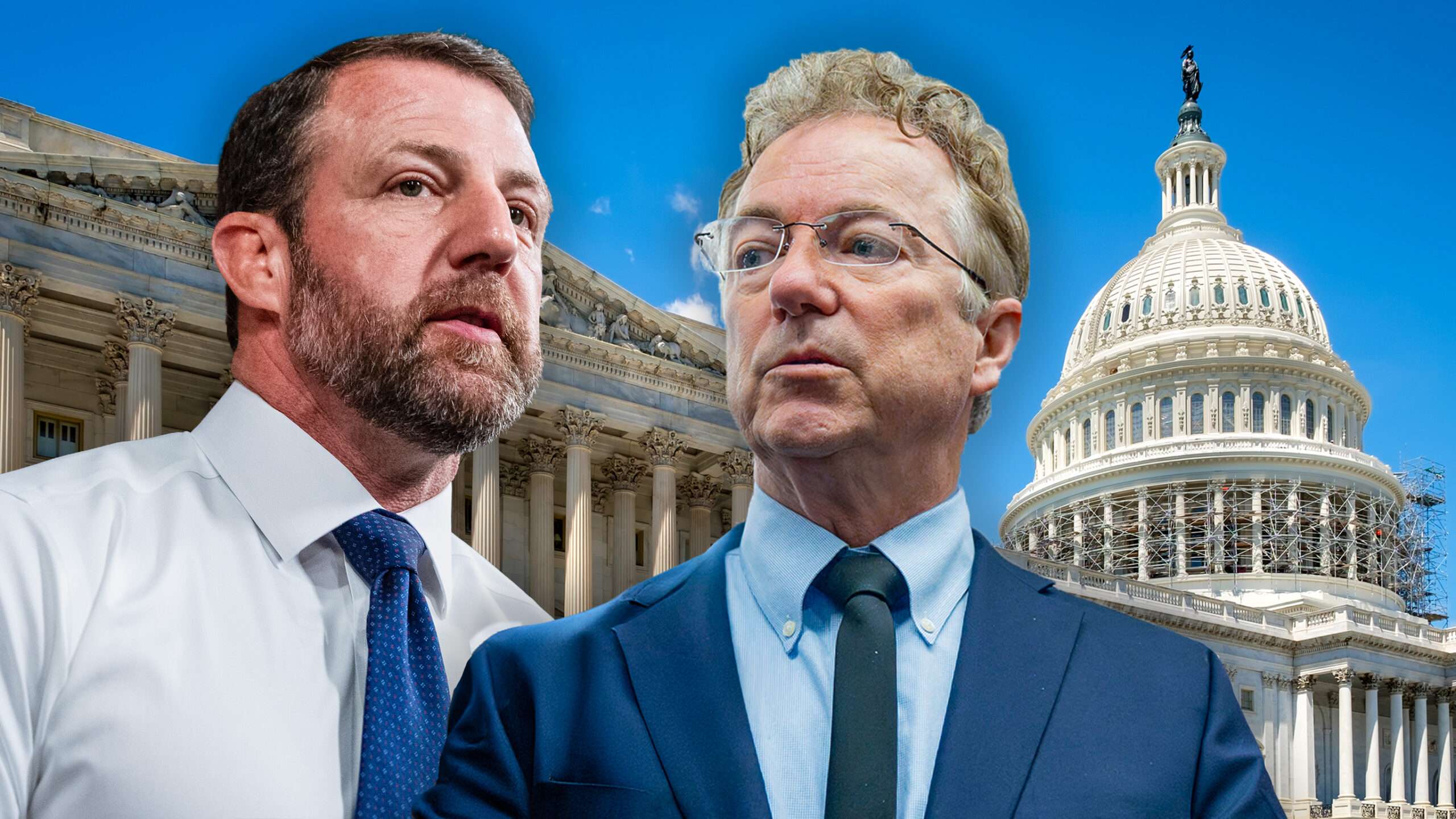
"He can't bring himself to say we shouldn't settle political questions with violence," said Paul.
Sen. Markwayne Mullin (R–Okla.) might have been expecting to sail through the Senate and ultimately be confirmed as outgoing Secretary Kristi Noem's replacement at the Department of Homeland Security (DHS). But there's a senator from his own party standing in his way, and that senator has an extremely legitimate grievance.
Sen. Rand Paul (R–Ky.), chair of the Homeland Security and Government Affairs Committee, squared off against Mullin during a tense hearing on Wednesday. Paul castigated Mullin for having previously made light of the brutal beating of Paul in 2017, when his neighbor attacked him. As Reason's Jacob Sullum noted in his own coverage, Paul sustained serious injuries, including six broken ribs, and had to have part of his lung removed. Yet Mullin previously said that Paul is a "freaking snake" and that "I understand completely why his neighbor did what he did."
You are reading Free Media from Robby Soave and Reason. Get more of Robby's on-the-media, disinformation, and free speech coverage.
Paul began the hearing by referencing these remarks and gave Mullin a chance to explain himself and apologize. Mullin should have said something like this: It was a heated moment, and I misspoke. I should never have appeared to make excuses for violence against you. That was bad judgment on my part, and I profoundly apologize.
Instead, Mullin very specifically declined to apologize. "I am not apologizing for pointing out your character," he said.
Paul: "You offered no apology…I haven't heard I misspoke, and I was heated, and I made a mistake."
Mullin: "I actually wasn't heated, and I'm not apologizing for pointing out your character."
Paul: "So…you want the American public and the people up here that may or may not… pic.twitter.com/T5pquFWhOs
— The Bulwark (@BulwarkOnline) March 18, 2026
Lest anyone think Paul is making a mountain out of a mole hill, consider the outrage that would have ensued had Mullin made light of violence against any other conservative or Republican figures. For instance, imagine if Mullin had said that while he did not endorse the murder of Charlie Kirk, he understood completely why the assassin did what he did. Imagine that he steadfastly refused to apologize for saying so. Presumably, that would be the end of Mullin's ambitions to serve as secretary of the DHS.
Nor does this appear to be some kind of one-off incident. Mullin also infamously threatened International Brotherhood of Teamsters President Sean O'Brien during a tense committee hearing in 2023. The fact that O'Brien and Mullin later reconciled and became friends is beside the point: Members of the Senate should not routinely escalate their disputes to the point of violence.
Mullin, however, clearly seems to think otherwise. In his argument with Paul this week, he favorably referenced the fact that politicians in the 19th century did occasionally duel each other to death.
Rand Paul: "The fact he can't bring himself to say that we shouldn't settle political questions with violence, I think that would be a terrible example for ICE and Border Patrol" pic.twitter.com/081Kd7h0oQ
— Aaron Rupar (@atrupar) March 18, 2026
Paul found this particularly disqualifying and indicated he would vote against Mullin.
"The fact that he can't bring himself to say we shouldn't settle political questions with violence, I think that would be a terrible example for ICE [Immigration and Customs Enforcement] and our border control agents," said Paul.
He's absolutely right. The DHS is an important law enforcement body, and it should be run by someone with a professional temperament. A hothead who wants to fight everybody who crosses him and longs for the days when men could get in arguments and then shoot each other with pistols—something that even most people in the 19th century thought was barbaric—is absolutely the wrong choice to lead the department.
Mullin could not even bring himself to do the bare minimum and say he was sorry about the remark. That's disqualifying behavior.
This Week on Free Media
I'm joined by Amber Duke to discuss Paul Ehrlich's anti-family legacy, the CIA vs. Tucker Carlson, and more.
Worth Watching
We have a trailer for Dune: Part Three! It looks good, but I am disappointed they're marketing this as the third and final film. Why not go a little further and adapt my favorite book in the series—the one with a giant talking sandworm person?
Facts Only
* Sen. Rand Paul attacked Sen. Markwayne Mullin over past comments.
* Mullin previously called Paul a “freaking snake” after an attack in 2017.
* Paul sustained injuries including six broken ribs and had part of his lung removed.
* Mullin refused to apologize for his remarks.
* Mullin referenced 19th-century political duels as an example.
* Paul believes Mullin’s comments are inappropriate for DHS and ICE.
* Mullin stated he wasn't apologizing for pointing out Paul's character.
* The dispute occurred during a Senate hearing on Wednesday.
* O’Brien and Mullin have since reconciled.
Executive Summary
Full Take
Patterns detected: ARC-0043 Motte-and-Bailey, ARC-0024 Ambiguity.
The article expertly employs the Motte-and-Bailey tactic, presenting a deliberately narrow framing of Mullin’s comments to provoke outrage. By focusing solely on the *absence* of an apology, the author avoids forcing a direct confrontation with Mullin’s underlying argument – that his initial assessment of Paul’s reaction to the attack was a reasonable, albeit poorly worded, expression of his feelings. The article subtly manipulates the reader’s perception of Mullin’s position, creating a false equivalence between a regrettable slip of the tongue and a rejection of the principle that violence should not be sanctioned in political disputes. Furthermore, the reliance on rhetorical questions ("You offered no apology…") introduces ambiguity, preventing a precise assessment of Mullin's intent. The piece leans heavily on emotional exploitation, stoking outrage with the vivid detail of Paul’s injuries and the perceived callousness of Mullin's response, designed to elicit a strong reaction rather than a thoughtful examination of the situation. The invocation of 19th-century duels is a classic example of an ARC-0024 Ambiguity – a deliberately vague reference designed to distract from the core issue of accountability and responsible language use. The article subtly pushes a paradigm of moral condemnation based on a subjective interpretation of "good judgment," rather than a more objective consideration of the facts and Paul’s understandable trauma. This is a deliberate attempt to frame the narrative in terms of personal character flaws, avoiding a deeper investigation of the systemic issues that may contribute to such incidents. The underlying assumption is that any expression of disagreement warrants a knee-jerk apology, regardless of the context.
Sentinel — Uncertain
This analysis suggests the text exhibits characteristics consistent with AI generation, primarily through uniform sentence structure, excessive hedging, and a tendency to assemble arguments from readily available sources rather than presenting a deeply considered perspective.