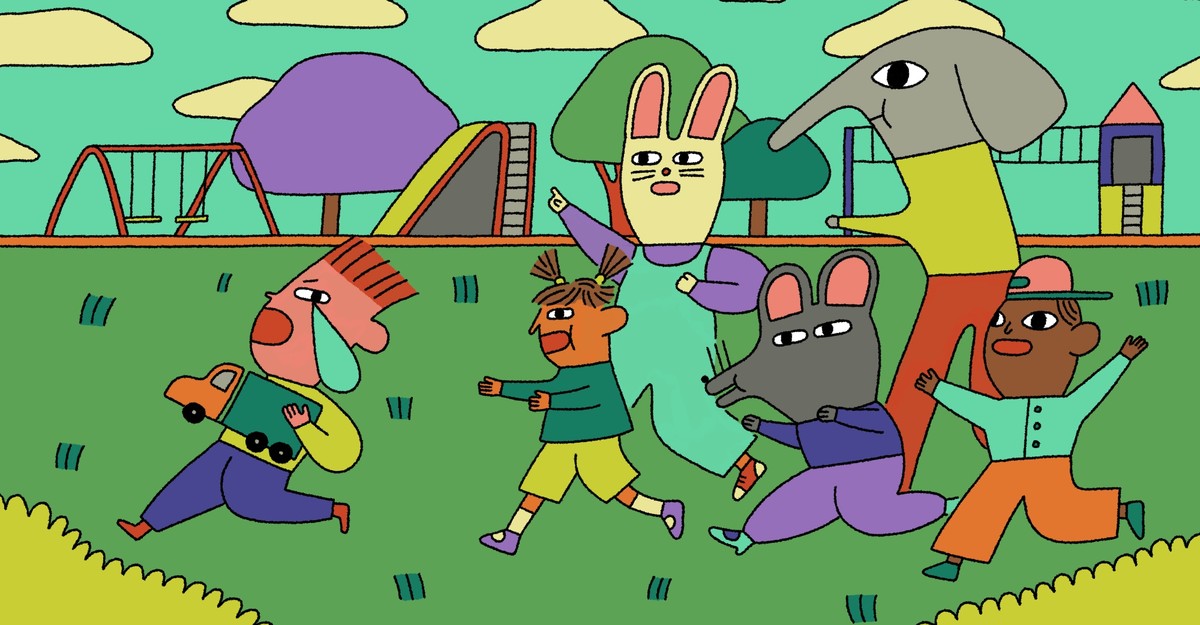
The trouble began with the truck. We usually went to the playground with only snacks: water and some Cheez-Its or an applesauce pouch. But one day, my son wanted to bring a toy. So we arrived with his little yellow excavator truck, which he rolled in zigzags on the sidewalk and then used to dig up mulch and dump it back on the ground in a pile. He was 3, and suddenly the most popular child on the playground.
A few kids circled around him as he played, staring at the truck. Their parents stared at me. I knew what everyone was thinking: The other kids wanted a turn; the parents expected me to tell my son to share; and my own child was oblivious, delightedly zooming his truck through the dirt.
If he didn’t offer to share, and I didn’t force him to, the other parents would think he was spoiled. But he loved that truck. Did he have to give it up just because this ring of kids wanted him to? One child kept trying to snatch the truck away. “No,” his mother said. He tried running at the toy; she had to grab him and hold him back. Finally, he released a scream that went on and on like a dial tone. I felt terrible. “Okay,” I told my son. “Let’s share.” I pulled the truck from his hands and dragged him, wailing, over to the swings.
His tears are good, I told myself. He needs to learn how to share, and this is his lesson. Parents make this choice multiple times every day; it’s part of helping kids grow up into responsible adults. But for weeks, I kept revisiting what had happened. I had made another child happy by making my own child suffer. Of course I wanted to raise a child with a sense of fairness, someone generous who cared about others’ feelings. But was forcing him to share like that right, or helpful?
As a girl, I was taught that one always has to share. And I grew up into a people pleaser. I was the easygoing friend, the one who stayed at the club long after I wanted to go home to sleep; the “That’s okay” friend who never admitted if my feelings had been hurt; the helpful volunteer who’d drive an hour out of my way so that my friend didn’t have to pay for an Uber home. Silencing my own needs has always been easier for me than telling someone else no. Was I raising my son to be the exact same way?
We tell our toddlers to share, but why? One friend told me she saw sharing as transactional: She wanted her son—an only child—to understand that if he wanted to play with other kids’ toys, he was going to have to share his own. That seemed reasonable enough. Another friend told me that she believed sharing was “an expression of care and empathy, and acknowledgment that the human experience is not singular, but shared.” But you can’t expect a 3-year-old to understand that!
There is evidence that kindness and altruism are innate, or at least demonstrated by even the youngest children. Researchers at the University of Washington’s Institute for Learning and Brain Sciences found, in a trial of almost 100 19-month-olds, that even children who were hungry themselves would give a treat to a stranger lacking food. Researchers have also found that children as young as 12 months can express worry for a person who is suffering and occasionally step in to console them; children may also point to an object if they notice an adult looking for it, showing a desire to help.
But children are not just short adults, Eileen Kennedy-Moore, a clinical psychologist who specializes in parenting and child development, reminded me. “They really think differently than we do,” she said. Children don’t develop what’s called a theory of mind—the cognitive ability to understand that other people have feelings and perspectives different from their own—until age 4. If you tell a 2-year-old to share, Kennedy-Moore said, they simply won’t understand, because they’re likely to see their toys as literally a part of themselves. “What they hear is Slice off part of your body and give it to someone else, and this makes absolutely no sense to them.”
Around age 4, this changes, because a child can at least understand what you mean when you tell them to share. But they still might not want to do it. Self-determination theory holds that humans have three innate psychological needs: to feel like they have autonomy, to feel like they have the competence to get things done, and to feel connected to other people. Sharing “touches on all three things,” Maryam Abdullah, a developmental psychologist, told me. “Sharing is an independent decision to provide some goodness with someone else.” The key word here, however, is independent.
Forcing a kid to share risks teaching them that generosity is “something that I am coerced to do, and it doesn’t feel good,” Abdullah said. They will feel that “someone more powerful than me is telling me to part from the very thing that I love right now.” That “takes away the basic need of autonomy.”
This doesn’t mean that you should just let your kid keep their toys to themselves and ignore other kids, however. If you encouraged that kind of behavior, they probably wouldn’t make many friends. Fortunately, there’s an alternative: Instead of telling a kid to share, Kennedy-Moore said, tell them to take turns.
Around the ages of 4 or 5, children can learn about dividing things evenly, Kennedy-Moore said. They also begin to appreciate fairness—to want to uphold and enforce it—and to understand that there are social expectations to collaborate with others. Above all, they understand that taking turns means they’ll eventually get the toy back. Taking turns, Abdullah said, involves “a form of fairness and justice” that all of us come to “expect and depend on in our social interactions.”
Kennedy-Moore told me I should stop worrying about preventing my son from being a people pleaser. “Don’t think about outcomes; think about skills,” she said. “We want to help our kids to develop the skills that they’re going to need to create a life that is meaningful and satisfying to them.” That entails learning both to speak up for themselves and to compromise with others. Sometimes, a child will have to do something he doesn’t like, “and that’s just how the world works.” Of course, the kid might be frustrated, but “frustration is temporary and tolerable.”
A couple of weeks ago, I took my son and his friends to our local recreation center to play. All three boys had remote-control monster trucks, and wanted to bring them along. On the way there, they raced the trucks down the sidewalk, the wheels surging over hardened snow, while I played referee, making sure the trucks didn’t go into the street. The play area was deserted except for two brothers. Of course, they, too, wanted to play with a monster truck. And of course, neither my son nor his friends wanted to give theirs up.
One of the brothers started crying. “Can that boy have a turn?” I asked my son. He shook his head no, and continued playing. Shame clouded my mind, but I decided not to force him, and to wait and see what happened. The other mother picked up her kids’ coats. “Time to go,” she announced, and began trying to drag them away.
But then I watched as my son walked to the crying boy and handed him the truck. A few minutes later, his two friends shared theirs as well. I turned to the boys’ mom and we smiled at each other. She put the coats back down, and we sat side by side watching the kids relish their new friends, the reward of their decision to share.
Facts Only
A parent took their 3-year-old son to a playground with a toy excavator truck.
Other children gathered around the truck, wanting to play with it.
The parent initially resisted forcing their son to share but eventually took the truck away, causing the child to cry.
The parent later reflected on whether forcing sharing was the right approach.
Research from the University of Washington’s Institute for Learning and Brain Sciences found that 19-month-olds can show altruism by sharing food with strangers.
Children as young as 12 months can express concern for others and offer help.
Clinical psychologist Eileen Kennedy-Moore stated that children under 4 lack a theory of mind, making it difficult for them to understand sharing.
Developmental psychologist Maryam Abdullah noted that forcing sharing can undermine a child’s sense of autonomy.
Kennedy-Moore suggested teaching turn-taking instead of forced sharing.
The parent later observed their son voluntarily sharing his toy with another child.
The parent and another mother watched as the children played together after sharing.
Executive Summary
A parent recounts an incident at a playground where their 3-year-old son brought a toy excavator truck, which attracted the attention of other children. The parent initially resisted forcing their son to share the truck but eventually intervened, leading to tears and distress. This experience prompted reflection on the broader implications of teaching sharing, including concerns about raising a people pleaser and the developmental appropriateness of sharing expectations for young children. The article explores psychological research on child development, highlighting that children under 4 lack the cognitive ability to fully understand sharing as adults do. Experts suggest that forcing sharing can undermine autonomy and that teaching turn-taking may be a more effective approach. The narrative concludes with a later incident where the child voluntarily shared his toy, demonstrating a more organic understanding of generosity.
The discussion includes perspectives from developmental psychologists, who emphasize that children develop a theory of mind around age 4, allowing them to grasp others' feelings and perspectives. The article also references studies showing innate altruism in young children, such as sharing food with strangers. However, experts caution that coercive sharing can teach children that generosity is an obligation rather than a choice, potentially fostering resentment. The parent ultimately adopts a more patient approach, allowing their child to decide when to share, which leads to a positive outcome where the child shares willingly and forms new friendships.
Full Take
The strongest version of this narrative highlights the tension between societal expectations of sharing and the developmental realities of young children. The parent’s initial struggle—balancing their child’s autonomy with social pressures—resonates with many caregivers. The inclusion of psychological research adds credibility, demonstrating that children’s cognitive abilities evolve and that coercive sharing may backfire. The article effectively challenges the assumption that sharing must always be enforced, offering turn-taking as a more developmentally appropriate alternative.
Pattern scan: The narrative avoids overt manipulation but leans into emotional framing, particularly in describing the child’s distress and the parent’s guilt. This could be seen as a mild form of emotional exploitation (ARC-0012 Emotional Appeal) to engage the reader, though it serves a constructive purpose by illustrating a common parenting dilemma. The article also presents a false binary (ARC-0043 Motte-and-Bailey) by framing the choice as either forcing sharing or raising a selfish child, though it later nuances this with expert input.
Root cause: The narrative reflects broader cultural anxieties about parenting—specifically, the fear of raising entitled or antisocial children. It also touches on the paradox of autonomy versus conformity, a recurring theme in child-rearing debates. The unstated assumption is that early socialization must prioritize collective harmony, even at the cost of individual agency.
Implications: Forcing sharing may teach children that compliance is more important than consent, potentially fostering resentment or people-pleasing behaviors. Conversely, allowing children to refuse sharing risks social isolation. The article suggests that turn-taking offers a middle path, preserving autonomy while teaching fairness.
Bridge questions: How might cultural differences shape expectations around sharing? Could the emphasis on sharing in early childhood reflect broader societal values about ownership and community? What long-term effects might different approaches to sharing have on a child’s sense of self?
Counterstrike scan: A bad actor pushing this narrative might exaggerate the harms of forced sharing to undermine parental authority or promote a libertarian view of child-rearing. However, the article’s balanced use of expert input and personal reflection does not align with such a pattern. It remains a thoughtful exploration of a common parenting challenge.
Sentinel — Human
The article exhibits strong human stylistic markers, including emotional complexity, personal voice, and expert-backed claims, with no significant signs of synthetic generation.