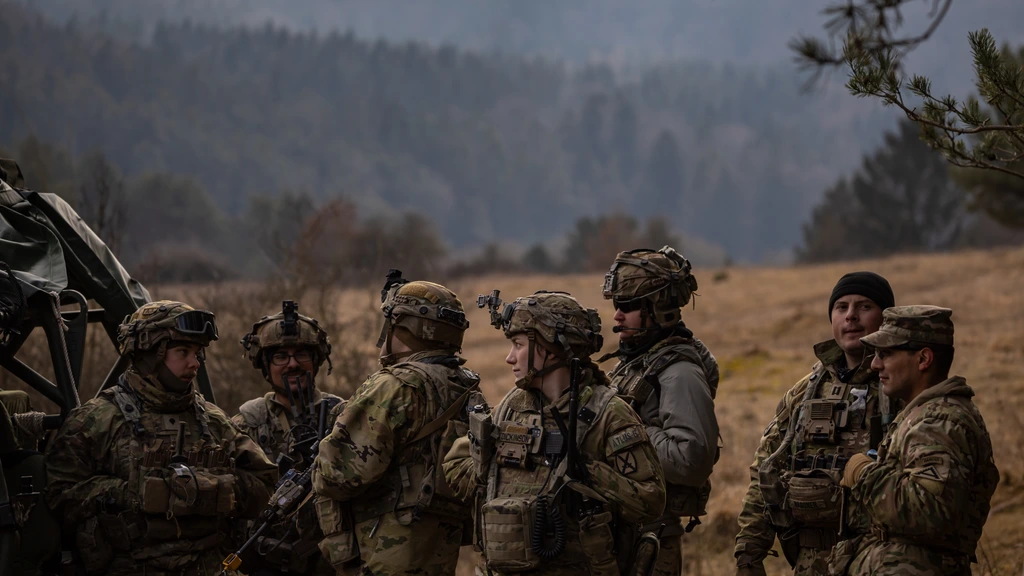
De Verenigde Staten trekken 5000 Amerikaanse militairen terug uit Duitsland. Dat heeft het Pentagon bekendgemaakt. De Amerikaanse president Trump had al gedreigd het aantal Amerikaanse troepen in Duitsland te verminderen na steeds fellere kritiek van de Duitse bondskanselier Merz op de rol van de Amerikanen bij de oorlog in het Midden-Oosten.
"De Verenigde Staten bestuderen en evalueren een mogelijke vermindering van troepen in Duitsland. Binnenkort wordt daarover een besluit genomen", schreef Trump eerder deze week op zijn sociale mediaplatform Truth Social.
Volgens een woordvoerder van het Pentagon zal de terugtrekking "naar verwachting in de komende zes tot twaalf maanden worden voltooid". De Verenigde Staten hebben vele tienduizenden militairen gestationeerd in Europa. Duitsland telt meerdere grote militaire bases waar circa 35.000 militairen zijn gestationeerd, zoals op de luchtbasis Ramstein. In geen ander Europees land zijn zo veel Amerikaanse troepen.
Merz
Het besluit van de Verenigde Staten komt na een publieke woordenwisseling tussen Merz en Trump over de oorlog in het Midden-Oosten. "De Amerikanen hebben duidelijk geen strategie. Daar wordt een hele natie vernederd door de Iraanse leiding", zei Merz begin deze week in gesprek met honderden scholieren op een middelbare school in Marsberg.
Trump viel Merz daarop aan op Truth Social en schreef dat de bondskanselier geen idee heeft waar hij het over heeft. Ook noemde hij het geen verrassing dat Duitsland het economisch en "op andere vlakken" zo slecht doet. Ondanks de kritiek over en weer zei Merz woensdag dat zijn relatie met Trump "nog steeds goed" is.
Meer bekijken?
Spanje boos om Merz' zwijgen in Oval Office, Europese eenheid onder druk
Rol aan de zijlijn of VS de les lezen over Iran? Merz op heikel bezoek bij Trump
Rutte in Witte Huis, 'onder meer om te praten over terugtrekking uit NAVO'
Trump dreigt met vertrek uit NAVO nu steun van bondgenoten bij Iran-oorlog uitblijft
Facts Only
The U.S. is withdrawing 5,000 military personnel from Germany.
The Pentagon announced the decision, with completion expected in six to twelve months.
Germany hosts around 35,000 U.S. troops, the largest concentration in Europe.
Key U.S. military installations in Germany include Ramstein Air Base.
The decision follows a public dispute between U.S. President Trump and German Chancellor Merz.
Merz criticized U.S. strategy in the Middle East as lacking and humiliating.
Trump responded by questioning Merz’s competence and linking Germany’s economic struggles to its leadership.
Merz stated that his relationship with Trump remains "good" despite the criticism.
The U.S. has threatened to reduce NATO commitments if allies do not support its Middle East policies.
Other European leaders, including Dutch Prime Minister Rutte, are engaging with the U.S. on defense issues.
The withdrawal is part of a broader reevaluation of U.S. troop presence in Germany.
The dispute occurred after Merz’s remarks to students in Marsberg, Germany.
Executive Summary
The United States is withdrawing 5,000 military personnel from Germany, a decision announced by the Pentagon following public tensions between U.S. President Trump and German Chancellor Merz. The withdrawal is expected to be completed within six to twelve months. Germany hosts approximately 35,000 U.S. troops, the largest American military presence in Europe, with key installations like Ramstein Air Base. The move follows a public dispute where Merz criticized U.S. strategy in the Middle East, calling it ineffective and humiliating to the American nation. Trump responded by attacking Merz’s competence and linking Germany’s economic struggles to its leadership. Despite the exchange, Merz maintained that his relationship with Trump remains intact. The decision reflects broader strains in transatlantic relations, particularly over military commitments and geopolitical strategy, with additional context suggesting broader European unease about U.S. leadership and NATO cohesion.
The withdrawal raises questions about the future of U.S.-Germany military cooperation and the stability of NATO, especially as other European leaders, like Dutch Prime Minister Rutte, engage in discussions with the U.S. about defense commitments. The timing and scale of the withdrawal, along with the public nature of the dispute, underscore the fragility of alliances under political pressure.
Full Take
This narrative presents a classic case of geopolitical tension framed through personal conflict, a pattern that often obscures deeper structural issues. The strongest version of the story—steelman—is that the U.S. is recalibrating its military footprint in Europe due to strategic disagreements with Germany, using troop withdrawals as leverage to pressure allies into aligning with its Middle East policies. The public spat between Trump and Merz serves as a visible symptom of these underlying strains, with both sides using rhetoric to rally domestic support while negotiating broader alliance dynamics.
However, the framing risks reducing complex geopolitical shifts to a personality-driven feud, which could distract from systemic questions about NATO’s future, European strategic autonomy, and the U.S.’s role in global security. The article leans into emotional exploitation (ARC-0012) by highlighting Trump’s personal attacks on Merz, which may amplify outrage or partisan reactions rather than fostering a nuanced discussion about military strategy. Additionally, the lack of deeper context about Germany’s strategic concerns—such as its historical reluctance to engage in Middle East conflicts or its economic ties to Iran—could create a false binary (ARC-0043) where the dispute appears purely as a failure of leadership rather than a clash of legitimate policy differences.
The root cause here is the erosion of trust within transatlantic alliances, accelerated by unilateral U.S. actions and divergent threat perceptions. The withdrawal of troops, while framed as a response to criticism, may also reflect a broader U.S. pivot toward prioritizing other regions or reducing overseas commitments. The implications for human agency are significant: if alliances fracture under political pressure, smaller nations may face coercion or abandonment, while citizens lose the stability that collective security provides.
Bridge questions to consider: How might Germany’s strategic calculus change if the U.S. further reduces its military presence in Europe? What alternative security architectures could emerge if NATO’s cohesion weakens? Would a more multipolar Europe better serve its citizens, or would it lead to greater instability?
Counterstrike scan: If this were part of a coordinated influence campaign, the playbook would involve amplifying divisions within NATO, portraying the U.S. as an unreliable ally, and framing European leaders as weak or incompetent. The actual content partially aligns with this pattern—emphasizing conflict over cooperation—but lacks the hallmarks of a deliberate disinformation effort, such as fabricated quotes or coordinated amplification across platforms. The narrative remains within the bounds of legitimate political disagreement, though it risks being weaponized by actors seeking to undermine transatlantic unity.
Patterns detected: ARC-0012 Emotional Exploitation, ARC-0043 False Binary
Sentinel — Human
This text exhibits characteristics of standard, human-edited news reporting, effectively synthesizing reported facts and political context.