With the rise of K-dramas on streaming services, it's hard to pinpoint just one or two shows that longtime fans stick to. When you get into that vast world, genre, number of episodes, duration, and even cast members are not the most important things; what's most important is the vibe of the series and how easily a show can win viewers over—it's about the writing, storytelling, and message.
Of course, not every brand-new K-drama has all three of those qualities. Some are underwhelming or are received fairly well but turn out to age quite poorly in the grand scheme of things; this turns out to be true for many of the classics, in particular. If we really want to get to the root of the K-drama popularity, we need to look at the classic K-dramas that have aged like fine wine and remember why we fell in love with this peculiar and beautiful world in the first place.
6 'Full House' (2004)
Full House was integral to the Korean Wave's second great expansion across Southeast and East Asia in the mid-2000s, establishing two careers that would define Korean popular culture for the next two decades. Song Hye-kyo, who was already well-known for her heartfelt performances in Autumn in My Heart, turned out to be a gifted physical comedian, while Rain was told by producers that he wasn't attractive enough to act and should stick to singing (boy, were they wrong). Full House is also the originator of some defining K-drama tropes, especially in rom-coms, from the contract relationship and forced cohabitation to the enemies-to-lovers storyline—a template that has been repeated in hundreds of dramas ever since.
Full House was based on the popular webtoon of the same name and follows Han Ji-eun (Song), a bright aspiring screenwriter who lives in the beautiful beach home her late father built (which she fondly calls "Full House"). After being tricked into taking a free vacation to China, Ji-eun's "friends" sell the house behind her back to settle their debts. On the plane to Shanghai, Ji-eun meets the vain movie star, Lee Young-jae (Rain), and upon returning home, she realizes he's her new landlord. Song's performance has aged really well—Ji-eun is funny, resilient, and bright, while the show's breezy summer energy and gorgeous filming location (near Incheon) continue to captivate. Full House is a classic in every way: entertaining and aware of its mistakes, a love story for every season.
5 'Winter Sonata' (2002)
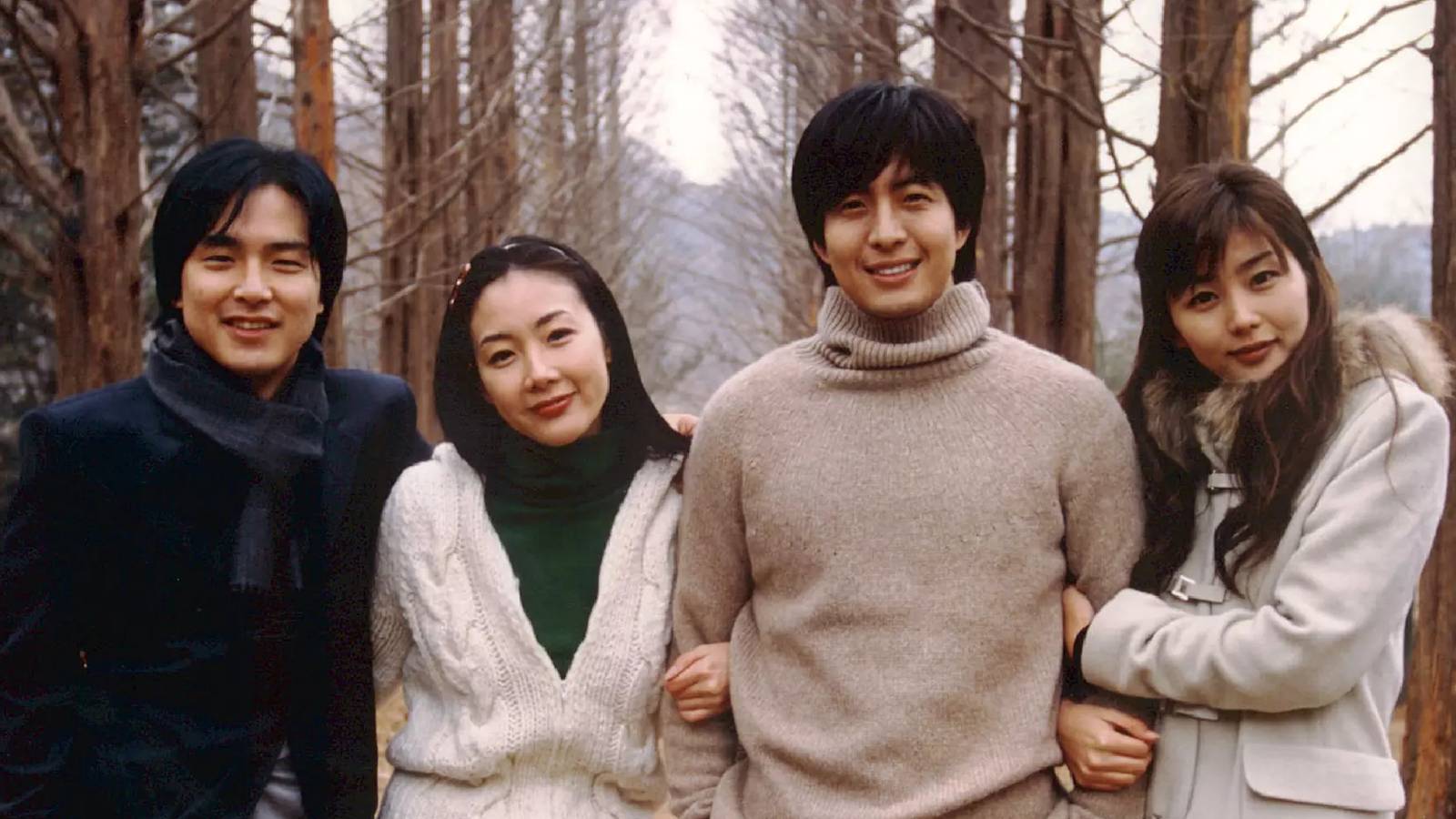
Winter Sonata is more than just a classic K-drama; it is the show that established K-drama as a global phenomenon. Many describe it as a pioneering drama of the Hallyu Wave, and Korean cultural critics found it healing for both the Korean-Japanese relations and the youth of South Korea, who were demotivated by the financial crisis of 1997. The series was actually so popular in Japan that Bae Yong-joon, the star of Winter Sonata, was welcomed by more than 3000 women upon his arrival at the Tokyo Airport in 2004. Winter Sonata also pioneered the "first love torn apart by tragedy" trope and memory loss as a plot driver, defining K-dramas and teaching an international audience to recognize and appreciate the genre.
Winter Sonata follows Joon-sang (Bae), who transfers to a high school in rural Chuncheon. There, he falls in love with the warm-hearted Yoo-jin (Choi Ji-woo), although her childhood friend Sang-hyuk (Park Yong-ha) has always loved her. On the night he was supposed to meet Yoo-jin, Joon-sang was hit by a car and vanished, presumed dead. Ten years later, Yoo-jin, now engaged to Sang-hyuk, meets Lee Min-hyung, who is the spitting image of Joon-sang but has no memory of her. The show's cinematography has aged quite gracefully, particularly the images of Nami Island in winter, which are still among the most beautiful scenes on Korean television. The show's slow, deliberate, and operatic pace may take some getting used to, but it has long been established and used in the K-drama world. Winter Sonata is a great classic, and not just because it has stood the test of time, but also because of its cultural significance—it is what first drew people into Korean dramas.
4 'Sungkyunkwan Scandal' (2010)
Sungkyunkwan Scandal holds a special place in K-drama history because it launched three of its generation's defining talents at the same time: Song Joong-ki, Park Min-young, and Yoo Ah-in. All three were essentially unknown at the time, but were so thrilling in their roles that their careers took off almost immediately after. Sungkyunkwan Scandal also arrived at a time when the sageuk genre became formulaic instead of just an occurrence; the show's approach of taking the prestigious institution of Sungkyunkwan and reimagining it with the social and emotional structure of a modern school drama made sageuk newly accessible to younger audiences.
Set in the late Joseon Dynasty, Sungkyunkwan Scandal follows Kim Yoon-hee (Park), a resourceful young woman from a poor family who disguises herself as her younger brother to feed her family. She attends the men's-only entrance examination for Sungkyunkwan, Joseon's most prestigious Confucian university, and passes, enrolling as a student. She finds herself sharing a room with the rigid Lee Seon-joon (Park Yoo-chun), and their uneasy living situation gradually draws in two more students: Goo Yong-ha (Song), a playful, perceptive aristocrat, and Moon Jae-shin (Yoo), a brooding rebel with a painful past. The ensemble chemistry has aged beautifully, but the show has an even more pressing message: institutions that exclude the poor and women cannot contain true talent and moral courage; this resonates as strongly as ever, making the show a statement of its time.
3 'Coffee Prince' (2007)
Coffee Prince is unique and timeless because it was the first mainstream Korean drama to address themes of gender identity and sexuality with seriousness and even grace. Released during the most conservative period of the Korean Wave in 2007, Coffee Prince was truly bold and game-changing. The show treated the protagonist's ongoing struggle with his feelings for someone he believes to be a man, as well as his willingness to eventually accept those feelings regardless of gender, with complete honesty and dedication. It also launched the career of Gong Yoo, who went on to become a defining face of modern K-drama. The café aesthetic that the show essentially invented for Coffee Prince has been imitated ever since, and the show's indie-folk original soundtrack is still one of the most popular in the genre's history.
Coffee Prince follows Eun-chan (Yoon Eun-hye), a young tomboy who has been her family's only provider since her father passed away. When she unexpectedly enters the life of Han-gyul (Gong), the careless heir to a food conglomerate, he believes her to be a boy. He inherits a failing old café from his grandmother, relaunches it under the name "Coffee Prince," hires only handsome young men, and invites Eun-chan to join the team. Han-gyul starts to worry about an attraction he can't understand for someone he believes to be a man. Eun-chan is an almost radical heroine for her time: unsentimental, physically capable, the family's financial anchor, with no interest in performing femininity, and loved for who she is. That, and Gong Yoo's physical comedy, in particular, are the main things that make Coffee Prince a show that has aged beautifully.
2 'Jewel in the Palace' (2003–2004)
Jewel in the Palace is the most significant Korean drama in the history of the Hallyu Wave's global reach. While Winter Sonata conquered Japan and parts of Southeast Asia, Jewel in the Palace conquered the world: it was broadcast across 91 different countries globally, with an estimated overall viewership of over 100 million people. It renewed international interest in traditional Korean cuisine and medicine so strongly that the Korea Tourism Organization created entire promotional campaigns around it. It is, by most accounts, the single most exported piece of Korean television in history, but at its core, it endures because of its most important factor: the character of Jang-geum herself.
Jewel in the Palace is based on the true story of Seo Jang-geum (Lee Young-ae), the first and only woman to serve as a Joseon king's chief royal physician. It describes her journey from becoming an orphan to her extraordinary rise through the imperial palace. After her parents are killed, Jang-geum joins the palace as a kitchen apprentice and becomes one of the court's most talented cooks. After being exiled, Jang-geum devotes herself to medicine with the same ambition she had for food, eventually earning the trust and favor of King Jungjong (Im Ho) and becoming his personal physician—a rank and title never before held by a woman in Korean history. Jang-geum's story is timeless, depicting a woman who refuses to accept the limitations imposed by gender, class, and political power. The show is long (54 episodes lasting over an hour), and its pacing is deliberate even by the standards of the time, but its length is inseparable from its power, proving slow and steady equals incredible storytelling.
1 'Reply 1988' (2015–2016)
Reply 1988 may not be a true classic, but it is old enough to be considered a "modern classic." It's worth mentioning because it's the most culturally significant Korean drama of the 2010s, and it achieved that status through entirely unique means. It didn't launch a star or a genre but triggered a rare act of awakening the nation's collective memory. Its portrait of the Ssangmun-dong neighborhood sparked a new cultural movement in South Korea—newtro—reigniting the country's fascination with 1980s nostalgia in various fields, from fashion to music and architecture. Even the BBC deems it a masterpiece and credits it with ushering in cable and streaming programming, a shift from which major broadcasting networks have never fully recovered. Its influence on storytelling, most notably the use of a multigenerational ensemble, can also be seen in almost every prestige drama produced in the decade since.
Reply 1988 is set in the close-knit Ssangmun-dong neighborhood of northern Seoul in 1988, and it follows five childhood friends and their families. The five friends are Sung Deok-sun (Lee Hyeri), the overlooked middle daughter; Kim Jung-hwan (Ryu Jun-yeol), the guarded boy next door; Choi Taek (Park Bo-gum), a globally celebrated baduk prodigy; Kim Sun-woo (Go Kyung-pyo), steady and kind; and Ryu Dong-ryong (Lee Dong-hwi), the neighborhood's comedic soul. The show pays equal attention to their parents, a generation of middle-aged Koreans who live on modest wages and find their greatest joy in each other's company. Everything in this show has aged well, particularly the parents. Reply 1988 gives them full, layered, and unironic inner lives, showing Ra Mi-ran as Dong-ryong's mother, Sung Dong-il as Deok-sun's father, and Kim Sung-kyun as Jung-hwan's father. These veterans give some of the best ensemble performances in any Korean drama, helping their characters become more resonant as the audience ages alongside the show. Viewers who first saw Reply 1988 as teenagers now return as adults and find themselves attached to different things and characters, discovering new layers with every viewing.
Facts Only
*Full House* (2004) starred Song Hye-kyo and Rain, based on a webtoon, and popularized rom-com tropes like contract relationships and forced cohabitation.
*Winter Sonata* (2002) starred Bae Yong-joon and Choi Ji-woo, pioneered the "first love torn apart by tragedy" trope, and was wildly popular in Japan.
*Sungkyunkwan Scandal* (2010) launched the careers of Song Joong-ki, Park Min-young, and Yoo Ah-in, blending historical sageuk with modern school drama elements.
*Coffee Prince* (2007) starred Yoon Eun-hye and Gong Yoo, addressing gender identity and sexuality, and introduced the café aesthetic trend.
*Jewel in the Palace* (2003–2004) starred Lee Young-ae, based on the true story of Seo Jang-geum, and became the most exported Korean drama globally.
*Reply 1988* (2015–2016) featured an ensemble cast including Lee Hyeri, Ryu Jun-yeol, and Park Bo-gum, sparking 1980s nostalgia in South Korea.
*Winter Sonata* was broadcast in Japan, where Bae Yong-joon’s arrival in 2004 drew over 3,000 fans to Tokyo Airport.
*Jewel in the Palace* aired in 91 countries, with an estimated viewership exceeding 100 million.
*Reply 1988* influenced the "newtro" cultural movement in South Korea, reviving interest in 1980s fashion, music, and architecture.
*Coffee Prince* was released during a conservative period in Korean media but boldly addressed LGBTQ+ themes.
*Sungkyunkwan Scandal* critiqued institutional exclusion of women and the poor in Joseon-era academia.
*Full House* was filmed near Incheon, with its beach house setting becoming iconic.
Executive Summary
Full Take
The strongest version of this narrative is its celebration of K-dramas as cultural artifacts that transcend entertainment, shaping global perceptions of Korean storytelling. The article rightly credits these shows for pioneering tropes, launching careers, and fostering cross-cultural connections. However, it leans heavily on nostalgia and cultural significance without critically examining the industry’s commercial pressures or the homogenization of tropes over time. The emphasis on "aging like fine wine" risks romanticizing these works without acknowledging their flaws—such as pacing issues in *Winter Sonata* or the occasional reliance on clichés in *Full House*.
Patterns detected: ARC-0024 Ambiguity (vague claims about "cultural significance" without measurable impact), ARC-0043 Motte-and-Bailey (broad praise for "storytelling" without defining what makes it exceptional).
Root cause: The narrative assumes that cultural impact equals artistic merit, a common paradigm in media analysis that conflates popularity with quality. It echoes the broader trend of retroactive canonization, where older works are elevated based on their influence rather than their inherent strengths.
Implications: While these dramas undeniably shaped the industry, the uncritical praise risks obscuring how modern K-dramas have evolved—or stagnated—in response. Who benefits? Streaming platforms and tourism boards capitalizing on nostalgia. Who bears costs? Newer creators pressured to replicate past successes rather than innovate.
Bridge questions: How might the K-drama industry balance nostalgia with innovation? What perspectives are missing from this retrospective—e.g., critiques of gender roles in *Jewel in the Palace* or the commercialization of *Reply 1988*’s nostalgia?
Counterstrike scan: A coordinated campaign would amplify nostalgia to drive tourism or streaming subscriptions, framing these shows as untouchable classics. The article aligns with this pattern but stops short of overt commercial advocacy, focusing instead on artistic legacy. No red flags, but the lack of critical counterpoints is notable.